Table of Contents
- 1. Product Overview
- 1.1 Core Features and Advantages
- 1.2 Target Market and Positioning
- 2. In-depth Technical Parameter Analysis
- 2.1 Viwango vya juu kabisa
- 2.2 Photoelectric Characteristics
- 3. Grading and Classification System
- 3.1 Luminous Intensity Grading
- 3.2 Forward Voltage Consistency
- 4. Performance Curve Analysis
- 4.1 Usambazaji wa Wigo
- 4.2 Uhusiano wa Mkondo wa Mbele na Voltage ya Mbele (I-V Curve)
- 4.3 Forward Current Derating Curve
- 5. Mechanical and Package Information
- 5.1 Physical Dimensions
- 5.2 Pin Configuration and Internal Circuit Diagram
- 6. Soldering and Assembly Guide
- 6.1 Vigezo vya Uchimbaji
- 6.2 Kinga dhidi ya Utoaji Umeme wa Tuli (ESD)
- 6.3 Masharti ya Uhifadhi
- 7. Ufungaji na Taarifa za Kuagiza
- 7.1 Vipimo vya Ufungaji
- 7.2 Labeling Instructions
- 8. Application Notes and Design Considerations
- 8.1 Typical Application Scenarios
- 8.2 Design ya Mzunguko wa Kuendesha
- 8.3 Usimamizi wa Joto
- 9. Ulinganishi wa Kiufundi na Tofauti
- 10. Maswali Yanayoulizwa Mara kwa Mara (Kulingana na Vigezo vya Kiufundi)
- 11. Uundaji wa Muundo na Uchunguzi wa Kesi za Matumizi
- 12. Kanuni ya Uendeshaji
- 13. Mwelekeo wa Teknolojia
1. Product Overview
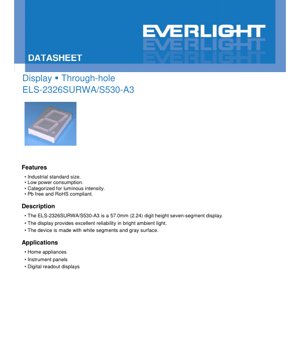
ELS-2326SURWA/S530-A3 ni sehemu ya kuziba moja kwa moja ya taa ya nambari saba, iliyoundwa kwa matumizi yanayohitaji usomaji wa nambari wazi na wa kuaminika chini ya hali mbalimbali za mwanga. Kifaa hiki ni sehemu ya mfululizo wa viwango vya viwanda, kinachojulikana kwa uimara na utendakazi thabiti.
1.1 Core Features and Advantages
Faida kuu za moduli hii ya kuonyesha zinatokana na muundo na uteuzi wa nyenzo. Inatumia ukubwa wa kifurushi cha kiwango cha viwanda, na kuhakikisha utangamano na mpangilio uliopo wa PCB na soketi zilizoundwa kwa vipengele sawa. Faida muhimu ni matumizi ya nguvu ya chini, inayofanya iweze kutumika katika programu zinazotumia betri au zinazohitaji uangalifu wa matumizi ya nishati. Kifaa hiki kimetengenezwa kwa nyenzo zisizo na risasi, na kinakidhi kabisa maagizo ya RoHS, kikikidhi mahitaji ya kisasa ya kimazingira na kisheria. Sehemu za kuonyesha ni nyeupe, zikiwa kwenye mandharinye ya kijivu, na hutoa tofauti kubwa ya rangi, na hivyo kuboresha uwezo wa kusomeka.
1.2 Target Market and Positioning
This seven-segment display is positioned for cost-effective applications that prioritize reliability, where clear numeric indication is crucial. Its design emphasizes long-term performance under standard operating conditions, rather than extreme environments requiring specialized components.
2. In-depth Technical Parameter Analysis
Utendaji wa ELS-2326SURWA/S530-A3 unafafanuliwa na mfululizo wa vigezo vya umeme, vya macho na vya joto, ambavyo wabunifu lazima wazingatie ili kuhakikisha matumizi yanayofanikiwa.
2.1 Viwango vya juu kabisa
Viwango hivi vinafafanua mipaka ya mkazo ya kifaa, na kuzidi mipaka hii kunaweza kusababisha uharibifu wa kudumu. Havikusudiwi kwa uendeshaji wa kawaida.
- Voltage ya kinyume (VR):5 V. Kuzidi voltage hii chini ya upendeleo wa kinyume kunaweza kusababisha kuvunjika kwa kiungo.
- Sasa endelevu ya mbele (IF):25 mA. Hii ndiyo mkondo wa moja kwa moja wa juu zaidi unaoweza kutumiwa kwa kila sehemu ya kuonyesha kwa mfululizo.
- Kilele cha mkondo wa mbele (IFP):60 mA. Mkondo huu unaruhusiwa tu chini ya hali ya msukumo (uwiano wa kazi ≤ 10%, masafa ≤ 1 kHz), na haupaswi kutumika kwa uendeshaji wa mkondo wa moja kwa moja.
- Power Consumption (Pd):60 mW. The maximum power that can be dissipated as heat, calculated as forward voltage (VF) × forward current (IF).
- Operating Temperature (Topr):-40°C to +85°C. The device is specified to operate over this ambient temperature range.
- Storage temperature (Tstg):-40°C to +100°C.
- Welding temperature (Tsol):260°C, kwa muda wa sekunde 5 kwa upeo. Hii ni muhimu kwa mchakato wa kuuza kwa wimbi la juu au kuuza kwa mkono, ili kuzuia uharibifu wa joto kwenye kifurushi cha epoxy na sehemu za ndani za kuunganisha.
2.2 Photoelectric Characteristics
Vipimo hivi vinachukuliwa chini ya joto la kawaida la kiungo (Ta= 25°C), na vinaelezea tabia ya mwanga na umeme ya kifaa chini ya hali za kawaida za uendeshaji.
- Mwangaza wa mwanga (Iv):15 mcd (kiwango cha chini), 34 mcd (kiwango cha kawaida), chini ya hali ya IF= 10 mA. Hii ni pato la wastani la mwanga kwa kila sehemu. Thamani hii ina uvumilivu wa ±10%, ikimaanisha kifaa kitagawanywa au kuainishwa kulingana na nguvu iliyopimwa.
- Urefu wa wimbi wa kilele (λp):632 nm (kiwango cha kawaida). Urefu wa wimbi ambao utoaji wa wigo ni mkubwa zaidi. Hii ni kigezo muhimu kinachobainisha rangi inayohisiwa (nyekundu angavu).
- Mdomo wa mawimbi (λd):624 nm (kawaida). Mdomo wa mawimbi mmoja unaolingana zaidi na rangi inayohisiwa na mwanga, unaweza kutofautisha kidogo na mdomo wa mawimbi wa kilele.
- Upana wa wigo (Δλ):20 nm (kawaida). Masafa ya mawimbi yanayotolewa, yanapimwa kwenye upana kamili wa nusu ya kilele. Upana mwembamba zaidi unaonyesha rangi ya wigo safi zaidi.
- Forward Voltage (VF):2.0 V (Typical), 2.4 V (Maximum), at IF= 20 mA condition. This is the voltage drop across the LED during operation. The drive circuit must be designed to provide sufficient voltage. A tolerance of ±0.1V is specified.
- Reverse Current (IR):100 µA (Maximum), at VRUnder the condition of = 5 V. This is the small leakage current that flows when the device is reverse-biased within its maximum ratings.
3. Grading and Classification System
The datasheet indicates that the device"Classified according to luminous intensity."This refers to the common "binning" practice in LED manufacturing.
3.1 Luminous Intensity Grading
Due to inherent variations in semiconductor epitaxial growth and manufacturing processes, the light output of LEDs will differ. To ensure consistency for end users, manufacturers test and categorize (bin) LEDs based on their measured luminous intensity. The ELS-2326SURWA/S530-A3 has a typical intensity of 34 mcd and a minimum of 15 mcd. Purchased devices will fall within a specific intensity range (bin), which should be consistent within the same production lot or order. The inclusion of "CAT: Luminous Intensity Grade" on the label confirms this practice.
3.2 Forward Voltage Consistency
Ingawa haijaelezewa wazi kama kigezo cha kugawanya katika viwango, uvumilivu mkali wa voltage ya mbele (±0.1V) unaonyesha udhibiti mzuri wa mchakato. VFNi muhimu kwa kubuni saketi rahisi ya kizuizi cha sasa ya upinzani mfululizo, kwani inapunguza kiwango cha juu cha tofauti za mwangaza kati ya sehemu mbalimbali zinazotumika wakati zinatumika kutoka kwa chanzo kimoja cha voltage.
4. Performance Curve Analysis
Data ya michoro hutoa ufahamu wa kina juu ya jinsi vigezo vinavyobadilika kulingana na hali ya kufanya kazi.
4.1 Usambazaji wa Wigo
The spectral curve shows the relative intensity of emitted light at different wavelengths. For this AlGaInP-based device, the curve is centered at 632 nm (peak) with a typical bandwidth of 20 nm. This curve confirms its monochromatic "bright red" color, with no significant emission in other color bands.
4.2 Uhusiano wa Mkondo wa Mbele na Voltage ya Mbele (I-V Curve)
Mkunjo huu unaonyesha uhusiano usio wa mstari kati ya mkondo na voltage katika diode ya semiconductor. Kwa LED, ongezeko dogo la voltage baada ya kuzidi kizingiti cha kuwasha (takriban 1.8V) husababisha mkondo kuongezeka kwa kasi kwa kiwango cha kielelezo. Ndio maana LED lazima iendeshwe na chanzo cha kudhibiti mkondo (k.m. kiendeshi cha mkondo wa mara kwa mara au upinzani wa mfululizo), na sio chanzo cha voltage ya mara kwa mara, ili kuzuia kukosa udhibiti wa joto na uharibifu.
4.3 Forward Current Derating Curve
Hii ni mojawapo ya chati muhimu zaidi katika usanifu wa kuaminika. Inaonyesha mkondo wa juu unaoruhusiwa wa mwelekeo sahihi unaoendelea (IF) How must be reduced as the ambient temperature increases. At 25°C, a full rating of 25 mA is allowed. As the temperature rises towards the maximum operating temperature of 85°C, the allowable current decreases significantly. This derating is necessary because the internal junction temperature of the LED increases due to ambient temperature and self-heating from current flow. Exceeding the safe junction temperature reduces light output and drastically shortens lifespan. Designers must use this curve to select an appropriate operating current based on the worst-case ambient temperature in their application.
5. Mechanical and Package Information
5.1 Physical Dimensions
The character height of this device is 57.0 mm (2.24 inches), classifying it as a large-size display suitable for long-distance viewing. The package dimension drawing provides detailed measurement data for the overall display body dimensions, through-hole pin pitch and dimensions, and segment layout. Unless otherwise specified, the general tolerance is ±0.25 mm. This drawing is crucial for creating the PCB footprint, ensuring proper installation, and defining the keep-out area on the board.
5.2 Pin Configuration and Internal Circuit Diagram
The internal circuit diagram shows the electrical connections for each segment (a through g) and the common connection. This display uses a common anode configuration, meaning the anodes (positive terminals) of all LED segments are internally connected to a common pin (or set of pins). The cathode (negative terminal) of each segment is brought out to an individual pin. To illuminate a segment, the common anode pin is connected to a positive voltage source, and the corresponding cathode pin is pulled low (grounded) through a current-limiting resistor. The pin arrangement diagram specifies which physical pin corresponds to which segment cathode and common anode.
6. Soldering and Assembly Guide
Inahitaji usindikaji sahihi ili kudumisha ukomo na utendaji wa kifaa.
6.1 Vigezo vya Uchimbaji
Kikomo cha juu kabisa cha joto cha kuchomea ni digrii 260 Selsiasi, kwa muda usiozidi sekunde 5. Hii inatumika kwa joto la waya wakati wa uchomaji wa mawimbi au uchomaji wa mikono. Kwa uchomaji wa reflow, curve ya kawaida ya uchomaji isiyo na risasi yenye kilele cha joto kisichozidi digrii 260 Selsiasi inapaswa kutumiwa. Mfiduo wa muda mrefu kwa joto la juu unaweza kuhariri waya wa ndani wa kuunganisha, kuharibu kifuniko cha epoksi, au kusababisha kutenganishwa kwa tabaka.
6.2 Kinga dhidi ya Utoaji Umeme wa Tuli (ESD)
Mwongozo una onyo kali kuhusu usikivu wa ESD. Chip ya semiconductor ya AlGaInP ni nyeti kwa uharibifu wa umeme wa tuli, ambao unaweza kusababisha kushindwa mara moja au kasoro za siri zinazoweza kupunguza uaminifu wa muda mrefu. Hatua za lazima za kuzuia ni pamoja na: watendaji kuvaa mkanda wa mkono uliowekwa ardhini; kutumia kituo cha kazi, matandiko na zana zilizopinga umeme wa tuli; kuhakikisha vifaa vyote vimewekwa ardhini ipasavyo; na kuhifadhi/kusafirisha kifaa kwenye mfuko wa kufanya umeme au wa kuzuia umeme wa tuli. Kizazi cha ioni kinaweza kutumiwa kutuliza malipo kwenye nyenzo zisizofanya umeme katika eneo la kazi.
6.3 Masharti ya Uhifadhi
Kifaa kinapaswa kuhifadhiwa katika anuwai ya halijoto maalum ya uhifadhi (-40°C hadi +100°C), katika mazingira yaliyokauka, ili kuzuia unyevunyevu, na kuhifadhiwa kwenye mfuko wake asili wa ulinzi wa ESD kabla ya matumizi.
7. Ufungaji na Taarifa za Kuagiza
7.1 Vipimo vya Ufungaji
The device follows a specific packaging flow: 10 pieces are loaded into a tube to provide mechanical protection and facilitate handling. Then, 10 tubes are placed into a box. Finally, 4 boxes are packed into a master shipping carton. This hierarchical packaging (10 pieces/tube → 10 tubes/box → 4 boxes/carton) is common for through-hole components and aids in inventory management and automated assembly.
7.2 Labeling Instructions
Lebo lililopo kwenye kifurushi lina misimbo kadhaa: CPN (Nambari ya Sehemu ya Mteja), P/N (Nambari ya Sehemu ya Mtengenezaji: ELS-2326SURWA/S530-A3), QTY (Idadi), CAT (Kategoria/Aina ya Ukubwa wa Mwanga) na LOT No (Nambari ya Kundi la Uzalishaji Inayoweza Kufuatiliwa). Msimbaji "CAT" ni muhimu kwa kuhakikisha usawa wa mwangaza katika kundi lote la uzalishaji.
8. Application Notes and Design Considerations
8.1 Typical Application Scenarios
Uchambuzi wa maelezo unapendekeza matumizi makuu matatu: Vifaa vya nyumbani (kwa mfano, kipima wakati cha jokofu, skrini ya mashine ya kufulia), paneli za vifaa vya kipimo (kwa vifaa vya viwanda, vifaa vya kupima au soko la baada ya mauzo ya magari) na vionyeshi vya usomaji wa nambari kwa matumizi ya jumla. Ukubwa wake mkubwa na tofauti nzuri ya rangi hufanya iwe inafaa kwa matumizi yanayohitaji kusoma maudhui ya onyesho kutoka umbali wa futi chache au chini ya mwangaza wa mazingira unaofaa.
8.2 Design ya Mzunguko wa Kuendesha
Kubuni ya mzunguko wa kuendesha inahitaji mahesabu muhimu kadhaa. Kwanza, kulingana na mwangaza unaohitajika na halijoto ya mazingira, tumia mkunjo wa kupunguza thamani kuamua mkondo wa uendeshaji (IF). Thamani ya kawaida inaweza kuwa kati ya 10-20 mA. Kwa muundo rahisi wa upinzani mfululizo wa onyesho la anode ya pamoja linalounganishwa na voltage ya usambazaji VCC, thamani ya upinzani kwa kila sehemu ya sehemu ni: R = (VCC- VF) / IF. Using a typical VF= 2.0V, 5V power supply, IF=15mA, then R = (5 - 2.0) / 0.015 = 200 Ω. The power rating of the resistor should be at least IF2× R = (0.015)2× 200 = 0.045W, so a standard 1/8W (0.125W) resistor is sufficient. For multi-digit multiplexing, dedicated driver ICs (such as the 74HC595 shift register or MAX7219 display driver) are typically used to control the segment cathodes and digit anodes, significantly reducing the number of required microcontroller I/O pins.
8.3 Usimamizi wa Joto
Although not a high-power device, thermal considerations are still important for extending lifespan. Ensure sufficient spacing on the PCB to allow for some air circulation. Avoid placing the display near other significant heat sources. Following the current derating curve is the primary method for thermal management. The wide operating temperature range (-40°C to +85°C) indicates its suitability for most indoor and many outdoor environments.
9. Ulinganishi wa Kiufundi na Tofauti
ELS-2326SURWA/S530-A3 hutofautishwa na mchanganyiko wake maalum wa sifa: urefu mkubwa wa herufi wa 57.0 mm, usakinishaji wa kuingiza moja kwa moja, mwanga wa AlGaInP nyekundu mkali, na usanidi wa anodi ya pamoja. Ikilinganishwa na vionyeshi vidogo (k.m., 14.2 mm au 20 mm), ina kuonekana bora wakati wa kutazama kutoka umbali mrefu. Ikilinganishwa na vionyeshi vya vifaa vilivyosakinishwa kwenye uso (SMD), toleo la kuingiza moja kwa moja kama hili kwa kawaida huchukuliwa kuwa thabiti zaidi katika mazingira yenye mtikisiko mkali au matumizi yanayohitaji ukarabati wa mkono, na kwa kawaida ni rahisi zaidi kwa utengenezaji wa mfano. Ikilinganishwa na teknolojia za zamani, mfumo wa nyenzo wa AlGaInP hutoa ufanisi wa juu na usafi mzuri wa rangi katika anuwai ya wigo nyekundu/machungwa/kahawia.
10. Maswali Yanayoulizwa Mara kwa Mara (Kulingana na Vigezo vya Kiufundi)
Swali: Je, naweza kuendesha kionyeshi hiki moja kwa moja kwa kutumia pini ya microcontroller ya 5V?
Jibu: Hapana. Pini za microcontroller haziwezi kutoa au kuchukua mkondo wa kutosha (kwa kawaida hadi 20-40mA kwa kila pini, na kuna vizuizi vya jumla vya kifurushi) kuendesha sehemu nyingi za kionyeshi kwa mwangaza wa kutosha. Muhimu zaidi, LED lazima kizuizi cha mkondo kiwekwe. Kuiunganisha moja kwa moja kwenye chanzo cha voltage bila kupinga mfululizo itajaribu kuchota mkondo mwingi mno, kuharibu LED na uwezekano wa kuharibu pini ya microcontroller. Hakikisha unatumia kizuizi cha mkondo cha mfululizo au kiendesha cha mkondo wa kudumu maalum.
Swali: Kwa nini onyesho linakuwa giza ninapofanya kazi kwenye 85°C, hata kama ninatumia mkondo sawa na kwenye halijoto ya kawaida ya chumba?
Jibu: Ufanisi wa mwanga wa LED (pato la mwanga kwa kila pembejeo ya umeme) hupungua kadiri halijoto ya kiungo (junction temperature) inavyopanda. Hii ni sifa ya msingi ya semiconductor. Zaidi ya hayo, curve ya kupunguza mzigo (derating curve) inahitaji kuwa kwenye halijoto ya juu ya mazingirakupunguzaThe operating current is limited to prevent overheating. These two effects together lead to a reduction in brightness at high temperatures.
Q: What does "Lead-free and RoHS compliant" mean for my design?
A: It means the device contains no lead (Pb) or other restricted hazardous substances as defined by the RoHS (Restriction of Hazardous Substances) directive. This is a legal requirement for selling electronic products in many regions, including the EU. It also affects your soldering process, requiring the use of lead-free solder with a higher melting point, which is why the 260°C soldering rating is important.
Q: The typical forward voltage is 2.0V. Can I power it from a 3.3V system?
Jibu: Ndio, kabisa. Kwa kutumia chanzo cha umeme cha 3.3V (VCC), inahitaji kuhesabu upya thamani ya upinzani wa mfululizo. Kwa IF=15mA: R = (3.3 - 2.0) / 0.015 ≈ 87 Ω. Hakikisha mzunguko wako wa kuendesha (kudhibiti kichwa, kuendesha IC) unaweza kushughulikia mkondo wa sehemu wakati wa kuvuta cathode chini.
11. Uundaji wa Muundo na Uchunguzi wa Kesi za Matumizi
Scenario: Design a simple digital timer for a laboratory incubator.
The display needs to be clearly readable from across the room under laboratory ambient light. The 57.0 mm character height of the ELS-2326SURWA/S530-A3 was chosen to ensure visibility. The incubator interior houses a microcontroller running at 5V. To simplify the design, a common anode configuration was selected. This design uses a single 74HC595 shift register to control the 7 segment cathodes and uses a transistor array (e.g., ULN2003) to sink the common anode current for the 4 digits, enabling multiplexing. The operating current per segment was set to 12 mA to ensure good brightness while staying within the 25mA limit and leaving margin for temperature derating inside the warm incubator enclosure (up to approximately 40°C). A 220 Ω series resistor is used ((5V - 2.0V)/0.012A ≈ 250Ω; 220Ω is the nearest standard value, resulting in IF≈ 13.6mA). The PCB layout incorporated the exact footprints from the datasheet. During assembly, the technician used an anti-static wrist strap and a soldering iron temperature-controlled to 350°C, with quick soldering time per pin, less than 3 seconds.
12. Kanuni ya Uendeshaji
Seven-segment display is a component composed of seven light-emitting diode (LED) bars arranged in the shape of an "8". Each bar is an independent LED. By selectively illuminating specific combinations of these seven segments, all decimal digits (0–9) and some letters can be formed. In a common-anode display like this one, the anodes (positive terminals) of all segment LEDs are connected to a common node. The cathodes (negative terminals) are separate. To illuminate a segment, a positive voltage is applied to the common anode, and the cathode of the desired segment is connected to a lower voltage (usually ground) through a current-limiting circuit. The AlGaInP (aluminum gallium indium phosphide) semiconductor material used in this device is a direct-bandgap compound, specifically designed to emit light in the red-to-amber region of the visible spectrum when electrons and holes recombine across the bandgap—a process known as electroluminescence.
13. Mwelekeo wa Teknolojia
Soko la maonyesho ya nambari ya sehemu saba ya pekee kimsingi limekua thabiti, aina za kuingiza moja kwa moja kama hizi zinatumikia muundo wa jadi, soko la ukarabati na matumizi yanayothaminiwa uimara. Mwenendo mpana zaidi wa teknolojia ya maonyesho unaelekea kwenye vifaa vya kuingiza kwenye uso (SMD) kwa usanikishaji wa kiotomatiki, moduli za nambari nyingi zenye msongamano mkubwa, na ujumuishaji wa kudhibiti na kuendesha ndani ya kifurushi cha maonyesho. Pia kuna mwenendo wa kuelekea anuwai ya rangi pana na matumizi ya fosforasi ya hali ya juu katika taa za LED nyeupe, lakini kwa dalili nyekundu za rangi moja, AlGaInP bado ni teknolojia yenye ufanisi inayotawala. Kanuni za kuendesha umeme, usimamizi wa joto na ulinzi wa ESD zilizofunikwa katika hati hii ya maelezo ya kiufundi ni za msingi, na zinatumika kwa ujumla kwa teknolojia zote za LED kutoka kwa maonyesho haya ya pekee hadi taa za kisasa za LED zenye nguvu kubwa.
Maelezo ya kina ya Istilahi za Uainishaji wa LED
Kamusi Kamili ya Istilahi za Teknolojia ya LED
I. Viashiria Muhimu vya Utendaji wa Kielektroniki na Mwanga
| Istilahi | Unit/Penunjukkan | Penjelasan Populer | Kwa nini ni muhimu |
|---|---|---|---|
| Ufanisi wa Mwanga (Luminous Efficacy) | lm/W (lumen/watt) | The luminous flux emitted per watt of electrical power; the higher the value, the more energy-efficient. | Directly determines the energy efficiency rating and electricity cost of the luminaire. |
| Fluxi ya Mwanga (Luminous Flux) | lm (lumen) | Jumla ya kiasi cha mwanga kinachotolewa na chanzo cha mwanga, kinachojulikana kwa kawaida kama "mwangaza". | Huamua kama taa inatosha kuwa na mwangaza. |
| Pembe ya kuona mwanga (Viewing Angle) | ° (degree), e.g., 120° | The angle at which light intensity drops to half, determining the beam width. | Affects the illumination range and uniformity. |
| Joto la rangi (CCT) | K (Kelvin), k.m. 2700K/6500K | Joto la rangi ya mwanga, thamani ya chini huelekea manjano/joto, thamani ya juu huelekea nyeupe/baridi. | Huamua mazingira ya taa na matumizi yanayofaa. |
| Kielelezo cha Uonyeshaji Rangi (CRI / Ra) | Unitless, 0–100 | The ability of a light source to reproduce the true colors of objects, with Ra≥80 being preferable. | Inaathiri usahihi wa rangi, hutumiwa katika maeneo yenye mahitaji makubwa kama vile maduka makubwa, makumbusho ya sanaa. |
| Tofauti ya uvumilivu wa rangi (SDCM) | Idadi ya hatua za duaradufu ya MacAdam, k.m. "5-step" | A quantitative metric for color consistency; a smaller step number indicates better color consistency. | Ensures no color variation among luminaires from the same batch. |
| Wavelengthu Kuu (Dominant Wavelength) | nm (nanomita), k.m. 620nm (nyekundu) | Thamani ya wavelength inayolingana na rangi ya LED ya rangi. | Determines the hue of monochromatic LEDs such as red, yellow, and green. |
| Spectral Distribution | Wavelength vs. Intensity Curve | Shows the intensity distribution of light emitted by the LED at various wavelengths. | Affects color rendering and color quality. |
Vigezo vya Umeme
| Istilahi | Ishara | Penjelasan Populer | Vidokezo vya Ubunifu |
|---|---|---|---|
| Voltage ya Mbele (Forward Voltage) | Vf | Voltage ya chini inayohitajika kuwasha LED, kama "kizingiti cha kuanzisha". | Voltage ya chanzo cha usukumaji lazima iwe ≥ Vf, voltage inajumlishwa wakati LED nyingi zimeunganishwa mfululizo. |
| Forward Current | If | The current value that enables the LED to emit light normally. | Inatumika kwa kawaida kuendesha kwa mkondo wa kudumu, mkondo huamua mwangaza na maisha ya huduma. |
| Maximum Pulse Current | Ifp | Peak current that can be withstood for a short period, used for dimming or flashing. | Pulse width and duty cycle must be strictly controlled, otherwise overheating damage will occur. |
| Reverse Voltage | Vr | Upeo wa juu wa voltage ya nyuma ambayo LED inaweza kustahimili, ukizidi huo unaweza kusababisha kuvunjika. | Mzunguko unahitaji kuzuia uunganishaji wa kinyume au mshtuko wa voltage. |
| Thermal Resistance | Rth (°C/W) | Upinzani wa joto kutoka kwenye chip hadi kwenye sehemu ya kuuza, thamani ya chini inaonyesha usambazaji bora wa joto. | Upinzani mkubwa wa joto unahitaji muundo wa upoaji joto wenye nguvu zaidi, vinginevyo joto la kiungo litaongezeka. |
| Uvumilivu wa kutokwa na umeme tuli (ESD Immunity) | V (HBM), kama vile 1000V | Uwezo wa kukabiliana na mshtuko wa umeme wa tuli, thamani ya juu zaidi inamaanisha uwezekano mdogo wa kuharibika kwa umeme wa tuli. | Katika uzalishaji, ni muhimu kuchukua hatua za kinga dhidi ya umeme wa tuli, hasa kwa LED zenye usikivu mkubwa. |
III. Usimamizi wa Joto na Uaminifu
| Istilahi | Viashiria Muhimu | Penjelasan Populer | Athari |
|---|---|---|---|
| Joto la Kiungo (Junction Temperature) | Tj (°C) | Halisi ya joto la kufanya kazi ndani ya chip ya LED. | Kupunguza kila 10°C kunaweza kuongeza maisha mara mbili; joto la juu sana husababisha kupungua kwa mwanga na kuteleza kwa rangi. |
| Kupungua kwa Mwanga (Lumen Depreciation) | L70 / L80 (saa) | Muda unaohitajika kwa mwangaza kushuka hadi 70% au 80% ya thamani ya awali. | Kufafanua moja kwa moja "maisha ya huduma" ya LED. |
| Kiwango cha Kudumisha Lumini (Lumen Maintenance) | % (kama 70%) | Asilimia ya mwangaza uliobaki baada ya kutumia kwa muda fulani. | Inaonyesha uwezo wa kudumisha mwangaza baada ya matumizi ya muda mrefu. |
| Mabadiliko ya Rangi (Color Shift) | Δu′v′ au Duaradufu ya MacAdam | Kiwango cha mabadiliko ya rangi wakati wa matumizi. | Inaathiri uthabiti wa rangi katika eneo la taa. |
| Thermal Aging | Deterioration of material properties | Degradation of packaging materials due to prolonged high temperatures. | May lead to decreased brightness, color shift, or open-circuit failure. |
Nne. Ufungaji na Nyenzo
| Istilahi | Aina za Kawaida | Penjelasan Populer | Sifa na Matumizi |
|---|---|---|---|
| Aina ya Ufungaji | EMC, PPA, Ceramic | A housing material that protects the chip and provides optical and thermal interfaces. | EMC offers good heat resistance and low cost; ceramic provides superior heat dissipation and long lifespan. |
| Chip Architecture | Face-up, Flip Chip | Chip Electrode Layout. | Flip-chip offers better heat dissipation and higher luminous efficacy, suitable for high-power applications. |
| Phosphor coating | YAG, silicates, nitrides | Coated on the blue LED chip, partially converted to yellow/red light, mixed to form white light. | Different phosphors affect luminous efficacy, color temperature, and color rendering. |
| Lens / Usanifu wa Optics | Uso wa gorofa, microlens, kutafakari kwa ukamilifu | The optical structure on the encapsulation surface controls the distribution of light. | Determines the emission angle and light distribution curve. |
V. Quality Control and Binning
| Istilahi | Yaliyomo ya Uainishaji | Penjelasan Populer | Kusudi |
|---|---|---|---|
| Luminous flux binning | Codes such as 2G, 2H | Grouped by brightness level, each group has a minimum/maximum lumen value. | Ensure consistent brightness within the same batch of products. |
| Voltage binning | Codes such as 6W, 6X | Grouped by forward voltage range. | Facilitates driver power matching and improves system efficiency. |
| Kugawanya kwa makundi kulingana na rangi | 5-step MacAdam ellipse | Group by color coordinates to ensure colors fall within an extremely narrow range. | Ensure color consistency to avoid uneven color within the same luminaire. |
| Color temperature binning | 2700K, 3000K, n.k. | Pangilia kwa makundi kulingana na joto la rangi, kila kundi lina anuwai maalum ya kuratibu. | Inakidhi mahitaji ya joto la rangi katika mazingira tofauti. |
Sita, Uchunguzi na Uthibitishaji
| Istilahi | Kigezo/Uchunguzi | Penjelasan Populer | Meaning |
|---|---|---|---|
| LM-80 | Lumen Maintenance Test | Long-term operation under constant temperature conditions, recording luminance attenuation data. | Used to estimate LED lifetime (in conjunction with TM-21). |
| TM-21 | Lifetime projection standard | Kuhesabu maisha ya matumizi halisi kulingana na data ya LM-80. | Kutoa utabiri wa maisha wa kisayansi. |
| IESNA standard | Illuminating Engineering Society Standard | Covers optical, electrical, and thermal test methods. | Msingi unaokubalika kitaalamu wa upimaji. |
| RoHS / REACH | Uthibitisho wa mazingira | Hakikisha bidhaa hazina vitu hatari (kama risasi, zebaki). | Masharti ya kuingia kwenye soko la kimataifa. |
| ENERGY STAR / DLC | Energy Efficiency Certification | Energy efficiency and performance certification for lighting products. | Commonly used in government procurement and subsidy programs to enhance market competitiveness. |