Yaliyomo
- 1. Uhakiki wa Bidhaa
- 1.1 Core Advantages and Target Market
- 2. In-depth Technical Parameter Analysis
- 2.1 Absolute Maximum Ratings
- 2.2 Electro-Optical Characteristics
- 3. Maelezo ya Mfumo wa Kugawa
- 4. Uchambuzi wa Mviringo wa Utendaji
- 4.1 Uhusiano wa Matumizi ya Nguvu na Joto la Mazingira
- 4.2 Uwezo wa Kugundua Wigo
- 4.3 Relationship Between Dark Current and Ambient Temperature
- 4.4 Relationship Between Reverse Photocurrent and Irradiance (Ee)
- 4.5 Relationship Between Terminal Capacitance and Reverse Voltage
- 4.6 Relationship Between Response Time and Load Resistance
- 5. Taarifa za Mitambo na Ufungaji
- 5.1 Vipimo vya Ufungaji
- 5.2 Utambuzi wa Upekee
- 6. Mwongozo wa Uchomaji na Usanikishaji
- 7. Taarifa za Ufungaji na Uagizaji
- 7.1 Vipimo vya Ufungaji
- 7.2 Vipimo vya Lebo
- 8. Mapendekezo ya Matumizi
- 8.1 Mandhari ya Kawaida ya Utumiaji
- 8.2 Kuzingatia Katika Ubunifu
- 9. Ulinganisho wa Kiufundi na Tofauti
- 10. Maswali Yanayoulizwa Mara kwa Mara (Kulingana na Vigezo vya Kiufundi)
- 10.1 Kuna tofauti gani kati ya mkondo mfupi (ISC) na mkondo wa mwanga wa kinyume (IL)?
- 10.2 Je, ninawezaje kuchagua BIN sahihi?
- 10.3 Je, naweza kuendesha photodiode hii kwa voltage kati ya 5V hadi 32V?
- 10.4 Je, ni lazima kutumia kikuza cha nje?
- 11. Mifano ya Uundaji na Matumizi Halisi
- 12. Utangulizi wa Kanuni ya Uendeshaji
- 13. Mwelekeo na Maendeleo ya Teknolojia
- 14. Tangazo la Kukataa Madai na Maelekezo ya Matumizi
- Detailed Explanation of LED Specification Terminology
- I. Core Photometric and Radiometric Performance Indicators
- II. Electrical Parameters
- III. Thermal Management and Reliability
- IV. Ufungaji na Nyenzo
- V. Udhibiti wa Ubora na Uainishaji
- VI. Uchunguzi na Uthibitishaji
1. Uhakiki wa Bidhaa
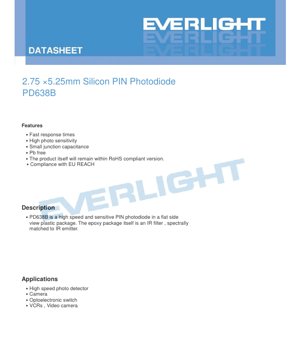
PD638B ni photodiode ya silikoni ya PIN yenye kasi ya juu na usikivu mkubwa, imefungwa kwa plastiki iliyobanwa kwa upande na ukubwa wa 2.75mm x 5.25mm. Kifaa hiki kimeundwa kwa matumizi yanayohitaji kugundua mwanga haraka. Muundo wake wa kufunga wa epoxy unajumuisha kichujio cha mwanga wa infrared (IR), na sifa zake za wigo zimefananishwa kwa makini ili kufaa vitoa mwanga vya kawaida vya infrared, na hivyo kuboresha uwiano wa ishara-kwa-kelele katika mifumo ya kuhisi infrared. Kifaa hiki kinakidhi kanuni za RoHS na REACH za Umoja wa Ulaya, na kimetengenezwa kwa vifaa visivyo na risasi.
1.1 Core Advantages and Target Market
Faida kuu za PD638B ni pamoja na wakati wake wa kujibu wa haraka sana, usikivu mkubwa wa mwanga na uwezo mdogo wa makutano, ambazo ni muhimu kwa matumizi yenye upana mkubwa wa masafa. Umbo lake dogo linafaa kwa miundo yenye nafasi ndogo. Ufungaji uliojumuishwa wa kichujio cha infrared unarahisisha muundo wa macho kwa kupunguza hitaji la vichujio vya nje. Photodiode hii inalenga hasa masoko na matumizi yanayohusisha kugundua mwanga kwa kasi, mifumo ya uchoraji picha na swichi za mwanga, kama vile vifaa vya matumizi ya kawaida, otomatiki ya viwanda na vifaa vya mawasiliano.
2. In-depth Technical Parameter Analysis
Sehemu hii inatoa maelezo ya kina na ya uwazi ya vigezo muhimu vya kiufundi vilivyoorodheshwa kwenye hati ya maelezo, na kuelezea umuhimu wake kwa wahandisi wa muundo.
2.1 Absolute Maximum Ratings
These ratings define the stress limits that may cause permanent damage to the device. Operation at or beyond these limits is not guaranteed.
- Reverse Voltage (VR):32 V. This is the maximum reverse bias voltage that can be applied across the photodiode pins. Exceeding this voltage may lead to avalanche breakdown and device failure.
- Power Dissipation (Pd):150 mW. This is the maximum allowable power the device can dissipate as heat, primarily determined by the product of the reverse voltage and the dark current or photocurrent under operating conditions.
- Operating Temperature (Topr):-40°C to +85°C. The specified ambient temperature range over which the device is designed to operate normally.
- Joto la Uhifadhi (Tstg):-40°C hadi +100°C. Masafa ya joto ambayo kifaa huhifadhiwa katika hali isiyo ya kufanya kazi na haisababishi uharibifu wa utendaji.
- Joto la Uchomaji (Tsol):260°C, kwa muda usiozidi sekunde 5. Hii ni muhimu kwa usanikishaji wa PCB kwa kutumia mchakato wa reflow au uchomaji wa mkono ili kuzuia uharibifu wa kifurushi.
2.2 Electro-Optical Characteristics
Vigezo hivi hupimwa kwa Ta=25°C na hufafanua utendaji mkuu wa photodiode kama sensor ya mwanga.
- Upana wa Wigo (λ0.5):840 nm hadi 1100 nm. Anuwai hii inaonyesha urefu wa wambamba ambao mwitikio wa photodiode ni angalau nusu ya thamani yake ya kilele. Inathibitisha kuwa kifaa hiki kimeboreshwa kwa wigo wa karibu infrared.
- Urefu wa wambamba wa usikivu wa kilele (λp):940 nm (kawaida). Photodiode hii ni nyeti zaidi kwa urefu huu wa wambamba wa infrared, na kufanya kuwa chaguo bora la kuunganishwa na LED ya infrared ya 940nm.
- Voltage ya wazi ya mzunguko (VOC):0.35 V (kawaida), chini ya hali ya Ee=5 mW/cm², λp=940nm. Hii ni voltage inayozalishwa na photodiode katika hali ya photovoltaic (bila bias) chini ya mwangaza maalum.
- Mkondo mfupi wa mzunguko (ISC):18 µA (kawaida), chini ya hali ya Ee=1 mW/cm², λp=940nm. Hii ni mkondo wa mwanga unaozalishwa wakati diode imefungwa mfupi (voltage kati ya ncha zake ni sifuri).
- Mkondo wa mwanga wa kinyume (IL):18 µA (kawaida, chini ya 10.2 µA), chini ya hali ya Ee=1 mW/cm², λp=940nm, VR=5V. Hii ni kigezo muhimu cha uendeshaji katika hali ya photoconductive (kutokana na mkazo wa kinyume). Inafafanua mkondo wa ishara kwa kiwango fulani cha mwanga.
- Mkondo wa giza (Id):5 nA (kawaida, juu ya 30 nA), chini ya hali ya VR=10V. Hii ni mkondo mdogo wa uvujaji wa kinyume unaotiririka wakati kifaa kiko gizani kabisa. Mkondo wa chini wa giza unafaa kwa kugundua ishara dhaifu za mwanga.
- Voltage ya kuvunja kinyume (BVR):170 V (kawaida, chini ya 32 V), inapimwa chini ya hali ya IR=100µA. Hii ni voltage ambapo mkondo wa kinyume huongezeka kwa kasi. Voltage ya kinyume ya uendeshaji inapaswa kuwa chini sana ya thamani hii.
- Uwezo wa jumla (Ct):25 pF (kawaida), chini ya hali ya VR=3V, f=1 MHz. Uwezo wa kiungo ni kipengele muhimu kinachoweka kikomo upana wa bendi. Uwezo wa chini unawezesha wakati wa majibu wa haraka zaidi.
- Muda wa kupanda/kushuka (tr/tf):50 ns / 50 ns (typical), under conditions of VR=10V, RL=1 kΩ. This specifies the speed at which the current output responds to a step change in light intensity. The value of 50 ns indicates its suitability for medium to high-speed detection applications.
3. Maelezo ya Mfumo wa Kugawa
PD638B offers different performance bins, primarily based on the reverse light current (IL) parameter measured under standard conditions (Ee=1 mW/cm², λp=940nm, VR=5V). This allows designers to select devices with a guaranteed photocurrent range to ensure consistency in system performance.
- BIN1:IL = 10.2 µA (min) to 16.5 µA (max)
- BIN2:IL = 13.5 µA (min) to 22.0 µA (max)
- BIN3:IL = 18.0 µA (minimum) to 27.5 µA (maximum)
- BIN4:IL = 22.5 µA (minimum) to 33.0 µA (maximum)
The datasheet also specifies standard tolerances for relevant parameters: luminous intensity (±10%), dominant wavelength (±1nm), and forward voltage (±0.1V). Although these parameters are more common for emitters, they may be listed as a reference for related products.
4. Uchambuzi wa Mviringo wa Utendaji
Typical characteristic curves visually demonstrate how key parameters vary with operating conditions.
4.1 Uhusiano wa Matumizi ya Nguvu na Joto la Mazingira
Mkunjo huu unaonyesha kupunguzwa kwa matumizi ya nguvu yanayoruhusiwa kiwango cha juu kadiri joto la mazingira linapoinuka zaidi ya 25°C. Ili kuhakikisha uaminifu, wakati wa kufanya kazi katika halijoto za juu, ni lazima kupunguza nguvu inayotumika kwa mstari kulingana na mchoro huu.
4.2 Uwezo wa Kugundua Wigo
Mchoro huu unaonyesha usikivu wa kawaida wa photodiode katika masafa yote ya urefu wa mawimbi. Unaonyesha wazi kilele cha 940 nm pamoja na upana wa wigo uliofafanuliwa kutoka 840 nm hadi 1100 nm, ukionyesha athari ya kichungi cha infrared kilichojumuishwa katika kupunguza mwanga unaoonekana.
4.3 Relationship Between Dark Current and Ambient Temperature
Mkondo wa giza unategemea sana halijoto, kwa kawaida ukiongezeka kwa takriban mara mbili kwa kila ongezeko la 10°C la joto. Mkunjo huu unaruhusu mbuni kukadiria sakafu ya kelele (mkondo wa giza) katika halijoto maalum ya uendeshaji, jambo muhimu sana kwa matumizi ya mwanga dhaifu au ya faida kubwa.
4.4 Relationship Between Reverse Photocurrent and Irradiance (Ee)
Mchoro huu unaonyesha uhusiano wa mstari kati ya mkondo wa mwanga unaozalishwa (IL) na mwangaza wa mwanga unaoingia. Uwiano wa mstari ni sifa muhimu ya diodi ya picha ya PIN, na kufanya iweze kutumika katika matumizi ya kupima mwanga.
4.5 Relationship Between Terminal Capacitance and Reverse Voltage
Uwezo wa kiungo hupungua kadri voltage ya upendeleo wa kinyume inavyoongezeka. Mkunjo huu unaonyesha jinsi voltage ya juu ya kinyume (ndani ya mipaka) inavyopunguza Ct, na hivyo kuweza kuongeza kasi ya majibu ya mzunguko.
4.6 Relationship Between Response Time and Load Resistance
Muda wa kupanda/kushuka huathiriwa na uwezo wa kiungo wa diodi ya picha na upinzani wa mzigo wa nje (RL) unaounda wakati wa RC. Mkunjo huu unaelekeza uteuzi wa RL ili kufikia upana wa bendi unaohitajika, ukionyesha kuwa thamani ndogo za RL zinaweza kutoa majibu ya haraka, lakini na mabadiliko madogo ya voltage ya pato.
5. Taarifa za Mitambo na Ufungaji
5.1 Vipimo vya Ufungaji
The PD638B employs a flat side-view plastic package. Key dimensions in the drawing are: body size 2.75mm (width) x 5.25mm (length). Pin pitch and overall height are also defined. Unless otherwise specified in the dimension drawing, all unspecified tolerances are ±0.25mm. The package features a black lens, which also serves as the integrated infrared filter.
5.2 Utambuzi wa Upekee
The cathode (K) and anode (A) pins must be correctly identified to ensure proper circuit connection. The package diagram in the datasheet indicates the pin arrangement. Typically, in reverse bias (photoconductive) operation, the cathode is connected to the more positive level.
6. Mwongozo wa Uchomaji na Usanikishaji
The absolute maximum soldering rating is 260°C for a duration not exceeding 5 seconds. This is compatible with standard lead-free reflow profiles (IPC/JEDEC J-STD-020). Strict adherence to this limit is crucial to prevent thermal damage to the epoxy package, internal die attach, or wire bonds. For hand soldering, a temperature-controlled iron should be used, and contact time should be minimized. Standard ESD (Electrostatic Discharge) precautions should be followed during handling and assembly, as photodiodes are sensitive semiconductor devices.
7. Taarifa za Ufungaji na Uagizaji
7.1 Vipimo vya Ufungaji
The standard packaging configuration is as follows:
1. 500 pieces per anti-static bag.
2. 6 bags per inner box.
3. 10 inner boxes per master (outer) carton.
Therefore, the total quantity per master carton is 30,000 pieces.
7.2 Vipimo vya Lebo
Lebo kwenye mfuko lina sehemu nyingi, zinazotumiwa kufuatilia na kutambua:
CPN:Nambari ya Sehemu ya Mteja.
P/N:Nambari ya Bidhaa ya Mtengenezaji (mfano, PD638B).
QTY:Idadi ya vifurushi.
CAT:Luminous Intensity Grade (BIN Code).
HUE:Dominant Wavelength Grade.
REF:Forward Voltage Grade.
LOT No:Production Lot Number, used for traceability.
X:Msimbo wa Mwezi.
Nambari ya kumbukumbu inayotumika kutambua lebo yenyewe.
8. Mapendekezo ya Matumizi
8.1 Mandhari ya Kawaida ya Utumiaji
- Kigunduzi cha Mwanga cha Kasi:Inatumika katika viungo vya mawasiliano ya mwanga, vichanganuzi vya msimbo wa mistari, au mifumo ya kugundua msukumo, ikitumia wakati wake wa kukabiliana wa ns 50.
- Kamera:Inaweza kutumika katika kugundua kichungi cha mwanga wa infrared katika moduli ya kamera, sensor ya kupima mwanga, au kugundu karibu.
- Photoelectric Switch:An interrupter module used for object detection, position sensing, or interruption of an infrared beam.
- Video Recorder, Camera:Used for tape-end detection, autofocus assist systems, or remote control receiver circuits (though remote controls typically use dedicated infrared receiver modules).
8.2 Kuzingatia Katika Ubunifu
- Bias Selection:Choose between photovoltaic mode (zero bias, low noise) and photoconductive mode (reverse bias, faster speed, better linearity) based on the application's requirements for speed, noise, and output linearity.
- Bias Circuit:Kwa hali ya uendeshaji wa mwanga-umeme, hakikisha chanzo cha upendeleo kinyume thabiti. Kawaida hutumia upinzani rahisi unaotokana na chanzo cha voltage, lakini kikuza cha upinzani-kuvuka (TIA) kinachotokana na kikuza cha uendeshaji ni mpango wa kawaida wa kubadilisha mkondo wa mwanga kuwa voltage na kufikia faida kubwa na upana wa bendi.
- Usawazishaji wa Upana wa Bendi na Uthibitishaji:Kuna usawazishaji kati ya hizo mbili. Kutumia upinzani mzigo mkubwa (RL) katika mzunguko rahisi huongeza voltage ya pato, lakini hupunguza upana wa bendi kwa sababu ya mara kwa mara ya RC ya juu. Usanidi wa TIA hudhibiti usawazishaji huu vyema zaidi.
- Uelekezaji wa Mwanga:Kwa kuzingatia mwelekeo wake wa ufungaji wa kuangalia kando, hakikisha uelekezaji unaofaa wa mitambo kati ya chanzo cha mwanga cha infrared (k.m., LED ya 940nm) na eneo linalofaa la fotodiodi.
- Kuzuia Mwanga wa Mazingira:Ingawa filamu za infrared zilizojengwa ndani zinasaidia, katika mazingira yenye mwanga wa infrared wa mazingira wenye nguvu (k.m., jua), inaweza kuhitaji kinga ya ziada ya mwanga au mbinu za usimbaji/ufumbuzi.
9. Ulinganisho wa Kiufundi na Tofauti
Ikilinganishwa na diodi ya kawaida ya mwanga ya PN, muundo wa PIN wa PD638B una faida kubwa:
Eneo pana la kukauka:Eneo la asili (I) linaunda upana mkubwa wa kukauka chini ya mkazo wa nyuma. Hii husababisha:
1. Uwezo mdogo wa kiungo:Inafanikisha wakati wa kukabiliana wa haraka (50 ns, wakati diodi fulani za PN kwa kawaida ziko katika kiwango cha mikrosekunde).
2. Ufanisi wa juu wa quantum:Eneo pana linaruhusu fotoni zaidi kufyonzwa katika eneo la kukauka, na kila fotoni inazalisha vibeba zaidi, hivyo kupata usikivu mkubwa wa mwanga.
3. Uboreshaji wa mstari:Uga wa umeme ndani ya eneo la I ni sawa zaidi, hivyo kuweka uhusiano bora wa mstari kati ya nguvu ya mwanga na mkondo wa mwanga katika anuwai pana.
Kichujio cha mwanga wa infrared kilichojumuishwa ni sababu nyingine muhimu ya kutofautisha, ikipunguza idadi ya vipengele na kurahisisha usanikishaji wa macho ikilinganishwa na kutumia photodiode na kichujio tofauti.
10. Maswali Yanayoulizwa Mara kwa Mara (Kulingana na Vigezo vya Kiufundi)
10.1 Kuna tofauti gani kati ya mkondo mfupi (ISC) na mkondo wa mwanga wa kinyume (IL)?
ISCInapimwa wakati voltage kwenye diode iko sifuri (fupi).ILInapimwa wakati voltage ya upande mwingine maalum (mfano, 5V) inatumika. Katika photodiode bora, zote mbili zinapaswa kuwa sawa, lakini kwa kweli, IL inaweza kuwa kidogo juu zaidi kwa sababu uwanja wa umeme husafirisha mashtaka kwa ufanisi zaidi. Mwongozo unaorodhesha zote mbili; IL ina maana zaidi kwa operesheni ya kawaida ya voltage ya upande mwingine.
10.2 Je, ninawezaje kuchagua BIN sahihi?
Chagua BIN kulingana na mkondo wa chini wa ishara unaohitajika kwa mzunguko kufanya kazi kwa uaminifu. Ikiwa faida ya mfumo wako imewekwa, chagua BIN inayohakikisha mkondo wa mwanga unaohitajika katika kiwango cha mwanga kinachotarajiwa. BIN3 (18-27.5 µA) hutoa thamani ya kawaida. Kwa usawa mkubwa kati ya mifumo, taja BIN moja.
10.3 Je, naweza kuendesha photodiode hii kwa voltage kati ya 5V hadi 32V?
Ndiyo, unaweza kuendesha kwa voltage yoyote ya upande mwingine isiyozidi kiwango cha juu kabisa cha 32V. Kuendesha kwa voltage ya juu ya upande mwingine (mfano, 10V au 20V) kwa kawaida hupunguza capacitance ya kiungo (kuongeza kasi), na inaweza kuongeza kidogo mkondo wa mwanga, lakini pia huongeza mkondo wa giza. Jedwali la sifa za photodiode linatoa data maalum kwa VR=5V na VR=10V kwa kumbukumbu.
10.4 Je, ni lazima kutumia kikuza cha nje?
Kwa matumizi mengi, ndiyo. Mkondo wa mwanga unaotolewa uko katika kiwango cha microampere. Kifaa cha kuongeza nguvu cha Transimpedance Amplifier (TIA) ni sakiti ya kawaida inayobadilisha mkondo huu mdogo kuwa ishara ya voltage inayoweza kutumiwa na faida na upana wa bendi unaoweza kudhibitiwa. Kwa matumizi ya msingi sana ya kubadili polepole, mzigo rahisi wa upinzani unaweza kutumika.
11. Mifano ya Uundaji na Matumizi Halisi
Tukio: Unda swichi ya kukatiza mwanga wa infrared yenye kasi ya juu.
Lengo:Gundua uwepo wa kitu kinachokatiza mwamba wa mwanga wa infrared, na uwe na wakati wa kujibu wa chini ya 100 µs.
Hatua za Uundaji:
1. Kuunganisha:Tumia LED ya infrared ya 940nm kama chanzo cha mwanga, tumia mkondo wa mapigo kuendesha ili kuokoa nguvu na kuzuia mwanga wa mazingira.
2. Upendeleo:Fanya PD638B ifanye kazi katika hali ya upitishaji wa mwanga. Tumia voltage ya upendeleo wa kinyume ya 5V hadi 10V kupitia upinzani wa kikomo wa mkondo kwenye reli ya umeme.
3. Usafishaji wa Ishara:Unganisha anodi ya photodiode kwa pembejeo ya kinyume ya kiwango cha uendeshaji kilichosanidiwa kama TIA. Kathodi iunganishwe kwenye chanzo cha upendeleo. Upinzani wa maoni (Rf) wa TIA huweka faida (Vout = I_photo * Rf). Capacitor ya maoni (Cf) inayounganishwa sambamba na Rf hutumiwa kudhibiti upana wa masafa na uthabiti.
4. Uchaguzi wa Vipengele:Chagua kipokezi-kikuzi chenye kiwango cha kutosha cha faida-upana wa masafa, mkondo mdogo wa upendeleo wa kuingiza na kelele ndogo. Chagua Rf, ili kupata mwinuko unaofaa wa voltage ya kutolea wakati mwamba haujakatika. Kokotoa Cf kulingana na uwezo wa diodi ya mwanga (Ct ~25pF) na upana wa masafa unaohitajika: kikomo cha msingi cha RC ni f_3dB ≈ 1/(2π * Rf * Ct), lakini hesabu ya uthabiti wa kipokezi-kikuzi ni muhimu sana.
5. Uchakataji wa Matokeo:Matokeo ya TIA ni voltage, ambayo hushuka wakati mwamba unapokatika. Ishara hii inaweza kutiwa kwenye kilinganishi chenye histeresis, ili kutoa ishara safi ya nambari ya matokeo.
12. Utangulizi wa Kanuni ya Uendeshaji
Diodi ya mwanga ya PIN ni kifaa cha semiconductor chenye muundo wa tabaka za aina-P, asili (isiyo na doping) na aina-N. Katika hali ya uendeshaji wa upitishaji-mwanga, voltage ya upendeleo wa nyuma hutumiwa. Hii inapanua eneo la utumiaji, ambalo kimsingi lina tabaka ya asili. Wakati fotoni zenye nishati kubwa kuliko pengo la bendi la semiconductor (k.m., mwanga wa infrared wa silikoni) zinapogonga eneo la utumiaji, zinachochea elektroni kutoka kwenye bendi ya thamani hadi bendi ya uendeshaji, na kuzalisha jozi za elektroni-na-shimo. Kwa sababu ya upendeleo wa nyuma, uga mkali wa umeme uliopo katika eneo la utumiaji hutenganisha haraka vibeba hivi, na kuwapeleka kwenye terminali zao husika – elektroni kuelekea upande wa N, na mashimo kuelekea upande wa P. Mwendo huu wa malipo huunda mkondo wa mwanga unaotiririka kupitia sakiti ya nje, sawia na nguvu ya mwanga unaoingia. Jukumu muhimu la tabaka ya asili ni kutoa eneo kubwa, lenye uga dhaifu kwa kunyonya fotoni na uzalishaji wa vibeba, na hivyo kufanikisha ufanisi wa juu na kasi ya juu, huku ikidumisha uwezo mdogo.
13. Mwelekeo na Maendeleo ya Teknolojia
Uwanja wa kugundua mwanga unaendelea kukua. Mienendo ya jumla inayohusiana na vipengele kama PD638B ni pamoja na:
Kuongezeka kwa ushirikiano:Mwelekeo wa kuunganisha photodiode na saketi za kuongeza na kurekebisha ishara kwenye chipi moja (mfano, mchanganyiko wa photodiode-kuongeza uliojumuishwa).
Uboreshaji wa utendaji:Maendeleo ya kuendelea yanalenga kufikia mkondo wa giza ulio chini, kasi ya juu zaidi (majibu ya chini ya nanosekunde) na unyeti ulioboreshwa katika anuwai pana ya wigo.
Ufungaji wa hali ya juu:Uundaji wa ufungaji wa kiwango cha wafer na ukubwa wa chipi (WLCSP) kwa ajili ya eneo la chini la kukaa na utendaji bora wa masafa ya juu, na ufungaji ulio na lenzi zilizojumuishwa ili kuboresha ukusanyaji wa mwanga.
Nyenzo mpya:Explore materials such as InGaAs to extend infrared detection beyond the silicon limit (approximately 1100 nm). However, due to silicon's mature manufacturing technology and excellent cost-performance ratio, silicon PIN photodiodes like the PD638B remain the dominant, cost-effective solution in the near-infrared spectroscopy field.
14. Tangazo la Kukataa Madai na Maelekezo ya Matumizi
Provide key disclaimers and usage instructions that must be adhered to:
1. The manufacturer reserves the right to adjust product material specifications.
2. The product conforms to published specifications for 12 months from the date of shipment.
3. Charts and typical values are for reference only and do not represent guaranteed minimum or maximum limits.
4. The user is responsible for operating the device within the absolute maximum ratings. The manufacturer assumes no liability for damage caused by operation or misuse beyond these ratings.
5. The content of the datasheet is copyrighted; reproduction requires prior consent.
6. This product不is not suitable for safety-critical, military, aerospace, automotive, medical, life-support, or life-saving applications. For such applications, contact the manufacturer for qualified components.
Detailed Explanation of LED Specification Terminology
Maelezo kamili ya istilahi za kiteknolojia ya LED
I. Core Photometric and Radiometric Performance Indicators
| Istilahi | Kipimo/Uwakilishi | Maelezo ya kawaida | Kwa nini ni muhimu |
|---|---|---|---|
| Ufanisi wa Mwanga (Luminous Efficacy) | lm/W (lumen/watt) | Kiasi cha mwanga kinachotolewa kwa kila watt ya umeme, ukubwa zaidi unamaanisha matumizi bora ya nishati. | Huamua moja kwa moja kiwango cha ufanisi wa nishati cha taa na gharama ya umeme. |
| Mtiririko wa Mwanga (Luminous Flux) | lm (lumen) | Jumla ya mwanga unaotolewa na chanzo cha mwanga, unaojulikana kwa kawaida kama "mwangaza". | Huamua kama taa inatosha kuwa na mwanga. |
| Pembe ya kuona mwanga (Viewing Angle) | ° (digrii), kama 120° | Pembe ambapo nguvu ya mwanga hupungua hadi nusu, huamua upana wa boriti ya mwanga. | Huathiri eneo la mwangaza na usawa wake. |
| Joto la rangi (CCT) | K (Kelvin), k.m. 2700K/6500K | Joto la rangi ya mwanga, thamani ya chini inaelekea manjano/joto, thamani ya juu inaelekea nyeupe/baridi. | Huamua mazingira ya taa na matumizi yanayofaa. |
| Kielelezo cha uonyeshaji rangi (CRI / Ra) | Hakuna kipimo, 0–100 | Uwezo wa chanzo cha mwanga kurejesha rangi halisi ya kitu, Ra≥80 ni bora. | Huathiri ukweli wa rangi, hutumika katika maeneo yenye mahitaji makubwa kama maduka makubwa, majumba ya sanaa, n.k. |
| Tofauti ya uvumilivu wa rangi (SDCM) | Idadi ya hatua za duaradufu ya MacAdam, k.m. "5-step" | Kipimo cha kiasi cha uthabiti wa rangi, idadi ndogo ya hatua inaonyesha uthabiti mkubwa wa rangi. | Kuhakikisha hakuna tofauti ya rangi kati ya taa za kundi moja. |
| Urefu wa wimbi kuu (Dominant Wavelength) | nm (nanomita), k.m. 620nm (nyekundu) | Thamani ya urefu wa wimbi inayolingana na rangi ya LED zenye rangi. | Huamua hue ya LED za rangi moja kama nyekundu, manjano, kijani, n.k. |
| Usambazaji wa wigo (Spectral Distribution) | Mkunjo wa urefu wa wimbi dhidi ya nguvu | Inaonyesha usambazaji wa nguvu za mwanga unaotolewa na LED katika urefu tofauti wa wimbi. | Huathiri ubora wa kuonyesha rangi na ubora wa rangi. |
II. Electrical Parameters
| Istilahi | Ishara | Maelezo ya kawaida | Mazingatio ya Ubunifu |
|---|---|---|---|
| Forward Voltage | Vf | Voltage ya chini inayohitajika kuwasha LED, kama "kizingiti cha kuanzisha". | Voltage ya chanzo cha umeme inahitaji kuwa ≥ Vf, voltage inajumuishwa wakati LED nyingi zimeunganishwa mfululizo. |
| Mkondo wa Mbele (Forward Current) | If | Thamani ya mkondo inayofanya LED mwangaza kwa kawaida. | Inatumika kwa kawaida kuendesha kwa mkondo wa kudumu, mkondo huamua mwangaza na maisha ya taa. |
| Mkondo wa juu zaidi wa msukumo (Pulse Current) | Ifp | Mkondo wa kilele unaoweza kustahimili kwa muda mfupi, hutumika kudhibiti mwangaza au kwa mwanga wa kumulika. | Upana wa msukumo na uwiano wa wakati wa kazi lazima udhibitiwe kwa uangalifu, vinginevyo kunaweza kuharibika kwa joto kupita kiasi. |
| Voltage ya kinyume (Reverse Voltage) | Vr | The maximum reverse voltage that an LED can withstand; exceeding it may cause breakdown. | Reverse connection or voltage surges must be prevented in the circuit. |
| Thermal Resistance | Rth (°C/W) | The resistance to heat flow from the chip to the solder joint; a lower value indicates better heat dissipation. | Upinzani wa juu wa joto unahitaji muundo wa nguvu zaidi wa kupoza joto, vinginevyo joto la kiungo litaongezeka. |
| ESD Immunity | V (HBM), k.m. 1000V | Uwezo wa kukabiliana na mshtuko wa umeme wa tuli, thamani ya juu zaidi inaonyesha uwezo mkubwa wa kuepusha uharibifu kutokana na umeme wa tuli. | Katika uzalishaji, ni muhimu kuchukua hatua za kinga dhidi ya umeme wa tuli, hasa kwa LED zenye usikivu mkubwa. |
III. Thermal Management and Reliability
| Istilahi | Viashiria Muhimu | Maelezo ya kawaida | Athari |
|---|---|---|---|
| Joto la Kiungo (Junction Temperature) | Tj (°C) | Joto halisi la kufanya kazi ndani ya Chip ya LED. | Kwa kila kupungua kwa 10°C, maisha yanaweza kupanuliwa mara mbili; joto la juu sana husababisha kupungua kwa mwanga na kuteleza kwa rangi. |
| Kupungua kwa Mwanga (Lumen Depreciation) | L70 / L80 (saa) | Muda unaohitajika kwa mwangaza kupungua hadi 70% au 80% ya thamani ya awali. | Inafafanua moja kwa moja "maisha ya matumizi" ya LED. |
| Kiwango cha Kudumisha Mwanga (Lumen Maintenance) | % (kama 70%) | Asilimia ya mwangaza uliobaki baada ya kutumia kwa muda. | Inaonyesha uwezo wa kudumisha mwangaza baada ya matumizi ya muda mrefu. |
| Color Shift | Δu′v′ au MacAdam Ellipse | Kiwango cha mabadiliko ya rangi wakati wa matumizi. | Inaathiri usawa wa rangi katika eneo la taa. |
| Uzeeshaji wa joto (Thermal Aging) | Kupungua kwa utendaji wa nyenzo | Uharibifu wa nyenzo za ufungaji unaosababishwa na joto la juu la muda mrefu. | Inaweza kusababisha kupungua kwa mwangaza, mabadiliko ya rangi, au kushindwa kwa mzunguko wazi. |
IV. Ufungaji na Nyenzo
| Istilahi | Aina za kawaida | Maelezo ya kawaida | Sifa na Matumizi |
|---|---|---|---|
| Aina ya Ufungaji | EMC, PPA, Ceramic | Nyenzo za kifuniko zinazolinda chip na kutoa kiolesura cha macho na joto. | EMC ina mwonekano mzuri wa joto na gharama nafuu; Ceramic ina usambazaji bora wa joto na maisha marefu. |
| Muundo wa Chip | Front-side, Flip Chip | Chip Electrode Layout. | Flip Chip offers better heat dissipation and higher luminous efficacy, suitable for high-power applications. |
| Phosphor Coating | YAG, Silicate, Nitride | Coated on the blue LED chip, partially converts to yellow/red light, mixing to form white light. | Fosfori tofauti huathiri ufanisi wa mwanga, halijoto ya rangi na ubora wa kuonyesha rangi. |
| Lens/Usanifu wa Optics | Bapa, Micro-lens, Kutafakari kwa Jumla | Muundo wa optics kwenye uso wa ufungaji, unaodhibiti usambazaji wa mwanga. | Huamua pembe ya mwanga na mkunjo wa usambazaji wa mwanga. |
V. Udhibiti wa Ubora na Uainishaji
| Istilahi | Yaliyomo ya Uainishaji | Maelezo ya kawaida | Kusudi |
|---|---|---|---|
| Uainishaji wa Flux ya Mwanga | Msimbo kama 2G, 2H | Kugawanya kulingana na kiwango cha mwangaza, kila kikundi kina thamani ya chini/ya juu ya lumen. | Kuhakikisha mwangaza ni sawa kwa bidhaa za kundi moja. |
| Mgawanyiko wa voltage | Msimbo kama 6W, 6X | Gawanya kulingana na anuwai ya voltage ya mwelekeo mzuri. | Ili kuwezesha ulinganifu wa chanzo cha kuendesha na kuboresha ufanisi wa mfumo. |
| Mgawanyiko wa rangi | 5-step MacAdam ellipse | Group by color coordinates to ensure colors fall within an extremely narrow range. | Ensure color consistency to avoid color variation within the same luminaire. |
| Color temperature binning | 2700K, 3000K, etc. | Group by color temperature, each group has a corresponding coordinate range. | Meet the color temperature requirements of different scenarios. |
VI. Uchunguzi na Uthibitishaji
| Istilahi | Kigezo/Upimaji | Maelezo ya kawaida | Maana |
|---|---|---|---|
| LM-80 | Upimaji wa Kudumisha Lumeni | Inawashwa kwa muda mrefu chini ya hali ya joto la kudumu, kurekodi data ya kupungua kwa mwangaza. | Kutumia kukadiria maisha ya LED (kwa kuchanganya TM-21). |
| TM-21 | Kigezo cha kukadiria maisha | Kukadiria maisha chini ya hali halisi ya matumizi kulingana na data ya LM-80. | Kutoa utabiri wa kisayansi wa maisha. |
| IESNA Standard | Illuminating Engineering Society Standard | Covers optical, electrical, and thermal test methods. | Industry-recognized testing basis. |
| RoHS / REACH | Environmental Certification | Ensures products are free from hazardous substances (e.g., lead, mercury). | Masharti ya kuingia katika soko la kimataifa. |
| ENERGY STAR / DLC | Uthibitisho wa ufanisi wa nishati. | Uthibitisho wa ufanisi wa nishati na utendaji kwa bidhaa za taa. | Hutumiwa kwa shughuli za ununuzi wa serikali, miradi ya ruzuku, na kuimarisha ushindani wa soko. |