Table of Contents
- 1. Product Overview
- 2. Technical Specifications and Objective Interpretation
- 2.1 Absolute Maximum Ratings
- 2.2 Electro-Optical Characteristics
- 3. Bin System Description
- 3.1 Kugawanya Kwa Nguvu ya Mwanga
- 3.2 Kugawanya Kwa Wimbi Kuu
- 4. Uchambuzi wa Mkunjo wa Utendaji
- 4.1 Mkondo wa Mbele vs. Voltage ya Mbele (Mkunjo wa I-V)
- 4.2 Luminous Intensity vs. Forward Current
- 4.3 Luminous Intensity vs. Ambient Temperature
- 4.4 Forward Current Derating Curve
- 4.5 Spectral Distribution
- 4.6 Radiation Pattern
- 5. Mechanical and Packaging Information
- 5.1 Package Dimensions
- 5.2 Recommended Pad Layout
- 6. Mwongozo wa Uchomeaji na Usanikishaji
- 6.1 Mkunjo wa Joto la Reflow Soldering
- 6.2 Maelekezo ya Uchomeaji wa Mikono
- LED imefungwa kwenye mfuko wa kuzuia unyevu wenye desiccant. Kabla ya kufungua, inapaswa kuhifadhiwa chini ya hali ya ≤ 30°C na ≤ 90% RH. Baada ya kufunguliwa, "maisha ya kiwandani" chini ya hali ya ≤ 30°C / ≤ 60% RH ni mwaka 1. Ikiwa kipindi hiki kinazidi, inahitaji kukaushwa (60 ± 5°C, kwa masaa 24) kabla ya reflow soldering ili kuzuia "popcorn effect" (ufungaji unapasuka kutokana na mvuke wa unyevu wakati wa uchomeaji).
- 7.1 Vipimo vya Carrier Tape na Reel
- Vifaa vinapatikana katika mfumo wa 8mm upana wa embossed carrier tape, iliyoviringishwa kwenye reel yenye kipenyo cha inchi 7. Vipimo vya reel, muundo wa mfereji wa tepi na vipimo vya cover tape vimeelezwa kwa kina ili kuhakikisha utangamano na vifaa vya kiotomatiki vya kuweka vipande. Kila roll ina vipande 3000.
- Lebo ya reel ina misimbo kadhaa:
- 8.1 Kizuizi cha Mkondo Lazima Kifanyike
- The primary precaution in the datasheet emphasizes: "The customer must use a resistor for protection." Due to the steep I-V curve of the LED, a small increase in supply voltage can lead to a large, even destructive, increase in current. To ensure safe operation, a series resistor is required, or preferably, a dedicated constant-current LED driver circuit.
- Despite its compact package, its performance is temperature-dependent. To maintain consistent brightness and long life, PCB layout should employ thermal management techniques. This includes using sufficient copper area connected to the LED's thermal pad (if applicable) or cathode/anode pads to act as a heat sink, and possibly using thermal vias to transfer heat to inner or bottom layers.
- The 120° viewing angle makes this LED suitable for wide-area illumination without secondary optics. For more focused light, an external lens or reflector is required. Designers should consider the angular intensity distribution when planning light guides or diffusers for backlight applications.
- The key differentiation of this LED lies in its specific combination of package size, wide viewing angle, blue color point, and detailed binning structure. Compared to non-binned or loosely binned LEDs, it offers higher predictability in color and brightness for applications requiring visual consistency. Its compatibility with standard SMD assembly processes and lead-free soldering makes it a plug-and-play component for modern electronic manufacturing lines. Comprehensive derating curves and application warnings provide designers with the necessary data to use the component reliably within its specification limits.
- 10.1 Kwa nini LED yangu ina mwangaza mdogo kuliko ilivyotarajiwa?
- Angalia hali ya kufanya kazi: 1) Hakikisha mkondo wa mbele ni 5 mA haswa (au mkondo unaolingana na hali ya majaribio ya spec). 2) Thibitisha halijoto ya mazingira. Nguvu ya mwanga hupungua kwa joto la juu (angalia sehemu ya 4.3). 3) Thibitisha msimbo wa kiwango ulichonunua (CAT kwenye lebo). Kwa mkondo sawa, LED ya kiwango cha N1 itakuwa na mwangaza mdogo kuliko ile ya kiwango cha P2.
- Tumia kanuni ya Ohm: R = (V
- Haipendekezi kudhibiti moja kwa moja. V ya kawaida
- Tukio: Kubuni jopo la kiashiria cha hali lenye LED nyingi za bluu zilizo sawasawa.
- 12. Utangulizi mfupi wa kanuni ya kufanya kazi
- 13. Mwelekeo wa kiteknolojia
- Ufafanuzi wa istilahi za maelezo ya LED
- I. Viashiria Muhimu vya Utendaji wa Umeme na Mwanga
- II. Vigezo vya Umeme
- III. Udhibiti wa Joto na Uthabiti
- IV. Ufungaji na Nyenzo
- V. Quality Control and Binning
- VI. Testing and Certification
1. Product Overview
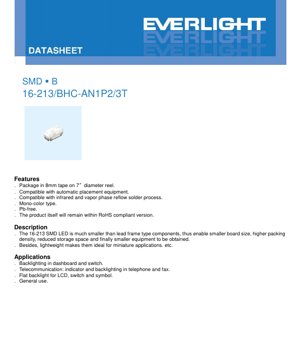
The 16-213/BHC-AN1P2/3T is a Surface-Mount Device (SMD) Light Emitting Diode (LED) designed for modern electronic applications requiring compact, efficient, and reliable indicator or backlight solutions. Utilizing InGaN (Indium Gallium Nitride) semiconductor technology, it produces blue light with a typical dominant wavelength of 468 nanometers. Its core design philosophy focuses on miniaturization and compatibility with automated, high-volume manufacturing processes.
Upeo wa msingi wa LED hii unatokana na ufungaji wake wa SMD. Ikilinganishwa na vipengele vya aina ya kawaida vilivyo na waya, inaweza kupunguza kwa kiasi kikubwa ukubwa wa bodi ya mzunguko wa kuchapishwa (PCB) na kuruhusu msongamano mkubwa wa mpangilio wa vipengele, jambo ambalo husaidia moja kwa moja kufikia umbo dogo la bidhaa ya mwisho. Zaidi ya hayo, ufungaji huu ni mwepesi, unaofaa kabisa kwa matumizi ya kubebebebwa na madogo madogo ambayo yana mahitaji madhubuti ya uzito.
Soko lengwa la LED hii ni pana, linajumuisha elektroniki za watumiaji, udhibiti wa viwanda, na sekta ya mawasiliano. Matumizi yake ya kawaida yanajumuisha taa za nyuma za dashibodi, swichi, na kibodi, pamoja na viashiria vya hali katika vifaa kama vile simu, mashine za faksi, n.k. Pia inafaa kwa matumizi ya taa ya jumla yanayohitaji chanzo cha mwanga cha bluu kilicho kompakt.
2. Technical Specifications and Objective Interpretation
2.1 Absolute Maximum Ratings
Viwango vya juu kabisa hufafanua mipaka ya mkazo ambayo inaweza kusababisha uharibifu wa kudumu wa kifaa. Haya si hali za kawaida za uendeshaji.
- Voltage ya nyuma (VR):5V. Exceeding this voltage under reverse bias may cause junction breakdown.
- Forward Current (IF):25 mA. This is the recommended maximum continuous DC current for reliable operation.
- Peak Forward Current (IFP):100 mA (duty cycle 1/10, frequency 1 kHz). This rating allows brief high-current pulses, suitable for multiplexed drive schemes, but continuous operation at this level is not recommended.
- Power Dissipation (Pd):95 mW. This is the maximum power the package can dissipate without exceeding its thermal limits, calculated as VF* IF.
- Electrostatic Discharge (ESD) Human Body Model (HBM):150V. Hii inaonyesha kifaa kina unyeti wa kati kwa ESD. Ni lazima kuchukua taratibu sahihi za usindikaji (k.m., kituo cha kazi kilichogunduliwa, povu ya kielektriki) ili kuzuia hitilafu zinazoweza kutokea au zenye uharibifu mkubwa.
- Muda wa kufanya kazi na uhifadhi:-40°C hadi +85°C (kufanya kazi), -40°C hadi +90°C (uhifadhi). Masafa mapana yanahakikisha utendaji katika mazingira magumu.
- Joto la kuunganishia:Kuunganishia kwa reflow (hadi 260°C, kwa sekunde 10 zaidi) au kuunganishia kwa mkono (hadi 350°C, kwa sekunde 3 zaidi). Mipangilio hii ya joto ni muhimu kwa mchakato wa usanikishaji usio na risasi.
2.2 Electro-Optical Characteristics
Vigezo hivi vimepimwa chini ya hali ya kawaida ya majaribio ya joto la mazingira la 25°C na mkondo wa mbele (IF) wa 5 mA, isipokuwa ikitajwa vinginevyo.
- Ukali wa mwanga (Iv):28.5 hadi 72.0 mcd (millicandela). Safu mpana inasimamiwa kupitia mfumo wa kugawanya daraja (angalia Sehemu ya 3). Thamani ya kawaida haijapewa, ikimaanisha uchaguzi unahitaji kutegemea msimbo maalum wa daraja.
- Pembe ya mtazamo (2θ1/2):Digrii 120 (thamani ya kawaida). Hii ndio pembe kamili wakati nguvu ya mwanga inapungua hadi nusu ya kilele chake. Pembe ya mtazamo ya 120° hutoa muundo mpana sana wa utoaji, unaofaa kwa taa za eneo badala ya boriti iliyolengwa.
- Urefu wa wimbi la kilele (λp):468 nm (thamani ya kawaida). Hii ndio urefu wa wimbi ambapo usambazaji wa nguvu ya wigo unafikia thamani ya juu zaidi.
- Urefu wa wimbi mkuu (λd):464.5 hadi 476.5 nm. Hii ndio urefu wa wimbi mmoja ambao jicho la binadamu huhisi rangi ya LED, pia unaathiriwa na kugawanywa daraja.
- Upana wa wigo (Δλ):35 nm (thamani ya kawaida). Hii inafafanua safu ya urefu wa wimbi unaotolewa unaozingatia urefu wa wimbi la kilele. Upana wa wigo mwembamba zaidi, unaonyesha rangi ya wigo safi zaidi.
- Forward voltage (VF):2.7V to 3.7V, typically 3.3V at IF=5mA. The tolerance for this parameter is ±0.05V. VFis crucial for designing current limiting circuits.
- Reverse current (IR):Maximum 50 µA at VR=5V. Low reverse current is desirable.
3. Bin System Description
To ensure color and brightness consistency in production, LEDs are sorted into different bins. This device uses two independent binning parameters.
3.1 Kugawanya Kwa Nguvu ya Mwanga
Luminous intensity is divided into four bins (N1, N2, P1, P2), each covering a specific range. The total span from the lowest (N1 minimum: 28.5 mcd) to the highest (P2 maximum: 72.0 mcd) is substantial. Designers must specify the required bin to guarantee the minimum brightness level for their application. The tolerance within a bin is ±11%.
3.2 Kugawanya Kwa Wimbi Kuu
The dominant wavelength, which determines the perceived blue hue, is divided into four bins (A9, A10, A11, A12). These bins range from 464.5 nm (bluer, shorter wavelength) to 476.5 nm (slightly greenish, longer wavelength). Specifying a bin ensures color consistency among multiple LEDs in a product. The tolerance within a bin is ±1 nm.
4. Uchambuzi wa Mkunjo wa Utendaji
The datasheet provides several characteristic curves, which are crucial for understanding the LED's behavior under different operating conditions.
4.1 Mkondo wa Mbele vs. Voltage ya Mbele (Mkunjo wa I-V)
This curve illustrates the typical exponential relationship of a diode. Within the recommended operating current range of 5-20 mA, the forward voltage remains relatively stable between 3.0V and 3.8V. This non-linear relationship highlights why constant current drivers are far superior to constant voltage sources for driving LEDs, as minor voltage variations can lead to significant current fluctuations.
4.2 Luminous Intensity vs. Forward Current
This curve indicates that within the low to medium current range, light output is approximately proportional to the forward current. However, at extremely high currents, efficiency (light output per unit electrical input) typically decreases due to increased heat generation. Operating near the maximum rated current (25 mA) may offer higher brightness, but at the cost of reduced lifespan and lower efficiency.
4.3 Luminous Intensity vs. Ambient Temperature
Light output decreases as the ambient temperature rises. This is a key consideration for thermal management. For instance, if an LED operates at its maximum temperature (+85°C), its luminous intensity will be significantly lower than its rated value at 25°C. Adequate PCB thermal design (copper pours, vias) is necessary to minimize the LED junction temperature and maintain stable light output.
4.4 Forward Current Derating Curve
This graph clearly defines the maximum allowable continuous forward current as a function of ambient temperature. As temperature increases, the maximum safe operating current decreases linearly. This is to prevent the junction temperature from exceeding its limit, thereby accelerating performance degradation. Designers must use this curve to select an appropriate operating current based on the expected maximum ambient temperature.
4.5 Spectral Distribution
The spectrum confirms blue emission with a peak wavelength of approximately 468 nm and a full width at half maximum (FWHM) of about 35 nm. Minimal emission in other parts of the visible spectrum indicates good color purity for this blue LED.
4.6 Radiation Pattern
The polar plot visually confirms a 120° viewing angle, showing a Lambertian-like emission pattern where intensity is highest at 0° (perpendicular to the chip) and smoothly decreases towards the edges.
5. Mechanical and Packaging Information
5.1 Package Dimensions
The LED is packaged in a standard SMD package. The dimension drawing provides key dimensions for PCB pad design, including body length, width, height, and lead (terminal) pitch. Adherence to these dimensions is necessary for proper placement and soldering. A note specifies that, unless otherwise stated, the general tolerance is ±0.1 mm.
5.2 Recommended Pad Layout
The recommended pad pattern (footprint) is provided. This includes pad dimensions, shape, and spacing. The datasheet correctly notes that this is a reference design and should be modified based on specific manufacturing capabilities (e.g., solder paste stencil design, reflow temperature profile). The primary goals of pad design are to ensure reliable solder joint formation and adequate heat dissipation.
6. Mwongozo wa Uchomeaji na Usanikishaji
6.1 Mkunjo wa Joto la Reflow Soldering
Provides a detailed temperature profile for lead-free reflow soldering. Key parameters include: preheat stage (150-200°C, lasting 60-120 seconds), time above liquidus (above 217°C, lasting 60-150 seconds), peak temperature not exceeding 260°C for a maximum of 10 seconds, and controlled ramp-up/cool-down rates. It explicitly states that reflow soldering should not exceed two cycles to avoid thermal stress on components.
6.2 Maelekezo ya Uchomeaji wa Mikono
如果必须进行手工焊接,则有严格的限制:电烙铁头温度 ≤ 350°C,每个端子的接触时间 ≤ 3 秒,烙铁功率 ≤ 25W,并且焊接每个端子之间至少间隔2秒。规格书警告,损坏通常发生在手工焊接过程中,强调应优先选择回流焊接工艺。<6.3 存储与湿度敏感性
LED imefungwa kwenye mfuko wa kuzuia unyevu wenye desiccant. Kabla ya kufungua, inapaswa kuhifadhiwa chini ya hali ya ≤ 30°C na ≤ 90% RH. Baada ya kufunguliwa, "maisha ya kiwandani" chini ya hali ya ≤ 30°C / ≤ 60% RH ni mwaka 1. Ikiwa kipindi hiki kinazidi, inahitaji kukaushwa (60 ± 5°C, kwa masaa 24) kabla ya reflow soldering ili kuzuia "popcorn effect" (ufungaji unapasuka kutokana na mvuke wa unyevu wakati wa uchomeaji).
7. Packaging & Ordering Information
7.1 Vipimo vya Carrier Tape na Reel
Vifaa vinapatikana katika mfumo wa 8mm upana wa embossed carrier tape, iliyoviringishwa kwenye reel yenye kipenyo cha inchi 7. Vipimo vya reel, muundo wa mfereji wa tepi na vipimo vya cover tape vimeelezwa kwa kina ili kuhakikisha utangamano na vifaa vya kiotomatiki vya kuweka vipande. Kila roll ina vipande 3000.
7.2 Label Description
Lebo ya reel ina misimbo kadhaa:
P/N:
- Part Number (full part number, e.g., 16-213/BHC-AN1P2/3T).CAT:
- Luminous intensity grade (brightness bin code: N1, N2, P1, P2).HUE:
- Ngazi ya krominansi na urefu wa wimbi kuu (Msimbo wa kiwango cha rangi: A9, A10, A11, A12).REF:
- Ngazi ya voltage ya mbele.LOT No:
- Nambari ya kundi inayoweza kufuatiliwa.Misimbo hii ni muhimu kwa ufuatiliaji na kuhakikisha matumizi ya aina sahihi ya vipengele katika uzalishaji.
8.1 Kizuizi cha Mkondo Lazima Kifanyike
The primary precaution in the datasheet emphasizes: "The customer must use a resistor for protection." Due to the steep I-V curve of the LED, a small increase in supply voltage can lead to a large, even destructive, increase in current. To ensure safe operation, a series resistor is required, or preferably, a dedicated constant-current LED driver circuit.
8.2 Thermal Management
Despite its compact package, its performance is temperature-dependent. To maintain consistent brightness and long life, PCB layout should employ thermal management techniques. This includes using sufficient copper area connected to the LED's thermal pad (if applicable) or cathode/anode pads to act as a heat sink, and possibly using thermal vias to transfer heat to inner or bottom layers.
8.3 Optical Design
The 120° viewing angle makes this LED suitable for wide-area illumination without secondary optics. For more focused light, an external lens or reflector is required. Designers should consider the angular intensity distribution when planning light guides or diffusers for backlight applications.
9. Ulinganisho wa Teknolojia na Tofauti
The key differentiation of this LED lies in its specific combination of package size, wide viewing angle, blue color point, and detailed binning structure. Compared to non-binned or loosely binned LEDs, it offers higher predictability in color and brightness for applications requiring visual consistency. Its compatibility with standard SMD assembly processes and lead-free soldering makes it a plug-and-play component for modern electronic manufacturing lines. Comprehensive derating curves and application warnings provide designers with the necessary data to use the component reliably within its specification limits.
10. Maswali Yanayoulizwa Mara kwa Mara (Kulingana na Vigezo vya Kiufundi)
10.1 Kwa nini LED yangu ina mwangaza mdogo kuliko ilivyotarajiwa?
Angalia hali ya kufanya kazi: 1) Hakikisha mkondo wa mbele ni 5 mA haswa (au mkondo unaolingana na hali ya majaribio ya spec). 2) Thibitisha halijoto ya mazingira. Nguvu ya mwanga hupungua kwa joto la juu (angalia sehemu ya 4.3). 3) Thibitisha msimbo wa kiwango ulichonunua (CAT kwenye lebo). Kwa mkondo sawa, LED ya kiwango cha N1 itakuwa na mwangaza mdogo kuliko ile ya kiwango cha P2.
10.2 Je, Ninawezaje Kuchagua Upinzani Sahihi wa Kukandamiza Mkondo?
Tumia kanuni ya Ohm: R = (V
Chanzo cha umeme- V) / IF. Tumia thamani ya juu ya VFkutoka kwenye spec (3.7V) ili kuhesabu thamani ya chini ya upinzani inayoweza kudhibiti mkondo kwa IFinayohitajika katika hali mbaya zaidi. Kisha angalia nguvu ya kiwango cha upinzani: PF= (IR* R.F)210.3 Naweza kutumia pini ya 3.3V ya microcontroller kuendesha LED hii moja kwa moja?
Haipendekezi kudhibiti moja kwa moja. V ya kawaida
Ni 3.3V, thamani ya juu inaweza kufikia 3.7V. Chini ya usambazaji wa umeme wa 3.3V, huenda hakuna ukingo wa voltage wa kutosha kuwasha LED kwa utulivu, hasa wakati wa joto la chini VFInaweza kupanda. Zaidi ya hayo, pini za MCU zina kikomo cha pato la sasa (kawaida 20-25mA). Njia sahihi ya kiunganishi ni kutumia transistor au mzunguko wa kuendesha.F11. Muundo halisi na kesi za matumizi
Tukio: Kubuni jopo la kiashiria cha hali lenye LED nyingi za bluu zilizo sawasawa.
Ufafanuzi wa vipimo:
- Fafanua mwangaza wa chini unaohitajika na tone halisi la rangi. Ili kuhakikisha uthabiti, bainisha daraja moja, kali kwa nguvu ya mwanga (mfano P1) na urefu wa wimbi kuu (mfano A10).Circuit Design:
- Use a constant current driver IC capable of providing 5 mA per channel for multiple LEDs. This ensures all LEDs receive the same current, resulting in uniform brightness, unaffected by Vthe impact of minor variations.F variations.
- PCB Layout:Design pads according to the recommended layout. Connect a small copper pour to the cathode pad of each LED to aid heat dissipation. Maintain LED spacing to prevent mutual heating.
- Assembly:Strictly follow the reflow soldering temperature profile. Store opened reels in a dry cabinet if not used immediately.
- Verification:Pima voltage ya mwelekeo na pato la mwanga la kipengele cha sampuli chini ya mkondo unaotarajiwa wa kazi na hali ya juu ya joto ili kuthibitisha utendaji.
12. Utangulizi mfupi wa kanuni ya kufanya kazi
LED hii inategemea makutano ya nusu-uwiano ya p-n iliyotengenezwa kwa nyenzo za InGaN. Unapotumia voltage ya mwelekeo inayozidi kizuizi cha makutano (voltage ya mwelekeo VF), elektroni na mashimo huingizwa kwenye eneo lenye ufanisi na huchanganyika humo. Katika nusu-uwiano yenye pengo la moja kwa moja kama InGaN, mchanganyiko huu hutoa nishati kwa njia ya fotoni (mwanga). Pengo maalum la mseto wa InGaN huamua urefu wa wimbi la fotoni inayotolewa, ambayo katika mfano huu iko katika eneo la bluu ya wigo unaoonekana (takriban 468 nm). Kifuniko cha epoksi hutumiwa kulinda chipi ya nusu-uwiano, kutumika kama lenzi kuunda pato la mwanga (na hivyo kutoa pembe ya maono ya 120°), na kutoa muundo wa mitambo wa kuuza.
13. Mwelekeo wa kiteknolojia
SMD LED kama mfululizo wa 16-213 zinawakilisha kiwango cha tasnia cha udogo na usanikishaji wa otomatiki. Mwelekeo unaoendelea katika uwanja huu ni pamoja na:
- Uboreshaji wa Ufanisi:Kukuza miundo mpya ya epitaksia na nyenzo ili kufikia ufanisi wa juu wa utoaji wa mwanga (utoaji zaidi wa mwanga kwa kila watt ya umeme).
- Uboreshaji wa Ulinganifu wa Rangi:Maendeleo katika udhibiti wa utengenezaji na algoriti za kugawanya, ili kupata uvumilivu mkali zaidi wa rangi na mwangaza moja kwa moja kutoka kwa uzalishaji.
- Uboreshaji wa Utendaji wa Joto:Kukuza ufungashaji wenye upinzani wa chini wa joto, ili kuruhusu mkondo wa kuendesha wa juu zaidi na kudumisha utendaji katika halijoto za juu.
- Ujumuishaji:Maendeleo ya LED kuelekea ufungashaji wa chip nyingi (RGB, mwanga mweupe) na viendeshi vilivyojumuishwa au saketi za udhibiti ("LED zenye akili").
Ufafanuzi wa istilahi za maelezo ya LED
Ufafanuzi Kamili wa Istilahi za Teknolojia ya LED
I. Viashiria Muhimu vya Utendaji wa Umeme na Mwanga
| Istilahi | Kipimo/Uwakilishi | Ufafanuzi Rahisi | Kwa Nini Ni Muhimu |
|---|---|---|---|
| Ufanisi wa Mwanga (Luminous Efficacy) | lm/W (lumen/watt) | Mwangaza unaotolewa kwa kila watt ya umeme, unavyozidi kuwa juu ndivyo unavyozidi kuwa wa kutumia nishati kwa ufanisi. | Huamua moja kwa moja kiwango cha ufanisi wa nishati na gharama ya umeme ya taa. |
| Mwangaza (Luminous Flux) | lm (lumen) | Jumla ya mwanga unaotolewa na chanzo cha mwanga, unaojulikana kwa jina la "mwangaza". | Huamua kama taa inatosha kuwa na mwangaza. |
| Pembe ya kuona mwanga (Viewing Angle) | ° (digrii), kama 120° | Pembe ambapo nguvu ya mwanga hupungua hadi nusu, huamua upana wa boriti ya mwanga. | Huathiri eneo la mwangaza na usawa wake. |
| Joto la rangi (CCT) | K (Kelvin), k.m. 2700K/6500K | Joto la rangi ya mwanga, thamani ya chini inaelekea manjano/joto, thamani ya juu inaelekea nyeupe/baridi. | Huamua mazingira ya taa na matumizi yanayofaa. |
| Kielelezo cha uwakilishi wa rangi (CRI / Ra) | Hakuna kipimo, 0–100 | Uwezo wa chanzo cha mwanga kurejesha rangi halisi ya kitu, Ra≥80 ni bora. | Huathiri ukweli wa rangi, hutumika katika maeneo yenye mahitaji makubwa kama maduka makubwa, majumba ya sanaa, n.k. |
| Tofauti ya uvumilivu wa rangi (SDCM) | Idadi ya hatua za duaradufu ya MacAdam, k.m. "5-step" | Kipimo cha kiasi cha uthabiti wa rangi, idadi ndogo ya hatua inaonyesha uthabiti mkubwa wa rangi. | Kuhakikisha hakuna tofauti ya rangi kati ya taa za kundi moja. |
| Wimbi kuu (Dominant Wavelength) | nm (nanomita), k.m. 620nm (nyekundu) | Thamani ya urefu wa wimbi inayolingana na rangi ya LED zenye rangi. | Huamua hue ya LED za rangi moja kama nyekundu, manjano, kijani, n.k. |
| Usambazaji wa wigo (Spectral Distribution) | Mkunjo wa Urefu wa Wimbi dhidi ya Nguvu | Inaonyesha usambazaji wa nguvu ya mwanga unaotolewa na LED katika kila urefu wa wimbi. | Inaathiri ubora wa kuonyesha rangi na ubora wa rangi. |
II. Vigezo vya Umeme
| Istilahi | Ishara | Ufafanuzi Rahisi | Uzingatiaji wa Ubunifu |
|---|---|---|---|
| Voltage ya Mbele (Forward Voltage) | Vf | The minimum voltage required to light up an LED, similar to a "starting threshold". | The driving power supply voltage must be ≥ Vf; voltages add up when multiple LEDs are connected in series. |
| Forward Current | If | The current value that enables an LED to emit light normally. | Mara nguvu ya umeme ya kudumu hutumiwa, na mkondo huamua mwangaza na maisha ya taa. |
| Mkondo wa juu zaidi wa msukumo (Pulse Current) | Ifp | Mkondo wa kilele unaoweza kustahimili kwa muda mfupi, unaotumika kwa kudhibiti mwangaza au kumulika. | Upana wa msukumo na uwiano wa wakati wa kazi lazima udhibitiwe kwa uangalifu, vinginevyo kuharibika kwa joto kupita kiasi. |
| Voltage ya nyuma (Reverse Voltage) | Vr | The maximum reverse voltage that an LED can withstand; exceeding this may cause breakdown. | Reverse connection or voltage surges must be prevented in the circuit. |
| Thermal Resistance | Rth (°C/W) | The resistance to heat flow from the chip to the solder point; a lower value indicates better heat dissipation. | High thermal resistance requires a stronger heat dissipation design; otherwise, the junction temperature will rise. |
| Electrostatic Discharge Immunity (ESD Immunity) | V (HBM), e.g., 1000V | The higher the value, the more resistant the device is to electrostatic damage. | Anti-static measures must be implemented during production, especially for high-sensitivity LEDs. |
III. Udhibiti wa Joto na Uthabiti
| Istilahi | Viashiria Muhimu | Ufafanuzi Rahisi | Athari |
|---|---|---|---|
| Joto la Kiungo (Junction Temperature) | Tj (°C) | Joto halisi la kufanya kazi ndani ya Chip ya LED. | Kwa kila kupungua kwa 10°C, maisha yanaweza kuongezeka mara mbili; joto la juu sana husababisha kupungua kwa mwanga, na mabadiliko ya rangi. |
| Uchakavu wa Mwanga (Lumen Depreciation) | L70 / L80 (saa) | Muda unaohitajika ili mwangaza upunguke hadi 70% au 80% ya thamani ya awali. | Inafafanua moja kwa moja "maisha ya huduma" ya LED. |
| Kiwango cha Kudumisha Lumeni (Lumen Maintenance) | % (k.m. 70%) | Asilimia ya mwangaza uliobaki baada ya kutumia kwa muda fulani. | Inaonyesha uwezo wa kudumisha mwangaza baada ya matumizi ya muda mrefu. |
| Color Shift | Δu′v′ or MacAdam ellipse | Kiwango cha mabadiliko ya rangi wakati wa matumizi. | Huathiri ufanani wa rangi katika eneo la taa. |
| Uchakavu wa Joto (Thermal Aging) | Kupungua kwa Utendaji wa Nyenzo | Uboreshaji wa nyenzo za ufungaji unaosababishwa na joto la juu kwa muda mrefu. | Inaweza kusababisha kupungua kwa mwangaza, mabadiliko ya rangi, au kushindwa kwa mzunguko wazi. |
IV. Ufungaji na Nyenzo
| Istilahi | Aina za Kawaida | Ufafanuzi Rahisi | Features and Applications |
|---|---|---|---|
| Package Type | EMC, PPA, Ceramic | A housing material that protects the chip and provides optical and thermal interfaces. | EMC offers good heat resistance and low cost; ceramic provides superior heat dissipation and long lifespan. |
| Chip Structure | Front-side, Flip Chip | Chip electrode arrangement. | Flip Chip offers better heat dissipation and higher luminous efficacy, suitable for high-power applications. |
| Phosphor coating | YAG, Silicate, Nitride | Coated on the blue LED chip, partially converting to yellow/red light, mixing to form white light. | Fosfori tofauti huathiri ufanisi wa mwanga, halijoto ya rangi na ubora wa kuonyesha rangi. |
| Lens / Usanifu wa Optics | Uso wa gorofa, lenzi ndogo, kutafakari kwa jumla | Muundo wa optics kwenye uso wa kifuniko, udhibiti wa usambazaji wa mwanga. | Huamua pembe ya mwanga na mkunjo wa usambazaji wa mwanga. |
V. Quality Control and Binning
| Istilahi | Bin Contents | Ufafanuzi Rahisi | Purpose |
|---|---|---|---|
| Luminous Flux Binning | Codes such as 2G, 2H | Grouped by brightness level, each group has a minimum/maximum lumen value. | Ensure consistent brightness within the same batch of products. |
| Voltage binning | Codes such as 6W, 6X | Grouped according to forward voltage range. | Facilitates driver matching and improves system efficiency. |
| Color binning | 5-step MacAdam ellipse | Group by color coordinates to ensure colors fall within an extremely narrow range. | Ensure color consistency to avoid uneven color within the same luminaire. |
| Color temperature binning | 2700K, 3000K, etc. | Group by color temperature, each group has a corresponding coordinate range. | Meet the color temperature requirements of different scenarios. |
VI. Testing and Certification
| Istilahi | Viwango/Upimaji | Ufafanuzi Rahisi | Maana |
|---|---|---|---|
| LM-80 | Upimaji wa Kudumisha Lumeni | Inawashwa kwa muda mrefu chini ya hali ya joto la kudumu, kurekodi data ya kupungua kwa mwangaza. | For projecting LED lifetime (in conjunction with TM-21). |
| TM-21 | Lifetime projection standard | Projecting lifetime under actual use conditions based on LM-80 data. | Providing scientific lifetime prediction. |
| IESNA standard | Standard za Injenjering Rasvete | Obuhvata metode testiranja u optici, elektrici i termici. | Industrijska priznata osnova za testiranje. |
| RoHS / REACH | Ekološka sertifikacija | Osigurava da proizvod ne sadrži štetne materije (kao što su olovo, živa). | Masharti ya kuingia katika soko la kimataifa. |
| ENERGY STAR / DLC | Uthibitisho wa ufanisi wa nishati. | Uthibitisho wa ufanisi wa nishati na utendaji kwa bidhaa za taa. | Hutumiwa kwa kawaida katika ununuzi wa serikali na miradi ya ruzuku, kuimarisha ushindani wa soko. |