Yaliyomo
- 1. Mchanganuo wa Bidhaa
- 1.1 Faida Kuu
- 1.2 Matumizi Lengwa
- 2. Uchambuzi wa Kina wa Vigezo vya Kiufundi
- 2.1 Viwango vya Juu Kabisa
- 2.2 Electro-Optical Characteristics
- 3. Performance Curve Analysis
- 3.1 Uwiano wa Ukali wa Mwangaza dhidi ya Joto la Mazingira
- 3.2 Uwiano wa Ukali wa Mwangaza dhidi ya Mkondo wa Mbele
- 3.3 Forward Current Derating Curve
- 3.4 Forward Voltage vs. Forward Current (I-V Curve)
- 3.5 Radiation Diagram
- 3.6 Spectrum Distribution
- 4. Mechanical and Package Information
- 4.1 Package Dimensions
- 4.2 Utambulishaji wa Uchanganuzi wa Kisiasa
- 5. Miongozo ya Kuuza na Usanikishaji
- 5.1 Uhifadhi na Unyeti wa Unyevu
- 5.2 Profaili ya Uuzaji wa Reflow (Bila Plumbi)
- 5.3 Hand Soldering
- 5.4 Rework and Repair
- 6. Packaging and Ordering Information
- 6.1 Standard Packaging
- 6.2 Label Explanation
- 7. Mambo ya Kuzingatia katika Ubunifu wa Programu
- 7.1 Kikomo cha Sasa ni Lazima
- 7.2 Usimamizi wa Joto
- 7.3 Ulinzi wa ESD
- 8. Ulinganishi wa Kiufundi na Uwekaji Nafasi
- 9. Maswali Yanayoulizwa Mara Kwa Mara (FAQs)
- 9.1 Je, naweza kuendesha chipsi za bluu na nyekundu kwa wakati mmoja kutoka kwa chanzo kimoja cha umeme?
- 9.2 Kwa nini kiwango cha ESD kimetofautiana sana kati ya chipsi za bluu na nyekundu?
- 9.3 "A01/2C" kwenye nambari ya sehemu inamaanisha nini?
- 10. Mfano wa Kubuni Unaotumika
- 11. Kanuni ya Uendeshaji
1. Mchanganuo wa Bidhaa
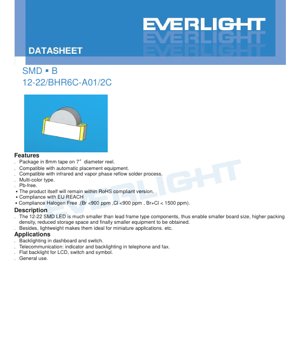
LED ya 12-22 SMD ni kifaa kidogo cha kusakinishwa kwenye uso, kilichoundwa kwa matumizi ya PCB yenye msongamano mkubwa. Inapatikana katika usanidi wa rangi nyingi, hasa kwa kuchanganya LED ya bluu (chip ya BH) na LED nyekundu angavu (chip ya R6) ndani ya kifurushi kimoja. Sehemu hii ni ndogo sana ikilinganishwa na LED za aina ya fremu ya kuongoza, na inawezesha kupunguzwa kwa kiasi kikubwa cha ukubwa wa bodi, kuongezeka kwa msongamano wa kufunga, kupunguzwa kwa mahitaji ya uhifadhi, na hatimaye kuchangia katika ukuzaji wa vifaa vidogo vya watumiaji wa mwisho. Ujenzi wake mwepesi unaufanya ufaae hasa kwa matumizi ya vidogo na yenye nafasi ndogo.
1.1 Faida Kuu
- Kupunguzwa kwa Ukubwa: Ukubwa mdogo wa eneo (1.2mm x 2.2mm) unaruhusu kuwekewa kwa msongamano mkubwa kwenye PCBs.
- Uambatanishaji: Imeandikwa kwenye mkanda wa milimita 8 kwenye makorokoro yenye kipenyo cha inchi 7, na kufanya iwe sawa kabisa na vifaa vya kawaida vya kuweka kiotomatiki (pick-and-place).
- Uzalishaji Imara: Inalingana na michakato ya kuuza tena ya infrared (IR) na vapor phase reflow.
- Uzingatifu wa Mazingira: The product is Pb-free, compliant with RoHS, EU REACH, and halogen-free standards (Br <900 ppm, Cl <900 ppm, Br+Cl < 1500 ppm).
1.2 Matumizi Lengwa
- Automotive/Industrial: Backlighting for instrument panels, dashboards, and switches.
- Telecommunications: Viashiria vya hali na taa za nyuma za kibodi katika simu na mashine za faksi.
- Vifaa vya Umeme vya Matumizi ya Kaya: Taa za nyuma zilizosawazishwa kwa LCD, taa za swichi, na taa za alama.
- Matumizi ya Jumla: Maombi yoyote yanayohitaji taa ya kiashiria ya kuaminika na ya kompakt.
2. Uchambuzi wa Kina wa Vigezo vya Kiufundi
Sehemu zifuatazo zinatoa muhtasari wa kina wa vipimo vya umeme, vya nuru na vya joto vya kifaa. Vigezo vyote vinapimwa kwa halijoto ya mazingira (Ta) ya 25°C isipokuwa ikiwa imebainishwa vinginevyo.
2.1 Viwango vya Juu Kabisa
Viwango hivi vinabainisha mipaka ambayo kuzidi kwao kuharibika kudumu kwa kifaa kunaweza kutokea. Uendeshaji chini ya au kwa hali hizi hauhakikishiwi.
| Parameter | Symbol | Code | Rating | Unit |
|---|---|---|---|---|
| Reverse Voltage | VR | - | 5 | V |
| Forward Current | IF | BH | 10 | mA |
| R6 | 25 | mA | ||
| Peak Forward Current (Duty 1/10 @1KHz) | IFP | BH | 40 | mA |
| R6 | 50 | mA | ||
| Power Dissipation | Pd | BH | 40 | mW |
| R6 | Sitini | mW | ||
| Electrostatic Discharge (HBM) | ESD | BH | 150 | V |
| R6 | 2000 | V | ||
| Joto la Uendeshaji | Topr | - | -40 ~ +85 | °C |
| Storage Temperature | Tstg | - | -40 ~ +90 | °C |
| Joto la Uuzi | Tsol | Reflow | 260°C for 10 sec. | - |
| Mkono | 350°C kwa sekunde 3. | - |
Uchunguzi Muhimu: Chip nyekundu (R6) ina uwezo wa juu wa kubeba mkondo na nguvu ikilinganishwa na chip ya buluu (BH). Ni muhimu kutambua kwamba usikivu wa ESD unatofautiana kwa kiasi kikubwa, ambapo chip ya BH (buluu) ni nyeti sana (150V HBM), na inahitaji ulinzi mkali wa ESD wakati wa kushughulikiwa, huku chip ya R6 (nyekundu) ikiwa imara zaidi (2000V HBM).
2.2 Electro-Optical Characteristics
These are the typical performance parameters under normal operating conditions.
| Parameter | Symbol | Code | Min. | Typ. | Max. | Unit | Hali |
|---|---|---|---|---|---|---|---|
| Uzito wa Mwanga | Iv | BH | 18.0 | 26.0 | ----- | mcd | IF=5mA |
| R6 | 22.5 | 30.0 | ----- | mcd | IF=5mA | ||
| Pembe ya Kuangalia (2θ)1/2) | - | - | ----- | 120 | ----- | deg | - |
| Peak Wavelength | λp | BH | ----- | 468 | ----- | nm | - |
| R6 | ----- | 632 | ----- | nm | - | ||
| Dominant Wavelength | λd | BH | ----- | 470 | ----- | nm | - |
| R6 | ----- | 624 | ----- | nm | - | ||
| Spectrum Bandwidth (Δλ) | - | BH | ----- | 25 | ----- | nm | - |
| R6 | ----- | 20 | ----- | nm | - | ||
| Forward Voltage | VF | BH | 2.7 | ----- | 3.1 | V | - |
| R6 | 1.7 | ----- | 2.2 | V | - | ||
| Reverse Current | IR | BH | ----- | ----- | 50 | μA | VR=5V |
| R6 | ----- | ----- | 10 | μA | VR=5V |
Vidokezo:
- Uvumilivu wa Nguvu ya Mwangaza ni ±11%.
- Toleleo ya Voltage ya Mbele ni ±0.05V.
Uchambuzi: LED ya bluu (BH) inafanya kazi kwa voltage ya mbele ya juu zaidi (2.7-3.1V) kama ilivyo kawaida kwa chips za msingi wa InGaN, huku LED nyekundu (R6) ikiwa na voltage ya mbele ya chini (1.7-2.2V) inayotambulisha teknolojia ya AlGaInP. Ukubwa wa mwanga umebainishwa kwa mkondo wa chini wa kuendesha wa 5mA, ikionyesha ufanisi wa juu. Pembe ya kuona ya upana wa digrii 120 hutoa muundo mpana wa utoaji mwanga unaofaa kwa matumizi ya viashiria.
3. Performance Curve Analysis
Karatasi ya data hutoa mikunjo ya kawaida ya sifa kwa chips zote BH (Bluu) na R6 (Nyekundu), ambazo ni muhimu kwa kuelewa tabia ya kifaa chini ya hali mbalimbali.
3.1 Uwiano wa Ukali wa Mwangaza dhidi ya Joto la Mazingira
Mikondo inaonyesha pato la mwanga hupungua kadri halijoto ya mazingira inavyoongezeka. Athari hii ya kuzima kwa joto ni sifa ya msingi ya semikondakta za LED. Wabunifu lazima wazingatie upungufu huu wakati wa uendeshaji katika halijoto ya juu ya mazingira ili kuhakikisha pato la mwanga linalotosha.
3.2 Uwiano wa Ukali wa Mwangaza dhidi ya Mkondo wa Mbele
Michoro hii zinaonyesha uhusiano usio wa mstari kati ya mkondo wa kudhibiti na mwanga unaotolewa. Kuongeza mkondo kunaleta faida inayopungua katika mwangaza huku ukizalisha joto zaidi. Kufanya kazi karibu na kiwango cha juu kabisa cha mkondo sio bora na hupunguza maisha ya kifaa.
3.3 Forward Current Derating Curve
Grafu huu muhimu hufafanua upeo wa mkondo wa mbele unaoruhusiwa kuendelea kama utendakazi wa joto la mazingira. Kadiri joto linavyopanda, mkondo wa juu unaoruhusiwa lazima upunguzwe ili kuzuia kuzidi kikomo cha utawanyiko wa nguvu kifaa na kusababisha kukimbia kwa joto.
3.4 Forward Voltage vs. Forward Current (I-V Curve)
I-V curve inaonyesha uhusiano wa kielelezo unaotokana na diode. "Knee" voltage ni takriban forward voltage (VFMteremko wa curve katika eneo la uendeshaji unahusiana na upinzani wa nguvu wa LED.
3.5 Radiation Diagram
Michoro ya polar inaonyesha usambazaji wa anga wa ukubwa wa mwanga, ikithibitisha pembe ya kuona ya digrii 120. Muundo kwa kawaida ni wa Lambertian au karibu na Lambertian kwa aina hii ya ufungaji wa LED.
3.6 Spectrum Distribution
Michoro ya wigo inaonyesha muundo wa utoaji:
- BH (Blue): Peak wavelength ~468nm, dominant wavelength ~470nm, with a spectral bandwidth (FWHM) of ~25nm.
- R6 (Red): Peak wavelength ~632nm, dominant wavelength ~624nm, with a narrower spectral bandwidth of ~20nm.
4. Mechanical and Package Information
4.1 Package Dimensions
The 12-22 SMD LED has a compact rectangular package. Key dimensions (in mm, tolerance ±0.1mm unless specified) include:
- Urefu wa jumla: 2.2 mm
- Upana wa jumla: 1.2 mm
- Urefu wa jumla: 1.1 mm
- Vipimo na nafasi za pini (terminali) kama ilivyo kwenye mchoro wa kina.
4.2 Utambulishaji wa Uchanganuzi wa Kisiasa
Sehemu hiyo ina alama ya upeo, kwa kawaida ni mfuo au nukta kwenye kifurushi au kona iliyokatwa kwenye mfuko wa mkanda wa usafirishaji, kuonyesha cathode. Mwelekeo sahihi ni muhimu kwa uendeshaji wa mzunguko.
5. Miongozo ya Kuuza na Usanikishaji
Usindikaji sahihi ni muhimu kwa uaminifu. Kifaa hiki kina usikivu wa unyevunyevu (MSL) na kinahitaji maelezo maalum ya kuuza.
5.1 Uhifadhi na Unyeti wa Unyevu
- Kabla ya Kufungua: Hifadhi kwa ≤30°C na ≤90% RH.
- Baada ya Kufungua (Maisha ya Sakafu): Mwaka 1 kwa ≤30°C na ≤60% RH. Sehemu zisizotumiwa lazima zifungwe tena kwenye ufungashaji unaokinga unyevu na chokaa cha kukaushia.
- Baking: If the desiccant indicates moisture absorption or storage time is exceeded, bake at 60 ±5°C for 24 hours before use.
5.2 Profaili ya Uuzaji wa Reflow (Bila Plumbi)
Profaili inayopendekezwa ni ya muundo usio na risasi (mfano, SAC305):
- Joto Kabla: Panda hatua kwa hatua ili kuamilisha flux.
- Eneo la Kunyonya: Ili kuipasha joto bodi na sehemu kwa usawa.
- Reflow: Kiwango cha juu cha joto cha 260°C kwa upeo wa sekunde 10.
- Kupoza: Kupoza iliyodhibitiwa ili kupunguza mkazo wa joto.
5.3 Hand Soldering
Ikiwa ufungaji wa mkono hauepukiki:
- Use a soldering iron with a tip temperature <350°C.
- Punguza muda wa mguso hadi ≤3 sekunde kwa kila terminali.
- Tumia chuma chenye nguvu ≤25W.
- Ruhusu sekunde ≥2 kati ya kuunganisha kila terminali ili kuepuka joto kupita kiasi.
- Kuunganisha kwa mkono hubeba hatari kubwa ya kuharibika.
5.4 Rework and Repair
Ukarabati baada ya kutungia haupendekezwi kabisa. Ikiwa ni lazima kabisa:
- Tumia chuma maalum cha kutunga chenye vichwa viwili vilivyoundwa kwa ajili ya kuondoa SMD ili kutumia joto la wakati mmoja na lenye usawa kwa vituo vyote viwili.
- Daima thibitisha kuwa mchakato wa ukarabati haudhoofishi sifa za LED.
6. Packaging and Ordering Information
6.1 Standard Packaging
LEDs zinazotolewa zimefungwa kwa mfuko unaostahimili unyevu:
- Ukanda wa Kubeba: Ukanda upana wa milimita 8.
- Reel: 7-inch (178mm) diameter.
- Quantity: 2000 pieces per reel.
- Ufungaji unajumuisha kikaushi na umehifadhiwa kwenye mfuko wa alumini unaokinga unyevu.
6.2 Label Explanation
Lebo ya reel ina misimbo kadhaa:
- CPN: Nambari ya Bidhaa ya Mteja.
- P/N: Nambari ya Bidhaa (mfano, 12-22/BHR6C-A01/2C).
- Idadi: Idadi ya Ufungaji.
- CAT: Luminous Intensity Rank.
- HUE: Chromaticity Coordinates & Dominant Wavelength Rank.
- REF: Forward Voltage Rank.
- LOT No: Nambari ya Kundi la Uzalishaji kwa ufuatiliaji.
7. Mambo ya Kuzingatia katika Ubunifu wa Programu
7.1 Kikomo cha Sasa ni Lazima
LEDs are current-driven devices. An external current-limiting resistor (or constant current driver) is absolutely required for each chip (BH and R6). The forward voltage (VF) has a tolerance and a negative temperature coefficient (decreases as temperature rises). Connecting an LED directly to a voltage source, even one close to its nominal VF, inaweza kusababisha ongezeko ndogo la voltage kuendesha mkondo mkubwa usiodhibitiwa, na kusabia kushindwa papo hapo (kuchomeka). Thamani ya kipingamizi inahesabiwa kwa kutumia Sheria ya Ohm: R = (Vusambazaji - VF) / IF.
7.2 Usimamizi wa Joto
Ingawa kifurushi ni kidogo, utupaji wa nguvu (40mW kwa BH, 60mW kwa R6) hutoa joto. Kwa uendeshaji thabiti wa muda mrefu:
- Zingatia mkunjo wa kupunguza mkondo wa mbele katika halijoto ya mazingira iliyoinuka.
- Hakikisha eneo la shaba la PCB (pedi za uokoa joto) linalotosha kuiondoa joto kutoka kwenye viunganisho vya LED.
- Epuka kuweka LED karibu na vifaa vingine vinavyozalisha joto.
7.3 Ulinzi wa ESD
Chip ya buluu (BH) ni nyeti sana kwa ESD (150V HBM). Tekeleza ulinzi wa ESD katika mchakato wote wa uzalishaji:
- Tumia vituo vya kazi vilivyowekwa ardhini na vifungo vya mkono wakati wa kushughulikia na kukusanyika.
- Fikiria kuongeza diode za kukandamiza voltage za muda mfupi (TVS) au saketi zingine za ulinzi kwenye PCB ikiwa LED imeunganishwa na viunganishi vya nje vinavyoweza kupata matukio ya ESD.
8. Ulinganishi wa Kiufundi na Uwekaji Nafasi
The 12-22/BHR6C-A01/2C inatoa mchanganyiko maalum wa vipengele:
- vs. Larger SMD LEDs (e.g., 3528, 5050): It provides a much smaller footprint for ultra-compact designs but with correspondingly lower maximum light output and power handling.
- vs. Single-Color 12-22 LEDs: The multi-color (blue+red) configuration in one package saves board space compared to using two separate single-color LEDs, simplifying assembly and inventory.
- dhidi ya LED zilizo na Pini (Leaded LEDs): Inaondoa hitaji la mashimo ya kupenyeza, inawezesha usanikishaji wa kiotomatiki, na kupunguza ukubwa na uzito wa bidhaa kwa ujumla.
9. Maswali Yanayoulizwa Mara Kwa Mara (FAQs)
9.1 Je, naweza kuendesha chipsi za bluu na nyekundu kwa wakati mmoja kutoka kwa chanzo kimoja cha umeme?
Si moja kwa moja katika usanidi rahisi wa mfululizo au sambamba kwa sababu ya tofauti katika voltage ya mbele (VF). Chipsi ya bluu inahitaji ~3V, wakati chipsi nyekundu inahitaji ~2V. Ikiwa imeunganishwa sambamba na chanzo cha 3V, chipsi nyekundu ingepata mkondo mwingi. Ikiwa imeunganishwa mfululizo, chanzo cha 5V+ kingehitajika, na ulinganifu wa mkondo ungekuwa duni. Njia inayopendekezwa ni kutumia vipinga vya kuzuia mkondo kwa kila chipsi, hata kama zinashiriki reli ya voltage sawa, au kuziendesha kwa kujitegemea.
9.2 Kwa nini kiwango cha ESD kimetofautiana sana kati ya chipsi za bluu na nyekundu?
Hii ni kwa sababu ya tofauti za msingi katika teknolojia ya nyenzo za semiconductor. LED ya bluu hutumia muundo wa InGaN (Indium Gallium Nitride) uliokua kwenye vichanganyiko kama sapphire au silicon carbide, ambao unaweza kuwa nyeti zaidi kwa uharibifu wa kutokwa na umeme tuli katika kiwango cha kiungo cha microscopic. LED nyekundu hutumia muundo wa AlGaInP (Aluminum Gallium Indium Phosphide), ambao kwa asili yake ni imara zaidi dhidi ya ESD. Hii inahitaji uangalifu wa ziada wakati wa kushughulikia sehemu ya bluu.
9.3 "A01/2C" kwenye nambari ya sehemu inamaanisha nini?
Ingawa msimbo kamili wa ndani haujaelezewa kwa kina katika kipande hiki, viambishi kama hivi kwa kawaida huashiria makundi maalum ya vigezo muhimu kama vile nguvu ya mwanga (CAT), urefu wa wimbi kuu/utofauti wa rangi (HUE), na voltage ya mbele (REF). "A01" na "2C" kwa uwezekano kubwa zinaelezea makundi halisi ya utendaji kwa chips za bluu na nyekundu, mtawaliwa, kuhakikisha uthabiti wa rangi na mwangaza ndani ya uzalishaji mmoja.
10. Mfano wa Kubuni Unaotumika
Hali: Buni muundo wa kiashiria cha hali yenye rangi mbili kwa kutumia 12-22/BHR6C-A01/2C. LED itaendeshwa kutoka kwa pini ya GPIO ya microcontroller ya 5V. Lengo ni kuendesha kila chip kwa takriban 5mA.
Hesabu za Vipinga vya Kikomo cha Mkondo:
- Kwa Blue Chip (BH, VF ≈ 2.9V typ): Rbluu = (5V - 2.9V) / 0.005A = 420 Ω. Tumia kipingamizi cha kawaida cha 430 Ω. Kupoteza nguvu kwenye kipingamizi: P = I2R = (0.005)2 * 430 = 0.01075W (a 1/10W or 1/8W resistor is sufficient).
- For Red Chip (R6, VF ≈ 1.95V typ): Rred = (5V - 1.95V) / 0.005A = 610 Ω. Tumia kipingamizi cha kawaida cha 620 Ω. Matumizi ya nguvu: (0.005)2 * 620 = 0.0155W.
11. Kanuni ya Uendeshaji
Diodi za Kutoa Mwanga (LED) ni vifaa vya semiconductor vwa makutano p-n. Unapotumia voltage ya mbele inayozidi uwezo wa ndani wa makutano, elektroni kutoka eneo la aina-n huchanganyika tena na mashimo kutoka eneo la aina-p ndani ya tabaka linalotumika. Mchakato huu wa kuchanganyika tena hutoa nishati kwa njia ya fotoni (mwanga). Urefu maalum wa wimbi (rangi) wa mwanga unaotolewa umedhamiriwa na nishati ya pengo la bendi ya nyenzo za semiconductor zinazotumika katika eneo linalotumika. LED ya bluu (BH) hutumia mchanganyiko wa InGaN, ambao una pengo kubwa la bendi, na hutoa fotoni zenye nishati ya juu katika wigo wa bluu. LED nyekundu (R6) hutumia mchanganyiko wa AlGaInP, ambao una pengo dogo la bendi, na hutoa fotoni zenye nishati ya chini katika wigo nyekundu. Lenzi ya hariri ya epoksi huunda mwanga unaotolewa na hutoa ulinzi wa kiufundi na wa kimazingira.
Istilahi za Uainishaji wa LED
Maelezo kamili ya istilahi za kiufundi za LED
Utendaji wa Photoelectric
| Muda | Kipimo/Uwakilishi | Maelezo Rahisi | Kwa Nini Ni Muhimu |
|---|---|---|---|
| Ufanisi wa Mwanga | lm/W (lumens kwa watt) | Mwanga unaotolewa kwa kila watt ya umeme, thamani kubwa inamaanisha ufanisi zaidi wa nishati. | Huamua moja kwa moja daraja la ufanisi wa nishati na gharama ya umeme. |
| Flux ya Mwangaza | lm (lumens) | Jumla ya mwanga unaotolewa na chanzo, kwa kawaida huitwa "mwangaza". | Huamua ikiwa mwanga una mwangaza wa kutosha. |
| Pembe ya Kuangalia | ° (digrii), mfano, 120° | Pembe ambayo kiwango cha mwanga hupungua hadi nusu, huamua upana wa boriti. | Huathiri masafa ya mwangaza na usawa. |
| CCT (Color Temperature) | K (Kelvin), k.m., 2700K/6500K | Uwanga/baridi wa mwanga, thamani za chini za manjano/ya joto, za juu nyeupe/baridi. | Huamua mazingira ya taa na matukio yanayofaa. |
| CRI / Ra | Hakuna kitengo, 0–100 | Uwezo wa kuonyesha rangi za vitu kwa usahihi, Ra≥80 ni nzuri. | Huathiri ukweli wa rangi, hutumika katika maeneo yenye mahitaji makubwa kama maduka makubwa, makumbusho. |
| SDCM | Hatua za duaradufu ya MacAdam, mfano, "hatua 5" | Kipimo cha uthabiti wa rangi, hatua ndogo zinaashiria rangi thabiti zaidi. | Inahakikisha rangi sawa kwenye kundi moja la LED. |
| Dominant Wavelength | nm (nanometers), mfano, 620nm (nyekundu) | Urefu wa wimbi unaolingana na rangi ya LED zenye rangi. | Determines hue of red, yellow, green monochrome LEDs. |
| Spectral Distribution | Mstari wa urefu wa mawimbi dhidi ya ukubwa wa mwanga | Inaonyesha usambazaji wa ukubwa wa mwanga katika urefu mbalimbali wa mawimbi. | Huathiri uwasilishaji wa rangi na ubora. |
Vigezo vya Umeme
| Muda | Symbol | Maelezo Rahisi | Mambo ya Kuzingatia katika Ubunifu |
|---|---|---|---|
| Forward Voltage | Vf | Voltage ya chini ya kuwasha LED, kama "kizingiti cha kuanza". | Voltage ya kichocheo lazima iwe ≥Vf, voltage hujumlishwa kwa LED zilizounganishwa mfululizo. |
| Forward Current | Ikiwa | Thamani ya mkondo wa uendeshaji wa kawaida wa LED. | Usually constant current drive, current determines brightness & lifespan. |
| Mkondo wa Pigo wa Juu zaidi | Ifp | Kilele cha sasa kinachoweza kustahimili kwa muda mfupi, kinachotumiwa kwa kupunguza mwanga au kuwasha na kuzima. | Pulse width & duty cycle must be strictly controlled to avoid damage. |
| Reverse Voltage | Vr | Max reverse voltage LED can withstand, beyond may cause breakdown. | Circuit must prevent reverse connection or voltage spikes. |
| Upinzani wa Joto | Rth (°C/W) | Upinzani wa uhamisho wa joto kutoka kwenye chip hadi solder, chini ni bora. | Upinzani wa joto wa juu unahitaji utoaji wa joto wenye nguvu zaidi. |
| ESD Immunity | V (HBM), mfano, 1000V | Uwezo wa kustahimili kutokwa kwa umeme wa tuli, thamani kubwa inamaanisha usioathirika kwa urahisi. | Hatua za kuzuia umeme zinahitajika katika uzalishaji, hasa kwa LED nyeti. |
Thermal Management & Reliability
| Muda | Kipimo Muhimu | Maelezo Rahisi | Athari |
|---|---|---|---|
| Junction Temperature | Tj (°C) | Halisi ya joto la uendeshaji ndani ya chip ya LED. | Kupungua kwa kila 10°C kunaweza kuongeza maisha ya taa mara mbili; joto la juu sana husababisha kupungua kwa mwanga, na mabadiliko ya rangi. |
| Kupungua kwa Lumen | L70 / L80 (masaa) | Muda wa mwangaza kupungua hadi 70% au 80% ya awali. | Inafafanua moja kwa moja "maisha ya huduma" ya LED. |
| Lumen Maintenance | % (mfano, 70%) | Asilimia ya mwangaza uliobaki baada ya muda. | Inaonyesha udumishaji wa mwangaza kwa matumizi ya muda mrefu. |
| Mabadiliko ya Rangi | Δu′v′ or MacAdam ellipse | Kiwango cha mabadiliko ya rangi wakati wa matumizi. | Huathiri uthabiti wa rangi katika mandhari ya taa. |
| Uchakavu wa Joto | Uharibifu wa Nyenzo | Uharibifu kutokana na joto la juu la muda mrefu. | Inaweza kusababisha kupungua kwa mwangaza, mabadiliko ya rangi, au kushindwa kwa mzunguko wazi. |
Packaging & Materials
| Muda | Aina za Kawaida | Maelezo Rahisi | Features & Applications |
|---|---|---|---|
| Aina ya Kifurushi | EMC, PPA, Ceramic | Nyenzo ya kifurushi inayolinda chip, ikitoa kiolesura cha mwanga/joto. | EMC: upinzani mzuri wa joto, gharama nafuu; Ceramic: upitishaji bora wa joto, maisha marefu zaidi. |
| Muundo wa Chip | Front, Flip Chip | Chip electrode arrangement. | Flip chip: better heat dissipation, higher efficacy, for high-power. |
| Phosphor Coating | YAG, Silicate, Nitride | Covers blue chip, converts some to yellow/red, mixes to white. | Fosforasi tofauti huathiri ufanisi, CCT, na CRI. |
| Lens/Optics | Flat, Microlens, TIR | Optical structure on surface controlling light distribution. | Determines viewing angle and light distribution curve. |
Quality Control & Binning
| Muda | Yaliyomo Katika Uwekaji Makundi | Maelezo Rahisi | Madhumuni |
|---|---|---|---|
| Mfumo wa Mwanga | Code mfano, 2G, 2H | Imejengwa kwa mwangaza, kila kikundi kina thamani ya chini/ya juu ya lumen. | Inahakikisha mwangaza sawa katika kundi moja. |
| Voltage Bin | Code e.g., 6W, 6X | Imeunganishwa kwa safu ya voltage ya mbele. | Inarahisisha uendeshaji wa madereva, inaboresha ufanisi wa mfumo. |
| Color Bin | 5-step MacAdam ellipse | Grouped by color coordinates, ensuring tight range. | Guarantees color consistency, avoids uneven color within fixture. |
| CCT Bin | 2700K, 3000K etc. | Imeunganishwa kwa CCT, kila moja ina safu ya kuratibu inayolingana. | Inakidhi mahitaji ya CCT ya matukio tofauti. |
Testing & Certification
| Muda | Kigezo/Jaribio | Maelezo Rahisi | Umuhimu |
|---|---|---|---|
| LM-80 | Lumen maintenance test | Long-term lighting at constant temperature, recording brightness decay. | Inatumika kukadiria maisha ya LED (kwa TM-21). |
| TM-21 | Kigezo cha makadirio ya maisha | Inakadiria maisha chini ya hali halisi kulingana na data ya LM-80. | Inatoa utabiri wa kisayansi wa maisha. |
| IESNA | Illuminating Engineering Society | Inashughuli na mbinu za upimaji wa mwanga, umeme na joto. | Msingi wa upimaji unaokubalika katika tasnia. |
| RoHS / REACH | Uthibitisho wa mazingira | Inahakikisha hakuna vitu vyenye madhara (risasi, zebaki). | Mahitaji ya ufikiaji wa soko kimataifa. |
| ENERGY STAR / DLC | Uthibitisho wa ufanisi wa nishati. | Uthibitisho wa ufanisi na utendaji wa nishati kwa taa. | Inatumika katika ununuzi wa serikali, programu za ruzuku, inaboresha ushindani. |