İçindekiler
- 1. Ürüne Genel Bakış
- 2. Teknik Özelliklerin Derinlemesine İncelenmesi
- 2.1 Mutlak Maksimum Değerler
- 2.2 Elektro-Optik Karakteristikler (Ta=25°C)
- 3. Binning Sistemi Açıklaması
- 4. Performans Eğrisi Analizi
- 4.1 İleri Akım vs. İleri Voltaj (I-V Eğrisi)
- 4.2 Işık Şiddeti vs. İleri Akım
- 4.3 Işık Şiddeti vs. Ortam Sıcaklığı
- 4.4 İleri Akım Azaltma Eğrisi
- 4.5 Spektral Dağılım
- 4.6 Işıma Diyagramı (Görüş Açısı Deseni)
- 5. Mechanical & Package Information
- 5.1 Paket Boyutları
- 5.2 Polarite Tanımlama
- 6. Soldering & Assembly Guidelines
- 6.1 Nem Hassasiyeti ve Depolama
- 6.2 Kurşunsuz Reflow Lehimleme Profili
- 6.3 El Lehimleme Önlemleri
- 6.4 Yeniden İşleme ve Onarım
- 7. Packaging & Ordering Information
- 7.1 Şerit ve Makara Özellikleri
- 7.2 Etiket ve Nem Bariyeri Torbası
- 8. Uygulama Önerileri
- 8.1 Tipik Uygulama Senaryoları
- 8.2 Kritik Tasarım Hususları
- 9. Technical Comparison & Differentiation
- 10. Sıkça Sorulan Sorular (SSS)
- 10.1 Yeşil LED için 5V besleme ile hangi direnç değerini kullanmalıyım?
- 10.2 Bu LED'i sabit voltaj kaynağı kullanarak akım sınırlayıcı direnç olmadan sürebilir miyim?
- 10.3 Mavi (BH) LED için maksimum ileri akım neden farklı?
- 10.4 ±%11 ışık şiddeti toleransını nasıl yorumlamalıyım?
- 10.5 Bu LED otomotiv iç aydınlatması için uygun mudur?
- 11. Tasarım ve Kullanım Durum Çalışması
- 12. Çalışma Prensibi
- 13. Teknoloji Trendleri
- LED Spesifikasyon Terminolojisi
- Fotoelektrik Performans
- Elektriksel Parametreler
- Thermal Management & Reliability
- Packaging & Materials
- Quality Control & Binning
- Testing & Certification
1. Ürüne Genel Bakış
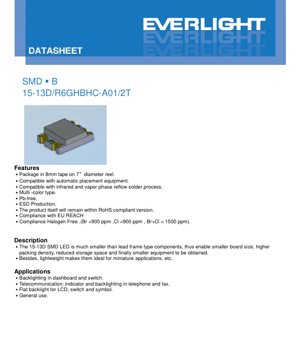
15-13D, küçültme ve yüksek güvenilirlik gerektiren modern elektronik uygulamalar için tasarlanmış kompakt, yüzeye montaj (SMD) bir LED'dir. Bu seri, farklı yarı iletken malzemelere dayalı üç farklı renk seçeneği sunar: Parlak Kırmızı (R6, AlGaInP), Parlak Yeşil (GH, InGaN) ve Mavi (BH, InGaN). Paket, 7 inç çapında bir makaraya sarılı 8mm şerit üzerinde tedarik edilir ve bu da onu yüksek hızlı otomatik al-yerleştir montaj ekipmanlarıyla tam uyumlu hale getirir.
Bu LED'in birincil avantajı, geleneksel kurşun çerçeve paketlerle karşılaştırıldığında önemli ölçüde azaltılmış kapladığı alandır. Bu, tasarımcıların baskılı devre kartlarında (PCB) daha yüksek bileşen paketleme yoğunluğuna ulaşmasını sağlayarak, genel kart boyutlarının küçülmesine ve sonuçta daha kompakt nihai ürünlere yol açar. Hafif yapısı, ağırlık ve alanın kritik kısıtlamalar olduğu taşınabilir ve minyatür uygulamalar için onu daha da ideal kılar.
The product is manufactured to be Pb-free (lead-free), compliant with the EU RoHS and REACH directives, and meets halogen-free requirements (Bromine <900 ppm, Chlorine <900 ppm, Br+Cl < 1500 ppm). It is also produced using ESD (Electrostatic Discharge) safe processes, enhancing its handling reliability.
2. Teknik Özelliklerin Derinlemesine İncelenmesi
2.1 Mutlak Maksimum Değerler
Bu değerler, cihaza kalıcı hasarın meydana gelebileceği sınırları tanımlar. Bu koşullar altında çalışma garanti edilmez.
- Ters Gerilim (VR): Tüm renk kodları için maksimum 5V. Bu değerin aşılması jonksiyon bozulmasına neden olabilir.
- İleri Akım (IF): R6 (Kırmızı) ve GH (Yeşil) için 25 mA; BH (Mavi) için 20 mA. Bu, maksimum sürekli DC akımdır.
- Tepe İleri Akım (IFP): Applicable under pulsed conditions (1/10 duty cycle @ 1kHz). R6: 60 mA; GH & BH: 100 mA.
- Güç Dağılımı (Pd): Paketin dağıtabileceği maksimum güç. R6: 60 mW; GH: 95 mW; BH: 75 mW. Bu, IF * VF olarak hesaplanır.
- Elektrostatik Deşarj (ESD) HBM: Tüm varyantlar 2000V İnsan Vücudu Modeli için derecelendirilmiştir, bu da standart kullanım için iyi doğal ESD dayanıklılığına işaret eder.
- Operating & Storage Temperature: Çalışma için -40°C ila +85°C; depolama için -40°C ila +90°C.
- Lehimleme Sıcaklığı: Reflow lehimleme tepe sıcaklığı: maksimum 10 saniye için 260°C. El lehimlemesi: her terminal için maksimum 3 saniye için 350°C.
2.2 Elektro-Optik Karakteristikler (Ta=25°C)
Bunlar, standart test koşullarında (IF=20mA, aksi belirtilmedikçe) ölçülen tipik performans parametreleridir.
- Işık Şiddeti (Iv): Işık çıkışı milikandela (mcd) cinsinden. R6: 90-140 mcd; GH: 112-180 mcd; BH: 45-70 mcd. ±%11 tolerans uygulanır.
- Görüş Açısı (2θ1/2): Yaklaşık 120 derece, yayılan ışığın geniş bir açı sağlar.
- Tepe Dalga Boyu (λp): Yayılım yoğunluğunun en yüksek olduğu dalga boyu. R6: 632 nm (Kırmızı); GH: 518 nm (Yeşil); BH: 468 nm (Mavi).
- Baskın Dalga Boyu (λd): İnsan gözü tarafından algılanan tek dalga boyu. R6: 624 nm; GH: 525 nm; BH: 470 nm.
- Spektral Bant Genişliği (Δλ): Emisyon spektrumunun maksimum yoğunluğun yarısındaki genişliği. R6: 20 nm; GH: 35 nm; BH: 25 nm.
- İleri Yönlü Gerilim (VF): The voltage drop across the LED at the test current. R6: 1.70-2.40V (Typ. 2.00V); GH & BH: 2.70-3.70V (Typ. 3.30V). Tolerance is ±0.05V.
- Ters Yönlü Akım (IR): Leakage current at VR=5V. R6: Max 10 μA; GH & BH: Not Applicable (NA).
3. Binning Sistemi Açıklaması
Veri sayfası, ürünün LED'leri temel parametrelere göre sınıflandırmak ve bir parti içinde tutarlılık sağlamak için bir binning sistemi kullandığını belirtir. Ambalaj üzerindeki etiket açıklaması belirli derecelerden bahseder:
- CAT (Işık Şiddeti Sınıfı): LED'leri ölçülen ışık şiddeti çıkışlarına göre gruplandırır.
- HUE (Chromaticity Coordinates & Baskın Dalga Boyu Rank): LED'leri, bir dizideki renk varyasyonunu en aza indirmek için renk noktalarına veya baskın dalga boylarına göre sıralar.
- REF (İleri Yönlü Gerilim Sınıfı): LED'leri, seri veya paralel devrelerde akım eşleştirmesi için önemli olan ileri yönlü gerilim düşüşlerine göre sınıflandırır.
Tasarımcılar, uygulama için renk veya yoğunluk eşleştirmesi kritik olduğunda detaylı seçim için üreticinin özel sınıflandırma çizelgelerine başvurmalıdır.
4. Performans Eğrisi Analizi
Veri sayfası, her LED tipi (R6, GH, BH) için tipik karakteristik eğriler sağlar. Bu grafikler, cihazın standart olmayan koşullar altındaki davranışını anlamak için gereklidir.
4.1 İleri Akım vs. İleri Voltaj (I-V Eğrisi)
Bu eğri, akım ve voltaj arasındaki üstel ilişkiyi gösterir. "Diz" voltajı, LED'in önemli ölçüde ışık yaymaya başladığı noktadır. Sağlanan tipik VF değerleri 20mA'de ölçülmüştür. Tasarımcılar bu eğriyi uygun akım sınırlayıcı dirençleri seçmek için kullanır.
4.2 Işık Şiddeti vs. İleri Akım
Bu grafik, ışık çıkışının genellikle ileri akımla orantılı olduğunu, ancak çok yüksek akımlarda termal ve verimlilik etkileri nedeniyle doğrusal altı hale gelebileceğini gösterir. İstenen bir parlaklığa ulaşmak için gereken sürücü akımını belirlemek için çok önemlidir.
4.3 Işık Şiddeti vs. Ortam Sıcaklığı
LED'lerde bağlantı sıcaklığı arttıkça ışık çıkışı azalır. Bu azaltma eğrisi, yüksek sıcaklık ortamlarında çalışan uygulamalar için hayati önem taşır. Ortam sıcaklığı yükseldikçe kalan bağıl ışık şiddeti yüzdesini gösterir.
4.4 İleri Akım Azaltma Eğrisi
Aşırı ısınmayı önlemek için, ortam sıcaklığı arttıkça izin verilen maksimum sürekli ileri akımın düşürülmesi gerekir. Bu eğri, cihazın sıcaklık aralığı boyunca güvenli çalışma alanını (SOA) sağlar.
4.5 Spektral Dağılım
Bu grafik, dalga boyu spektrumu boyunca yayılan ışığın bağıl şiddetini gösterir. Tepe ve baskın dalga boylarını doğrular ve yayılan rengin spektral saflığını (darlığını) gösterir.
4.6 Işıma Diyagramı (Görüş Açısı Deseni)
Işık şiddetinin uzaysal dağılımını gösteren bir kutupsal grafik. 15-13D tipik bir lambertiyen veya geniş açılı desene sahiptir; merkez eksenden açı arttıkça şiddet azalır ve yaklaşık ±60 derecede (toplam 120 derece görüş açısı) yarı şiddete ulaşır.
5. Mechanical & Package Information
5.1 Paket Boyutları
15-13D paketinin nominal boyutları 1.5mm (uzunluk) x 1.3mm (genişlik) x 0.8mm (yükseklik) şeklindedir. Aksi belirtilmedikçe toleranslar tipik olarak ±0.1mm'dir. Bileşen, polarite tanımlaması için paketin üstünde bir anot işareti (tipik olarak bir çentik, yeşil nokta veya başka bir gösterge) bulundurur. Önerilen bir PCB land pattern (pad düzeni) sağlanmıştır, ancak tasarımcıların kendi spesifik PCB üretim süreçlerine ve termal/mekanik gereksinimlerine göre bunu değiştirmeleri önerilir.
5.2 Polarite Tanımlama
Doğru polarite LED çalışması için esastır. Paket, anot (+) terminalini belirten görsel bir işaretleyici içerir. PCB tasarımı ve montajı sırasında, doğru yönlendirmeyi sağlamak için bu işaretleyici, board düzenindeki karşılık gelen anot pad'i ile hizalanmalıdır.
6. Soldering & Assembly Guidelines
6.1 Nem Hassasiyeti ve Depolama
LED'ler, reflow lehimleme sırasında "popcorning" (paket çatlaması) gibi hasarlara yol açabilecek nem emilimini önlemek için nem geçirmez bariyer torbalarda ve nem alıcı (desiccant) ile paketlenmiştir.
- Kullanıma hazır olana kadar torbayı açmayın.
- Açıldıktan sonra kullanılmayan parçalar ≤30°C ve ≤%60 RH koşullarında saklanmalıdır.
- Torba açıldıktan sonraki "kullanım ömrü" 168 saattir (7 gün).
- Aşılırsa veya nem alıcı göstergenin rengi değiştiyse, lehimlemeden önce 60±5°C'de 24 saat boyunca ısıl işlem (bake-out) gereklidir.
6.2 Kurşunsuz Reflow Lehimleme Profili
Kurşunsuz lehim (örneğin, SAC305) için önerilen bir sıcaklık profili sağlanmıştır:
- Ön Isıtma: 150-200°C, 60-120 saniye.
- Sıvı Faz Üzerinde Geçen Süre (TAL): >217°C for 60-150 seconds.
- Tepe Sıcaklığı: Maksimum 260°C, 10 saniyeden fazla tutulmamalı.
- Isınma Hızı: 255°C'ye kadar maksimum 3°C/sn, ardından tepe noktasına kadar maksimum 6°C/sn.
- Soğuma Hızı: Termal şoku önlemek için kontrollü.
Kritik Not: Aynı LED montajı üzerinde reflow lehimleme işlemi ikiden fazla yapılmamalıdır.
6.3 El Lehimleme Önlemleri
Manuel lehimleme gerekliyse, son derece dikkatli olunmalıdır:
- Use a soldering iron with a tip temperature <350°C.
- Her terminal için temas süresini ≤3 saniye ile sınırlayın.
- Güç derecesi ≤25W olan bir havya kullanın.
- Isı birikimini önlemek için her terminali lehimledikten sonra en az 2 saniyelik bir aralık bırakın.
- Lehimleme sırasında LED gövdesine mekanik stres uygulamaktan kaçının.
6.4 Yeniden İşleme ve Onarım
İlk lehimleme sonrası onarım şiddetle tavsiye edilmez. Kaçınılmazsa, LED çipine ve tel bağlantılarına olan termal stresi en aza indirmek için her iki terminali aynı anda ısıtmak üzere özel bir çift uçlu lehim havya kullanılmalıdır. LED özelliklerine zarar verme potansiyeli önceden değerlendirilmelidir.
7. Packaging & Ordering Information
7.1 Şerit ve Makara Özellikleri
Bileşenler, 15-13D paketi için özel olarak boyutlandırılmış kabartmalı taşıyıcı şerit içinde tedarik edilir. Şerit, standart 7 inç (178mm) çapında bir makaraya sarılır. Her makarada 2000 adet bulunur. Detaylı makara, taşıyıcı şerit ve yuva boyutları veri sayfasında, standart ±0.1mm toleransları ile sağlanmıştır.
7.2 Etiket ve Nem Bariyeri Torbası
Dış nem geçirmez torba, şu kritik bilgileri içeren bir etiket taşır: Müşteri Parça Numarası (CPN), Üretici Parça Numarası (P/N), Miktar (QTY) ve Işık Şiddeti (CAT), Renklilik (HUE) ve İleri Voltaj (REF) için sınıflandırma kodları. İzlenebilirlik için bir Parti Numarası (LOT No.) bulunur.
8. Uygulama Önerileri
8.1 Tipik Uygulama Senaryoları
- Arka Aydınlatma: Gösterge paneli göstergeleri, anahtar aydınlatması, tuş takımı arka aydınlatmaları.
- Telekomünikasyon Ekipmanları: Telefonlarda, faks makinelerinde, yönlendiricilerde ve modemlerde durum göstergeleri.
- LCD Düz Arka Aydınlatma: Küçük tek renkli veya renkli LCD ekranlar için kenar aydınlatması.
- Genel Gösterge Kullanımı: Tüketici elektroniği, ev aletleri ve endüstriyel kontrollerde güç durumu, mod göstergesi, uyarı sinyalleri.
8.2 Kritik Tasarım Hususları
- Akım Sınırlama: İleri yön akımını sınırlamak için harici bir seri direnç KESİNLİKLE GEREKLİDİR. LED'in üstel I-V karakteristiği, küçük bir voltaj artışının büyük, yıkıcı bir akım dalgalanmasına neden olabileceği anlamına gelir. Direnç değeri R = (Vbesleme - VF) / IF formülü ile hesaplanır.
- Termal Yönetim: Paket küçük olsa da, özellikle yüksek ortam sıcaklıklarında veya sürüş akımlarında güç dağılımı (Pd) dikkate alınmalıdır. Maksimum derecelendirmelere yakın çalışılıyorsa yeterli PCB bakır alanı veya termal geçişler sağlayın.
- ESD Koruması: 2000V HBM için derecelendirilmiş olsa da, hassas giriş hatlarında ESD koruması uygulamak veya üretimde ESD'ye karşı güvenli taşıma prosedürleri kullanmak iyi bir uygulama olarak kabul edilir.
- Dalga Lehimleme: Veri sayfası yalnızca reflow ve el lehimlemesini belirtir. Aşırı termal maruziyet nedeniyle bu tür bir SMD LED için dalga lehimleme genellikle önerilmez.
- Kart Eğilmesi: LED'ler lehimlendikten sonra PCB'yi bükmekten veya esnetmekten kaçının, çünkü bu lehim bağlantılarını ve LED paketini zorlayabilir.
9. Technical Comparison & Differentiation
15-13D serisi, özellikle yeşil ve kırmızı varyantlarda, çok küçük 1.5x1.3mm kapladığı alan ile boyutuna kıyasla nispeten yüksek ışık şiddetini birleştirerek kendini farklılaştırır. Geniş 120 derecelik görüş açısı, geniş görünürlük gerektiren uygulamalar için uygundur. Standart SMD montajı ve kurşunsuz reflow prosesleri ile uyumluluğu, modern, çevre düzenlemelerine uygun üretimle uyumlu hale getirir. Daha büyük SMD LED'lerle (örn., 0603, 0805) karşılaştırıldığında, yer tasarrufu sağlar ancak daha hassas yerleştirme ekipmanı gerektirebilir. Chip-scale paketlerle karşılaştırıldığında, daha sağlam, kapsüllenmiş ve güvenilir şekilde lehimlenmesi ve işlenmesi daha kolay bir yapı sunar.
10. Sıkça Sorulan Sorular (SSS)
10.1 Yeşil LED için 5V besleme ile hangi direnç değerini kullanmalıyım?
Tipik değerler kullanılarak: Vbesleme = 5V, VF (GH, tipik) = 3.3V, IF = 20mA. R = (5V - 3.3V) / 0.020A = 85 Ohm. En yakın standart değer 82 veya 91 Ohm olacaktır. Akımın tüm koşullarda limitler içinde kalmasını sağlamak için daima veri sayfasındaki min/maks VF değerleri kullanılarak yeniden hesaplama yapın.
10.2 Bu LED'i sabit voltaj kaynağı kullanarak akım sınırlayıcı direnç olmadan sürebilir miyim?
Hayır. Bu, neredeyse kesinlikle LED'i tahrip edecektir. LED'ler akım kontrollü cihazlardır. Sabit bir voltaj kaynağı, LED'in oldukça doğrusal olmayan bağlantısından geçen akımı düzenleyemez. Seri bir direnç veya daha iyi performans için sabit akımlı bir sürücü devresi gereklidir.
10.3 Mavi (BH) LED için maksimum ileri akım neden farklı?
Daha düşük maksimum sürekli akım (Kırmızı/Yeşil için 25mA'ye karşılık 20mA), büyük olasılıkla iç yarı iletken yapısındaki (Mavi/Yeşil için InGaN, Kırmızı için AlGaInP) farklılıklardan ve bununla ilişkili termal özelliklerden ve yüksek akım yoğunluklarındaki verimlilikten kaynaklanmaktadır; bu da mavi varyant için daha düşük bir güç dağılımı (Pd) derecesine yol açar.
10.4 ±%11 ışık şiddeti toleransını nasıl yorumlamalıyım?
Bu, bir üretim partisinden alınan herhangi bir bireysel LED'in ölçülen gerçek ışık şiddetinin, veri sayfasında belirtilen tipik veya nominal değerden ±%11 oranında değişebileceği anlamına gelir. Örneğin, tipik Iv değeri 180 mcd olan yeşil bir LED, yaklaşık 160 mcd ile 200 mcd arasında herhangi bir değerde ölçülebilir. Düzgün parlaklık gerektiren uygulamalar için, dar bir seçim grubundan (CAT kodu) LED'lerin seçilmesi gereklidir.
10.5 Bu LED otomotiv iç aydınlatması için uygun mudur?
Bazı kritik olmayan otomotiv iç mekan uygulamalarında (anahtar arka aydınlatması gibi) kullanılabilse de, veri sayfası, "askeri/havacılık, otomotiv güvenlik/güvenlik sistemleri ve tıbbi ekipman gibi yüksek güvenilirlik gerektiren uygulamalarda" kullanılmamasını tavsiye eden özel bir uygulama kısıtlama notu içerir. Herhangi bir otomotiv uygulaması için, özellikle güvenlikle ilgili olanlar için, özellikle otomotiv sınıfı standartlarına (örn. AEC-Q102) uygun olarak nitelendirilmiş bir bileşen kullanılmalıdır.
11. Tasarım ve Kullanım Durum Çalışması
Senaryo: Bir tüketici yönlendiricisi için çok durumlu gösterge paneli tasarımı.
Bir tasarımcı, Güç (Yeşil), İnternet Etkinliği (Yanıp Sönen Yeşil) ve Ethernet Bağlantısı (Kehribar/Kırmızı) durumlarını göstermek istemektedir. Alan sınırlıdır. Güç için bir adet 15-13D/GH (Yeşil), İnternet için bir adet (MCU tarafından yanıp söndürülecek) ve Ethernet göstergesi için bir adet 15-13D/R6 (Kırmızı) seçerler (kehribar rengi, kırmızı bir LED'i daha düşük akımla sürerek veya bir difüzör kullanarak yaklaşık olarak elde edilebilir).
Uygulama: MCU GPIO pinleri 3.3V'dur. Yeşil LED'ler (VF tipik 3.3V) için, gerilim düşümü beslemeye neredeyse eşittir ve direnç için çok az marj bırakır. Tasarımcı, güvenilir bir açılmayı sağlarken yeterli parlaklığa ulaşmak için daha düşük bir akım (örneğin, 10mA) kullanabilir ve R = (3.3V - 3.3V)/0.01A = 0 Ohm hesaplaması yapar. Bu sorunludur. Bunun yerine, katodu LED'e bağlı, anodu uygun bir direnç üzerinden daha yüksek bir gerilim hattına (örneğin, 5V) bağlanmış ve akım havuzu modunda yapılandırılmış bir GPIO pini veya bir transistör kullanırlar. Bu durum, sürücü devre geriliminin LED'in VF değeriyle eşleştirilmesinin önemini vurgular.
12. Çalışma Prensibi
Işık Yayan Diyotlar (LED'ler), elektrolüminesans adı verilen bir süreçle ışık yayan yarı iletken p-n eklem cihazlarıdır. İleri yönde bir gerilim uygulandığında, n-tipi bölgeden elektronlar ve p-tipi bölgeden oyuklar eklem boyunca enjekte edilir. Bu yük taşıyıcıları, eklemin yakınındaki aktif bölgede yeniden birleşir. Verimli LED'ler için bu yeniden birleşme, doğrudan bant aralıklı bir yarı iletken malzemede gerçekleşir. Yeniden birleşme sırasında açığa çıkan enerji, bir foton (ışık parçacığı) olarak yayılır. Yayılan ışığın dalga boyu (rengi), yarı iletken malzemenin bant aralığı enerjisi (Eg) tarafından belirlenir: E = hc/λ, burada h Planck sabiti, c ışık hızı ve λ dalga boyudur. 15-13D, kırmızı ışık için AlGaInP (daha düşük enerji/daha uzun dalga boyu için daha büyük bant aralığı) ve yeşil ve mavi ışık için InGaN (daha yüksek enerji/daha kısa dalga boyu için daha küçük bant aralığı) kullanır. Epoksi reçine lens, ışık çıktısını şekillendirir ve çevresel koruma sağlar.
13. Teknoloji Trendleri
15-13D, olgun bir SMD LED teknolojisini temsil eder. Gösterge LED pazarındaki genel eğilimler şu yönlere doğru ilerlemeye devam etmektedir:
- Daha Fazla Miniaturizasyon: Işık çıkışını korurken veya iyileştirirken daha da küçük paketler (örn. 1.0x0.5mm, chip-scale).
- Daha Yüksek Verimlilik: Watt başına lümen (lm/W) veya miliamper başına milikandela (mcd/mA) değerlerinin iyileştirilmesi, belirli bir parlaklık için güç tüketimini azaltır.
- Geliştirilmiş Güvenilirlik ve Sağlamlık: Daha yüksek maksimum jonksiyon sıcaklıkları, geliştirilmiş nem direnci ve yüksek sıcaklık çalışma ömrü (HTOL) testleri altında daha iyi performans.
- Entegre Çözümler: Tek bir paket içinde dahili akım sınırlama dirençleri, koruma diyotları (ESD, ters polarite) veya hatta sürücü IC'leri bulunan LED'ler.
- Genişletilmiş Renk Gamı ve Tutarlılık: Renk ve yoğunluk için daha sıkı sınıflandırma, görsel düzgünlüğün kritik olduğu tam renkli ekranlar ve gösterge dizilerinin taleplerini karşılamak için.
Daha yeni paketler mevcut olsa da, 15-13D, boyut, performans ve maliyet dengesinin en uygun olduğu genel amaçlı gösterge uygulamaları için güvenilir ve yaygın olarak kullanılan bir iş gücü bileşeni olmaya devam etmektedir.
LED Spesifikasyon Terminolojisi
LED teknik terimlerinin tam açıklaması
Fotoelektrik Performans
| Terim | Birim/Temsil | Basit Açıklama | Neden Önemli |
|---|---|---|---|
| Işık Etkinliği | lm/W (lümen bölü watt) | Watt başına ışık çıktısı, daha yüksek değer daha enerji verimli olduğu anlamına gelir. | Enerji verimliliği sınıfını ve elektrik maliyetini doğrudan belirler. |
| Işık Akısı | lm (lümen) | Kaynağın yaydığı toplam ışık, genellikle "parlaklık" olarak adlandırılır. | Işığın yeterince parlak olup olmadığını belirler. |
| Görüş Açısı | ° (derece), örn., 120° | Işık şiddetinin yarıya düştüğü açı, ışın genişliğini belirler. | Aydınlatma menzilini ve düzgünlüğünü etkiler. |
| CCT (Renk Sıcaklığı) | K (Kelvin), örn., 2700K/6500K | Işığın sıcaklığı/soğukluğu, düşük değerler sarımsı/sıcak, yüksek değerler beyazımsı/soğuk. | Işık atmosferini ve uygun senaryoları belirler. |
| CRI / Ra | Birimsiz, 0–100 | Nesne renklerini doğru şekilde yansıtma yeteneği, Ra≥80 iyidir. | Renk gerçekliğini etkiler; alışveriş merkezleri, müzeler gibi yüksek talepli yerlerde kullanılır. |
| SDCM | MacAdam elips adımları, örn. "5-adım" | Renk tutarlılığı metriği, daha küçük adımlar daha tutarlı renk anlamına gelir. | Aynı parti LED'lerde tek tip renk sağlar. |
| Baskın Dalga Boyu | nm (nanometre), örn. 620nm (kırmızı) | Renkli LED'lerin rengine karşılık gelen dalga boyu. | Kırmızı, sarı, yeşil tek renkli LED'lerin renk tonunu belirler. |
| Spektral Dağılım | Dalga boyu - yoğunluk eğrisi | Dalga boyları arasındaki yoğunluk dağılımını gösterir. | Renk geriverimini ve kaliteyi etkiler. |
Elektriksel Parametreler
| Terim | Sembol | Basit Açıklama | Tasarım Hususları |
|---|---|---|---|
| İleri Yönlü Gerilim | Vf | LED'i açmak için gereken minimum gerilim, "başlangıç eşiği" gibi. | Sürücü gerilimi ≥Vf olmalıdır, seri bağlı LED'lerde gerilimler toplanır. |
| İleri Yön Akımı | If | Normal LED çalışması için akım değeri. | Usually constant current drive, current determines brightness & lifespan. |
| Maksimum Darbe Akımı | Ifp | Kısa süreler için tolere edilebilen tepe akımı, karartma veya flaş için kullanılır. | Pulse width & duty cycle must be strictly controlled to avoid damage. |
| Ters Gerilim | Vr | LED'in dayanabileceği maksimum ters gerilim, aşılması bozulmaya neden olabilir. | Devre, ters bağlantı veya gerilim ani yükselmelerini önlemelidir. |
| Termal Direnç | Rth (°C/W) | Çipten lehime ısı transferine karşı direnç, düşük olması daha iyidir. | Yüksek termal direnç, daha güçlü ısı dağılımı gerektirir. |
| ESD Bağışıklığı | V (HBM), örn., 1000V | Elektrostatik deşarja dayanma yeteneği, daha yüksek değer daha az hassas olduğu anlamına gelir. | Üretimde, özellikle hassas LED'ler için antistatik önlemler gereklidir. |
Thermal Management & Reliability
| Terim | Temel Metrik | Basit Açıklama | Etki |
|---|---|---|---|
| Junction Temperature | Tj (°C) | LED çipinin içindeki gerçek çalışma sıcaklığı. | Her 10°C düşüş ömrü iki katına çıkarabilir; çok yüksek sıcaklık ışık azalmasına ve renk kaymasına neden olur. |
| Lümen Kaybı | L70 / L80 (saat) | Parlaklığın başlangıç değerinin %70'ine veya %80'ine düşmesi için geçen süre. | LED "hizmet ömrü"nü doğrudan tanımlar. |
| Lümen Bakımı | % (örneğin, %70) | Belirli bir süre sonunda korunan parlaklık yüzdesi. | Uzun süreli kullanımda parlaklık korunumunu gösterir. |
| Renk Kayması | Δu′v′ veya MacAdam elipsi | Kullanım sırasındaki renk değişim derecesi. | Aydınlatma sahnelerindeki renk tutarlılığını etkiler. |
| Thermal Aging | Malzeme bozulması | Uzun süreli yüksek sıcaklık nedeniyle bozulma. | Parlaklık düşüşüne, renk değişimine veya açık devre arızasına neden olabilir. |
Packaging & Materials
| Terim | Yaygın Tipler | Basit Açıklama | Features & Applications |
|---|---|---|---|
| Paket Tipi | EMC, PPA, Seramik | Kılıf malzemesi, çipi korur ve optik/termal arayüz sağlar. | EMC: iyi ısı direnci, düşük maliyet; Seramik: daha iyi ısı dağılımı, daha uzun ömür. |
| Çip Yapısı | Ön, Flip Chip | Çip elektrot düzeni. | Flip chip: daha iyi ısı dağılımı, daha yüksek verim, yüksek güç için. |
| Fosfor Kaplama | YAG, Silikat, Nitrür | Mavi çipi kaplar, bir kısmını sarı/kırmızıya dönüştürür, beyaz ışık elde etmek için karıştırır. | Farklı fosforlar verimliliği, CCT'yi ve CRI'yı etkiler. |
| Lens/Optikler | Düz, Mikrolens, TIR | Yüzeyde ışık dağılımını kontrol eden optik yapı. | Görüş açısını ve ışık dağılım eğrisini belirler. |
Quality Control & Binning
| Terim | Sınıflandırma İçeriği | Basit Açıklama | Amaç |
|---|---|---|---|
| Işık Akısı Sınıfı | Kod örn., 2G, 2H | Parlaklığa göre gruplandırılmıştır, her grubun min/maks lümen değerleri vardır. | Aynı partide düzgün parlaklık sağlar. |
| Voltage Bin | Kod örn., 6W, 6X | İleri voltaj aralığına göre gruplandırılmıştır. | Sürücü eşleştirmeyi kolaylaştırır, sistem verimliliğini artırır. |
| Color Bin | 5-step MacAdam ellipse | Renk koordinatlarına göre gruplandırılmıştır, sıkı bir aralık sağlar. | Renk tutarlılığını garanti eder, armatür içinde renk düzensizliğini önler. |
| CCT Bin | 2700K, 3000K vb. | CCT'ye göre gruplandırılmıştır, her birinin karşılık gelen koordinat aralığı vardır. | Farklı sahne CCT gereksinimlerini karşılar. |
Testing & Certification
| Terim | Standard/Test | Basit Açıklama | Önem |
|---|---|---|---|
| LM-80 | Lümen bakım testi | Sabit sıcaklıkta uzun süreli aydınlatma, parlaklık azalmasını kaydetme. | LED ömrünü tahmin etmek için kullanılır (TM-21 ile birlikte). |
| TM-21 | Ömür tahmin standardı | LM-80 verilerine dayanarak gerçek koşullar altında ömrü tahmin eder. | Bilimsel ömür tahmini sağlar. |
| IESNA | Illuminating Engineering Society | Optik, elektriksel, termal test yöntemlerini kapsar. | Sektör tarafından tanınan test temeli. |
| RoHS / REACH | Çevresel sertifikasyon | Zararlı maddelerin (kurşun, cıva) bulunmadığını garanti eder. | Uluslararası piyasaya erişim gereksinimi. |
| ENERGY STAR / DLC | Enerji verimliliği sertifikasyonu | Aydınlatma için enerji verimliliği ve performans sertifikasyonu. | Kamu alımlarında, teşvik programlarında kullanılır, rekabet gücünü artırır. |