目录
- 1. 产品概述
- 2. 技术参数详解
- 2.1 绝对最大额定值
- 2.2 光电特性
- 3. 分档系统说明
- 3.1 发光强度分档
- 3.2 主波长分档
- 4. 性能曲线分析
- 4.1 正向电流与正向电压关系曲线
- 4.2 发光强度与正向电流关系
- 4.3 温度依赖性
- 5. 机械与封装信息
- 5.1 封装尺寸
- 5.2 极性识别
- 5.3 编带与卷盘包装
- 6. 焊接与组装指南
- 6.1 回流焊温度曲线
- 6.2 手工焊接
- 6.3 湿敏等级与存储
- 7. 应用建议
- 7.1 典型应用场景
- 7.2 设计注意事项
- 8. 技术对比与差异化
- 9. 常见问题解答
- 9.1 为什么必须使用限流电阻?
- 9.2 我可以用 5V 电源驱动这颗 LED 吗?
- 9.3 峰值波长和主波长有什么区别?
- 9.4 为什么拆封后存在严格的"车间寿命"限制?
- 10. 工作原理
- 11. 行业趋势与背景
1. 产品概述
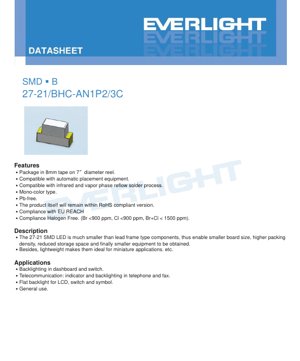
27-21 SMD LED 是一款紧凑型表面贴装器件,专为需要可靠指示灯或背光功能的现代电子应用而设计。其主要优势在于,相比传统的引线框架 LED,其占板面积显著减小,从而提高了印刷电路板上的元件密度,减少了存储需求,并最终有助于终端设备的小型化。其轻量化结构进一步增强了其在空间受限和便携式应用中的适用性。
这款单色蓝光 LED 采用 InGaN 半导体芯片制造,并封装在透明树脂中。它是一款无铅产品,符合 RoHS 指令、欧盟 REACH 法规以及无卤标准,确保了环境安全性和广泛的市场接受度。
2. 技术参数详解
2.1 绝对最大额定值
这些额定值定义了可能导致器件永久性损坏的极限。不保证在此条件下运行。
- 反向电压R:5V。在反向偏置下超过此电压可能导致结击穿。
- 连续正向电流F:25 mA。可靠运行的最大直流电流。
- 峰值正向电流FP:100 mA。此电流仅在脉冲条件下允许,以应对瞬态浪涌。
- 功耗d:95 mW。在环境温度为 25°C 时,封装可承受的最大功率。在更高温度下需要降额使用。a静电放电:
- 150V。在组装和操作过程中必须遵循正确的 ESD 处理程序。工作温度
- :-40°C 至 +85°C。器件正常工作的环境温度范围。存储温度:
- -40°C 至 +90°C。焊接温度:器件可承受峰值温度为 260°C、最长 10 秒的回流焊,或每个引脚在 350°C 下最长 3 秒的手工焊接。2.2 光电特性
- 这些参数在环境温度 25°C、正向电流 20mA 的典型工作条件下测得。发光强度
:
范围从 28.5 mcd 到 72.0 mcd,典型容差为 ±11%。这定义了 LED 的感知亮度。a视角F:
- 130 度。这个宽视角确保了从离轴位置也能获得良好的可见性。v峰值波长:
- 468 nm。光谱发射最强的波长。主波长:范围从 464.50 nm 到 476.50 nm。这定义了光的感知颜色,具有严格的 ±1 nm 容差。
- 光谱带宽p:25 nm。在半最大强度处的发射光谱宽度。
- 正向电压d:范围从 2.70V 到 3.70V,在 20mA 电流下典型值为 3.30V。这对于设计限流电路至关重要。
- 反向电流:
- 在反向电压 5V 下最大为 50 µA。此参数仅用于测试目的;器件不应在反向偏置下工作。F3. 分档系统说明为确保生产中的颜色和亮度一致性,LED 根据关键参数被分选到不同的档位中。
- 3.1 发光强度分档RLED 根据其在 20mA 电流下测得的发光强度被分为四个档位。这允许设计人员为其应用选择合适的亮度等级,确保在多 LED 阵列中外观均匀。档位 N1:R28.5 – 36.0 mcd
档位 N2:
36.0 – 45.0 mcd
档位 P1:
45.0 – 57.0 mcdF档位 P2:
- 57.0 – 72.0 mcd3.2 主波长分档
- LED 也根据主波长分为四个代码。这种严格的控制对于需要精确颜色匹配的应用至关重要。档位 A9:
- 464.5 – 467.5 nm档位 A10:
- 467.5 – 470.5 nm档位 A11:
470.5 – 473.5 nm
档位 A12:
- 473.5 – 476.5 nm4. 性能曲线分析
- 虽然规格书中引用了具体的图表,但其含义对设计至关重要。4.1 正向电流与正向电压关系曲线
- I-V 特性是指数型的。正向电压略微超过典型的 3.3V,就可能导致正向电流大幅、不受控制地增加,从而迅速超过 25mA 的绝对最大额定值并导致立即失效。限流电阻用于设定一个稳定的工作点。4.2 发光强度与正向电流关系
- 在额定范围内,发光强度大致与正向电流成正比。低于 20mA 工作会降低输出,而超过 25mA 则存在加速老化和缩短寿命的风险。4.3 温度依赖性
LED 性能对温度敏感。随着结温升高,正向电压通常会略微下降,而发光强度可能显著降低。PCB 上充分的散热管理对于保持亮度一致性非常重要。
5. 机械与封装信息
5.1 封装尺寸
27-21 封装的标称尺寸为 2.7mm x 2.1mm x 1.2mm。详细的尺寸图提供了 PCB 焊盘设计的关键尺寸。
5.2 极性识别
阴极通常由 LED 封装上的视觉标记指示。在贴装时必须观察正确的极性以确保正常工作。
5.3 编带与卷盘包装
器件以 8mm 载带形式供应在 7 英寸直径的卷盘上。每个卷盘包含 3000 片。包装包括防潮材料以保护 LED。
6. 焊接与组装指南
6.1 回流焊温度曲线
指定了无铅回流焊曲线。关键参数包括:预热阶段、液相线以上时间、峰值温度以及受控的升温和冷却速率。回流焊不应超过两次。
6.2 手工焊接
如需手工焊接,需要格外小心。使用烙铁头温度低于 350°C 的烙铁,每个引脚加热时间不超过 3 秒。
6.3 湿敏等级与存储
LED 对湿气敏感。密封的防潮袋应在使用前才打开。拆封后,未使用的 LED 必须在特定环境下存储。拆封后的"车间寿命"为 168 小时。
7. 应用建议
7.1 典型应用场景
背光:
适用于仪表盘指示灯、开关照明和符号背光。
通信设备:
用作电话、传真机等设备中的状态指示灯或键盘背光。
LCD 平面背光:
可用于小型低功耗 LCD 显示器的阵列中。
通用指示灯:
- 适用于消费类和工业电子产品中的电源状态、模式指示等信号功能。7.2 设计注意事项
- 电流限制:始终使用串联电阻。计算公式为:R = (电源电压 - LED正向电压) / 目标正向电流。
- 热管理:确保 PCB 有足够的铜面积连接到 LED 焊盘以充当散热器。
- ESD 保护:如果 LED 是用户可接触的,应在敏感输入线上实施 ESD 保护措施。
8. 技术对比与差异化
- 27-21 SMD LED 在其类别中具有多项关键优势。其 2.7x2.1mm 的占板面积小于许多传统的 3mm 或 5mm 直插式 LED。130° 的宽视角提供了更好的离轴可见性。采用 InGaN 技术可产生明亮、饱和的蓝色光。此外,其符合 RoHS、REACH 和无卤标准,使其成为符合严格环保法规的全球市场的未来之选。9. 常见问题解答CC9.1 为什么必须使用限流电阻?FLED 的 I-V 特性是非线性的。没有电阻,电源电压的微小增加会导致电流大幅、不受控制地激增,迅速超过 25mA 的绝对最大额定值并导致立即失效。电阻设定了稳定的工作点。F9.2 我可以用 5V 电源驱动这颗 LED 吗?CC可以,但必须使用串联电阻。例如,使用 5V 电源、典型正向电压 3.3V、目标电流 20mA,电阻值约为 85 欧姆。F9.3 峰值波长和主波长有什么区别?F峰值波长是光谱输出最高的物理波长。主波长是一个计算值,对应于人眼感知的颜色。对于这种单色蓝光 LED,两者通常接近,但主波长对于颜色规格更为相关。F9.4 为什么拆封后存在严格的"车间寿命"限制?
- SMD LED 的塑料封装会从大气中吸收湿气。在高温回流焊过程中,这些被困的湿气会迅速膨胀,导致内部分层或"爆米花"效应,从而破坏器件。车间寿命和烘烤程序用于管理此湿气含量。10. 工作原理
- LED 是一种半导体光子器件。当施加超过其结电势的正向电压时,电子和空穴被注入 InGaN 芯片的有源区。这些载流子复合,以光子的形式释放能量。InGaN 合金的特定成分决定了带隙能量,从而直接决定了发射光的波长。透明树脂封装保护芯片并充当透镜,将发射光塑造成指定的 130 度视角。11. 行业趋势与背景
27-21 封装代表了 SMD LED 市场中成熟且广泛采用的形态,平衡了尺寸、性能和可制造性。行业继续朝着更小的封装和更高功率的封装发展。影响此类组件的关键趋势包括:对高色准和一致分档的需求增加;集成片上 IC 的智能 LED;以及对提高发光效率和可靠性的持续关注。此外,环境合规性已成为全球供应链中大多数电子元件的基本要求。
The 27-21 SMD LED offers several key advantages in its class. Its 2.7x2.1mm footprint is smaller than many traditional 3mm or 5mm through-hole LEDs, saving significant board space. The wide 130° viewing angle provides better off-axis visibility compared to narrower-angle LEDs. The use of InGaN technology yields a bright, saturated blue color with high efficiency. Furthermore, its compliance with RoHS, REACH, and halogen-free standards makes it a future-proof choice for global markets with stringent environmental regulations. The detailed binning system provides designers with the predictability needed for high-volume production requiring visual consistency.
. Frequently Asked Questions (Based on Technical Parameters)
.1 Why is a current-limiting resistor mandatory?
The LED's I-V characteristic is non-linear. Without a resistor, a small increase in supply voltage causes a large, uncontrolled surge in current, rapidly exceeding the Absolute Maximum Rating of 25mA and leading to immediate failure. The resistor sets a stable operating point.
.2 Can I drive this LED with a 5V supply?
Yes, but you must use a series resistor. For example, with a 5V supply (VCC=5V), a typical VFof 3.3V, and a target IFof 20mA, the resistor value would be R = (5V - 3.3V) / 0.020A = 85 Ohms. A standard 82 or 100 Ohm resistor would be appropriate, with power rating P = I2R = (0.02)2* 85 = 0.034W, so a 1/8W or 1/10W resistor is sufficient.
.3 What is the difference between Peak and Dominant Wavelength?
Peak Wavelength (λp) is the physical wavelength where the spectral output is highest. Dominant Wavelength (λd) is a calculated value that corresponds to the perceived color by the human eye, factoring in the entire emission spectrum and the eye's sensitivity. For monochromatic LEDs like this blue one, they are often close, but λdis more relevant for color specification.
.4 Why is there a strict "floor life" after opening the bag?
SMD LEDs can absorb moisture from the atmosphere through their plastic packaging. During the high-temperature reflow soldering process, this trapped moisture can rapidly expand, causing internal delamination or "popcorning," which cracks the package and destroys the device. The floor life and baking procedures manage this moisture content.
. Operational Principles
This LED is a semiconductor photonic device. When a forward voltage exceeding its junction potential (approximately 3.3V) is applied, electrons and holes are injected into the active region of the InGaN chip. These charge carriers recombine, releasing energy in the form of photons (light). The specific composition of the InGaN alloy determines the bandgap energy, which directly dictates the wavelength (color) of the emitted light—in this case, blue at around 468 nm. The water-clear resin encapsulation protects the chip and acts as a lens, shaping the emitted light into the specified 130-degree viewing angle.
. Industry Trends & Context
The 27-21 package represents a mature and widely adopted form factor in the SMD LED market, balancing size, performance, and manufacturability. The industry continues to drive towards even smaller packages (e.g., 2016, 1608) for ultra-miniaturization, and higher-power packages for illumination. Key trends influencing components like this include: increased demand for high-color-accuracy and consistent binning for display applications; the integration of onboard ICs for smart LEDs; and a relentless focus on improving luminous efficacy (lumens per watt) and reliability. Furthermore, environmental compliance (RoHS, halogen-free) has transitioned from a differentiator to a baseline requirement for most electronic components in global supply chains.
LED规格术语详解
LED技术术语完整解释
一、光电性能核心指标
| 术语 | 单位/表示 | 通俗解释 | 为什么重要 |
|---|---|---|---|
| 光效(Luminous Efficacy) | lm/W(流明/瓦) | 每瓦电能发出的光通量,越高越节能。 | 直接决定灯具的能效等级与电费成本。 |
| 光通量(Luminous Flux) | lm(流明) | 光源发出的总光量,俗称"亮度"。 | 决定灯具够不够亮。 |
| 发光角度(Viewing Angle) | °(度),如120° | 光强降至一半时的角度,决定光束宽窄。 | 影响光照范围与均匀度。 |
| 色温(CCT) | K(开尔文),如2700K/6500K | 光的颜色冷暖,低值偏黄/暖,高值偏白/冷。 | 决定照明氛围与适用场景。 |
| 显色指数(CRI / Ra) | 无单位,0–100 | 光源还原物体真实颜色的能力,Ra≥80为佳。 | 影响色彩真实性,用于商场、美术馆等高要求场所。 |
| 色容差(SDCM) | 麦克亚当椭圆步数,如"5-step" | 颜色一致性的量化指标,步数越小颜色越一致。 | 保证同一批灯具颜色无差异。 |
| 主波长(Dominant Wavelength) | nm(纳米),如620nm(红) | 彩色LED颜色对应的波长值。 | 决定红、黄、绿等单色LED的色相。 |
| 光谱分布(Spectral Distribution) | 波长 vs. 强度曲线 | 显示LED发出的光在各波长的强度分布。 | 影响显色性与颜色品质。 |
二、电气参数
| 术语 | 符号 | 通俗解释 | 设计注意事项 |
|---|---|---|---|
| 正向电压(Forward Voltage) | Vf | LED点亮所需的最小电压,类似"启动门槛"。 | 驱动电源电压需≥Vf,多个LED串联时电压累加。 |
| 正向电流(Forward Current) | If | 使LED正常发光的电流值。 | 常采用恒流驱动,电流决定亮度与寿命。 |
| 最大脉冲电流(Pulse Current) | Ifp | 短时间内可承受的峰值电流,用于调光或闪光。 | 脉冲宽度与占空比需严格控制,否则过热损坏。 |
| 反向电压(Reverse Voltage) | Vr | LED能承受的最大反向电压,超过则可能击穿。 | 电路中需防止反接或电压冲击。 |
| 热阻(Thermal Resistance) | Rth(°C/W) | 热量从芯片传到焊点的阻力,值越低散热越好。 | 高热阻需更强散热设计,否则结温升高。 |
| 静电放电耐受(ESD Immunity) | V(HBM),如1000V | 抗静电打击能力,值越高越不易被静电损坏。 | 生产中需做好防静电措施,尤其高灵敏度LED。 |
三、热管理与可靠性
| 术语 | 关键指标 | 通俗解释 | 影响 |
|---|---|---|---|
| 结温(Junction Temperature) | Tj(°C) | LED芯片内部的实际工作温度。 | 每降低10°C,寿命可能延长一倍;过高导致光衰、色漂移。 |
| 光衰(Lumen Depreciation) | L70 / L80(小时) | 亮度降至初始值70%或80%所需时间。 | 直接定义LED的"使用寿命"。 |
| 流明维持率(Lumen Maintenance) | %(如70%) | 使用一段时间后剩余亮度的百分比。 | 表征长期使用后的亮度保持能力。 |
| 色漂移(Color Shift) | Δu′v′ 或 麦克亚当椭圆 | 使用过程中颜色的变化程度。 | 影响照明场景的颜色一致性。 |
| 热老化(Thermal Aging) | 材料性能下降 | 因长期高温导致的封装材料劣化。 | 可能导致亮度下降、颜色变化或开路失效。 |
四、封装与材料
| 术语 | 常见类型 | 通俗解释 | 特点与应用 |
|---|---|---|---|
| 封装类型 | EMC、PPA、陶瓷 | 保护芯片并提供光学、热学接口的外壳材料。 | EMC耐热好、成本低;陶瓷散热优、寿命长。 |
| 芯片结构 | 正装、倒装(Flip Chip) | 芯片电极布置方式。 | 倒装散热更好、光效更高,适用于高功率。 |
| 荧光粉涂层 | YAG、硅酸盐、氮化物 | 覆盖在蓝光芯片上,部分转化为黄/红光,混合成白光。 | 不同荧光粉影响光效、色温与显色性。 |
| 透镜/光学设计 | 平面、微透镜、全反射 | 封装表面的光学结构,控制光线分布。 | 决定发光角度与配光曲线。 |
五、质量控制与分档
| 术语 | 分档内容 | 通俗解释 | 目的 |
|---|---|---|---|
| 光通量分档 | 代码如 2G、2H | 按亮度高低分组,每组有最小/最大流明值。 | 确保同一批产品亮度一致。 |
| 电压分档 | 代码如 6W、6X | 按正向电压范围分组。 | 便于驱动电源匹配,提高系统效率。 |
| 色区分档 | 5-step MacAdam椭圆 | 按颜色坐标分组,确保颜色落在极小范围内。 | 保证颜色一致性,避免同一灯具内颜色不均。 |
| 色温分档 | 2700K、3000K等 | 按色温分组,每组有对应的坐标范围。 | 满足不同场景的色温需求。 |
六、测试与认证
| 术语 | 标准/测试 | 通俗解释 | 意义 |
|---|---|---|---|
| LM-80 | 流明维持测试 | 在恒温条件下长期点亮,记录亮度衰减数据。 | 用于推算LED寿命(结合TM-21)。 |
| TM-21 | 寿命推演标准 | 基于LM-80数据推算实际使用条件下的寿命。 | 提供科学的寿命预测。 |
| IESNA标准 | 照明工程学会标准 | 涵盖光学、电气、热学测试方法。 | 行业公认的测试依据。 |
| RoHS / REACH | 环保认证 | 确保产品不含有害物质(如铅、汞)。 | 进入国际市场的准入条件。 |
| ENERGY STAR / DLC | 能效认证 | 针对照明产品的能效与性能认证。 | 常用于政府采购、补贴项目,提升市场竞争力。 |