目錄
- 待翻譯文本序號811. 產品概述
- 待翻譯文本序號802. 深入技術參數分析
- 待翻譯文本序號792.1 電光特性
- 待翻譯文本序號782.2 電氣與熱參數
- 待翻譯文本序號773. 分級系統解說
- 待翻譯文本序號763.1 色溫 (CCT) 分級
- 待翻譯文本序號753.2 光通量分級
- 待翻譯文本序號743.3 正向電壓分級
- 待翻譯文本序號734. 性能曲線分析
- 待翻譯文本序號724.1 IV 與光通量特性
- 待翻譯文本序號714.2 溫度依賴性
- 待翻譯文本序號704.3 光譜與視角分佈
- 待翻譯文本序號695. 組裝與處理指引
- 待翻譯文本序號685.1 回流焊接
- 待翻譯文本序號675.2 儲存與處理
- 待翻譯文本序號666. 應用備註與設計考慮
- 待翻譯文本序號656.1 熱管理
- 待翻譯文本序號646.2 電氣驅動
- 待翻譯文本序號636.3 光學整合
- 待翻譯文本序號627. 技術比較與優勢
- 待翻譯文本序號618. 常見問題 (FAQs)
- 待翻譯文本序號609. 設計與使用案例研究
- 待翻譯文本序號5910. 技術原理與趨勢
- 待翻譯文本序號5810.1 工作原理
- 待翻譯文本序號5710.2 行業趨勢
1. 產品概述
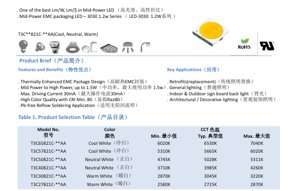
呢份文件詳細說明咗一系列採用3030外形尺寸(3.0mm x 3.0mm)同先進EMC(環氧樹脂模塑化合物)封裝嘅中功率LED規格。呢個系列旨在提供光效、可靠性同成本效益之間嘅最佳平衡,成為中功率領域嘅首選。核心設計理念集中於熱管理同光學性能,令其能夠喺高達1.5W嘅功率水平下運作。
呢個LED系列嘅主要目標市場包括:用嚟替換傳統白熾燈或熒光燈嘅改裝照明方案、住宅同商業空間嘅通用照明、室內外標誌嘅背光照明,以及對性能同美觀品質都要求極高嘅建築或裝飾照明應用。
2. 深入技術參數分析
2.1 電光特性
All measurements are standardized at a forward current (IF) of 25mA and an ambient temperature (Ta) of 25°C with 60% relative humidity. The product line offers a range of Correlated Color Temperatures (CCT) from warm white (2725K) to cool white (6530K), catering to diverse lighting needs. A minimum Color Rendering Index (CRI or Ra) of 80 ensures good color fidelity for general lighting applications.
The luminous flux output is categorized by both color bin and flux rank. Typical luminous flux values range from approximately 122 lumens to 156 lumens at the test condition of 25mA, depending on the specific CCT and flux bin. It is critical to note the stated measurement tolerances: ±7% for luminous flux and ±2 for CRI. The forward voltage (VF) typically falls between 5.0V and 5.4V at 25mA, with a specified measurement tolerance of ±0.5V.
2.2 電氣與熱參數
The absolute maximum ratings define the operational boundaries for reliable performance. The maximum continuous forward current (IF) is 30mA, with a pulsed forward current (IFP) of 40mA allowed under specific conditions (pulse width ≤ 100µs, duty cycle ≤ 1/10). The maximum power dissipation (PD) is 1.5W. Exceeding these ratings may cause permanent degradation or failure.
Thermal management is a key strength of the EMC package. The thermal resistance from the junction to the solder point (Rth j-sp) is specified at a typical value of 11 °C/W. This low thermal resistance facilitates efficient heat transfer from the LED chip to the printed circuit board (PCB), helping to maintain a lower junction temperature (Tj), which is critical for long-term lumen maintenance and reliability. The maximum allowable junction temperature is 115°C.
3. 分級系統解說
3.1 色溫 (CCT) 分級
LED會根據佢哋喺CIE 1931圖上嘅色度座標,被仔細分揀到精確嘅顏色分級中。對於2600K至7000K之間嘅色溫,其分級結構遵循Energy Star標準,確保顏色喺指定區域內保持一致。每個顏色代碼(例如27M5、30M5)對應一個特定嘅中心點(x, y座標)同一個由長/短軸(a, b)同角度(φ)定義嘅橢圓形公差區域。色度座標嘅測量不確定度為±0.007。
3.2 光通量分級
除咗顏色之外,LED仲會根據佢哋喺標準測試電流下嘅光通量輸出進行進一步分級。光通量等級由代碼(例如2E、2F、2G、2H)標示,每個代表一個特定嘅流明範圍(例如122-130 lm、130-139 lm)。呢種二維分級(顏色同光通量)讓設計師可以揀選符合其應用嘅色度同亮度要求嘅元件,確保最終照明產品嘅均勻性。
3.3 正向電壓分級
Forward voltage is also categorized to aid in circuit design, particularly for applications involving multiple LEDs in series. Voltage bins are defined by codes (e.g., 1, 2) with specified minimum and maximum voltage ranges (e.g., 4.6-4.8V, 4.8-5.0V). Matching VF bins can help achieve more uniform current distribution and simplified driver design.
4. 性能曲線分析
4.1 IV 與光通量特性
圖3展示咗正向電流同相對光通量之間嘅關係。輸出係次線性嘅;將電流增加到建議嘅25-30mA範圍以上,會導致光輸出嘅回報遞減,同時顯著增加熱量產生同器件嘅壓力。圖4顯示咗正向電壓與電流嘅關係曲線,呢個對於設計適當嘅限流電路至關重要。
4.2 溫度依賴性
The performance of LEDs is highly temperature-sensitive. Figure 6 demonstrates that relative luminous flux decreases as ambient temperature (Ta) increases. Figure 7 shows that forward voltage typically decreases with rising temperature. Figure 5 details the shift in chromaticity coordinates (CIE x, y) with temperature, which is crucial for applications requiring stable color points across operating conditions. Figure 8 is critical for thermal design, showing the derating curve for maximum allowable forward current as a function of ambient temperature for two different junction-to-ambient thermal resistance scenarios (35°C/W and 55°C/W).
4.3 光譜與視角分佈
Figure 1 provides the relative spectral power distribution, which defines the light's color quality. Figure 2 depicts the spatial radiation pattern (viewing angle distribution). The typical viewing angle (2θ1/2), where intensity is half the peak value, is 110 degrees, indicating a wide, Lambertian-like emission pattern suitable for general diffuse lighting.
5. 組裝與處理指引
5.1 回流焊接
呢啲LED兼容無鉛回流焊接製程。根據絕對最大額定值規定,最高焊接溫度曲線喺10秒內唔可以超過230°C或260°C。必須遵循製造商提供嘅建議回流溫度曲線,以防止熱衝擊或損壞EMC封裝同內部晶片貼裝。
5.2 儲存與處理
建議嘅儲存溫度範圍係-40°C至+85°C。為防止吸濕(呢個會導致回流焊接時出現爆米花現象),LED應儲存喺乾燥環境中,通常係裝有乾燥劑嘅密封防潮袋內。處理期間應遵守標準嘅ESD(靜電放電)預防措施,因為器件嘅ESD耐受電壓為1000V(人體模型)。
6. 應用備註與設計考慮
6.1 熱管理
有效嘅散熱係實現額定性能同長壽命嘅最重要單一因素。低至11 °C/W嘅結點到焊點熱阻,只有喺PCB同系統設計有助於散熱時先有效。對於喺最大電流/功率或接近該水平下運作嘅應用,強烈建議使用金屬芯PCB(MCPCB)或具有足夠散熱通孔嘅電路板。必須使用降額曲線(圖8)來確定應用實際熱環境下嘅安全工作電流。
6.2 電氣驅動
A constant current driver is mandatory for reliable operation. The driver should be designed to supply a stable current up to the maximum of 30mA, accounting for the forward voltage bin and its negative temperature coefficient. For designs using multiple LEDs in series, consider the voltage binning to ensure the total string voltage is within the driver's output range. Parallel connections are generally not recommended without additional balancing circuitry due to VF variations.
6.3 光學整合
110度嘅寬視角令呢啲LED適合需要寬闊、均勻照明而無需二次光學器件嘅應用。對於定向照明,可以使用適當嘅一次光學器件(透鏡)或反射器。高顯色指數(CRI ≥80)令佢哋非常適合零售照明、工作照明以及其他需要準確色彩感知嘅環境。
7. 技術比較與優勢
呢個3030 EMC系列嘅關鍵區別在於其封裝技術。同傳統嘅PPA(聚鄰苯二甲酰胺)或PCT塑膠相比,EMC材料提供更優越嘅導熱性、更高嘅耐溫性,以及更好嘅抗黃變同抗紫外線同熱降解能力。呢個意味著LED喺整個使用壽命期間光學性能更穩定,喺維持流明輸出同色點方面比塑膠封裝嘅替代品更好。
堅固嘅EMC封裝、高光效同精確嘅多維分級相結合,為要求高可靠性、長壽命同一致品質嘅應用(例如商業照明燈具同戶外標誌)提供顯著優勢。
8. 常見問題 (FAQs)
Q: What is the actual power consumption at the typical operating point?
A: At the test condition of IF=25mA and VF=5.4V (typical max), the power is 25mA * 5.4V = 135mW. The "1.2W Series" designation refers to its capability and thermal package rating, not the standard operating point.
Q: How does the luminous flux change if I drive the LED at 30mA instead of 25mA?
A: Refer to Figure 3. The relative luminous flux increases with current but not linearly. Driving at 30mA will yield more light but also generate significantly more heat. You must ensure the junction temperature remains below 115°C by implementing excellent thermal management, as per the derating curve in Figure 8.
Q: Can I use these LEDs for outdoor applications?
A: Yes, the EMC package offers good environmental resistance. However, for outdoor use, the entire luminaire must be properly sealed and designed to manage condensation and environmental stresses. The operating temperature range of -40°C to +85°C supports most outdoor conditions.
Q: Why is the forward voltage tolerance ±0.5V important?
A: This tolerance impacts the design of the power supply, especially when connecting multiple LEDs in series. The driver must accommodate the total possible voltage range of the string. Selecting LEDs from the same voltage bin (Table 7) can simplify driver design and improve system efficiency.
9. 設計與使用案例研究
Scenario: Designing a 1200lm LED Panel Light for Office Use.
A designer aims to create a 600mm x 600mm LED panel light with a neutral white color (4000K, CRI>80) and an output of 1200 lumens.
Component Selection: The designer selects the T3C40821C-**AA model (Neutral White, 3985K typical). From Table 6, for the 40M5 color bin, a flux rank of 2H offers 148-156 lumens at 25mA. Choosing the typical value of 152 lm for calculation.
Quantity Calculation: To achieve 1200 lm, approximately 1200 lm / 152 lm per LED ≈ 8 LEDs are needed at 25mA each.
Thermal & Electrical Design: The 8 LEDs will be arranged on an aluminum MCPCB. Total power at 25mA and typical VF (5.2V): 8 * (0.025A * 5.2V) = 1.04W. The thermal design must ensure the LED solder point temperature remains low enough to keep the junction below 115°C, utilizing the Rth j-sp of 11°C/W. A constant current driver outputting 25mA with a voltage compliance covering 8 * VF (considering bin 2: 4.8-5.0V) is selected.
Outcome: This design leverages the LED's high efficacy and EMC thermal performance to create a reliable, efficient, and uniform office lighting fixture.
10. 技術原理與趨勢
10.1 工作原理
呢啲LED基於半導體技術。當正向電壓施加喺p-n結兩端時,電子同電洞會復合,以光子(光)嘅形式釋放能量。半導體層嘅特定材料同結構決定咗發射光嘅波長(顏色)。喺發出藍光嘅晶片上塗覆一層熒光粉,將一部分藍光轉換成更長嘅波長,從而產生具有所需色溫同顯色指數嘅寬光譜白光。
10.2 行業趨勢
中功率LED領域繼續朝著更高光效(每瓦流明)同更具競爭力成本下嘅更高可靠性方向發展。主要趨勢包括廣泛採用EMC同其他類陶瓷封裝材料以獲得更好嘅熱性能同更長壽命。同時,行業亦非常注重提升色彩品質同一致性,更嚴格嘅分級標準同更高顯色指數選項變得越來越普遍。此外,驅動器集成同智能可控性對於下一代照明系統變得越來越重要。3030 EMC平台代表咗喺呢啲持續進行嘅行業發展中一個成熟且優化嘅解決方案。
LED規格術語詳解
LED技術術語完整解釋
一、光電性能核心指標
| 術語 | 單位/表示 | 通俗解釋 | 點解重要 |
|---|---|---|---|
| 光效(Luminous Efficacy) | lm/W(流明/瓦) | 每瓦電能發出嘅光通量,越高越慳電。 | 直接決定燈具嘅能效等級同電費成本。 |
| 光通量(Luminous Flux) | lm(流明) | 光源發出嘅總光量,俗稱"光亮度"。 | 決定燈具夠唔夠光。 |
| 發光角度(Viewing Angle) | °(度),例如120° | 光強降至一半時嘅角度,決定光束闊窄。 | 影響光照範圍同均勻度。 |
| 色溫(CCT) | K(開爾文),例如2700K/6500K | 光嘅顏色冷暖,低值偏黃/暖,高值偏白/冷。 | 決定照明氣氛同適用場景。 |
| 顯色指數(CRI / Ra) | 無單位,0–100 | 光源還原物體真實顏色嘅能力,Ra≥80為佳。 | 影響色彩真實性,用於商場、美術館等高要求場所。 |
| 色容差(SDCM) | 麥克亞當橢圓步數,例如"5-step" | 顏色一致性嘅量化指標,步數越細顏色越一致。 | 保證同一批燈具顏色冇差異。 |
| 主波長(Dominant Wavelength) | nm(納米),例如620nm(紅) | 彩色LED顏色對應嘅波長值。 | 決定紅、黃、綠等單色LED嘅色相。 |
| 光譜分佈(Spectral Distribution) | 波長 vs. 強度曲線 | 顯示LED發出嘅光喺各波長嘅強度分佈。 | 影響顯色性同顏色品質。 |
二、電氣參數
| 術語 | 符號 | 通俗解釋 | 設計注意事項 |
|---|---|---|---|
| 順向電壓(Forward Voltage) | Vf | LED點亮所需嘅最小電壓,類似"啟動門檻"。 | 驅動電源電壓需≥Vf,多個LED串聯時電壓累加。 |
| 順向電流(Forward Current) | If | 使LED正常發光嘅電流值。 | 常採用恆流驅動,電流決定亮度同壽命。 |
| 最大脈衝電流(Pulse Current) | Ifp | 短時間內可承受嘅峰值電流,用於調光或閃光。 | 脈衝寬度同佔空比需嚴格控制,否則過熱損壞。 |
| 反向電壓(Reverse Voltage) | Vr | LED能承受嘅最大反向電壓,超過則可能擊穿。 | 電路中需防止反接或電壓衝擊。 |
| 熱阻(Thermal Resistance) | Rth(°C/W) | 熱量從芯片傳到焊點嘅阻力,值越低散熱越好。 | 高熱阻需更強散熱設計,否則結溫升高。 |
| 靜電放電耐受(ESD Immunity) | V(HBM),例如1000V | 抗靜電打擊能力,值越高越不易被靜電損壞。 | 生產中需做好防靜電措施,尤其高靈敏度LED。 |
三、熱管理與可靠性
| 術語 | 關鍵指標 | 通俗解釋 | 影響 |
|---|---|---|---|
| 結溫(Junction Temperature) | Tj(°C) | LED芯片內部嘅實際工作溫度。 | 每降低10°C,壽命可能延長一倍;過高導致光衰、色漂移。 |
| 光衰(Lumen Depreciation) | L70 / L80(小時) | 亮度降至初始值70%或80%所需時間。 | 直接定義LED嘅"使用壽命"。 |
| 流明維持率(Lumen Maintenance) | %(例如70%) | 使用一段時間後剩餘亮度嘅百分比。 | 表徵長期使用後嘅亮度保持能力。 |
| 色漂移(Color Shift) | Δu′v′ 或 麥克亞當橢圓 | 使用過程中顏色嘅變化程度。 | 影響照明場景嘅顏色一致性。 |
| 熱老化(Thermal Aging) | 材料性能下降 | 因長期高溫導致嘅封裝材料劣化。 | 可能導致亮度下降、顏色變化或開路失效。 |
四、封裝與材料
| 術語 | 常見類型 | 通俗解釋 | 特點與應用 |
|---|---|---|---|
| 封裝類型 | EMC、PPA、陶瓷 | 保護芯片並提供光學、熱學介面嘅外殼材料。 | EMC耐熱好、成本低;陶瓷散熱優、壽命長。 |
| 芯片結構 | 正裝、倒裝(Flip Chip) | 芯片電極佈置方式。 | 倒裝散熱更好、光效更高,適用於高功率。 |
| 螢光粉塗層 | YAG、硅酸鹽、氮化物 | 覆蓋喺藍光芯片上,部分轉化為黃/紅光,混合成白光。 | 唔同螢光粉影響光效、色溫同顯色性。 |
| 透鏡/光學設計 | 平面、微透鏡、全反射 | 封裝表面嘅光學結構,控制光線分佈。 | 決定發光角度同配光曲線。 |
五、質量控制與分檔
| 術語 | 分檔內容 | 通俗解釋 | 目的 |
|---|---|---|---|
| 光通量分檔 | 代碼例如 2G、2H | 按亮度高低分組,每組有最小/最大流明值。 | 確保同一批產品亮度一致。 |
| 電壓分檔 | 代碼例如 6W、6X | 按順向電壓範圍分組。 | 便於驅動電源匹配,提高系統效率。 |
| 色區分檔 | 5-step MacAdam橢圓 | 按顏色坐標分組,確保顏色落喺極細範圍內。 | 保證顏色一致性,避免同一燈具內顏色不均。 |
| 色溫分檔 | 2700K、3000K等 | 按色溫分組,每組有對應嘅坐標範圍。 | 滿足唔同場景嘅色溫需求。 |
六、測試與認證
| 術語 | 標準/測試 | 通俗解釋 | 意義 |
|---|---|---|---|
| LM-80 | 流明維持測試 | 喺恆溫條件下長期點亮,記錄亮度衰減數據。 | 用於推算LED壽命(結合TM-21)。 |
| TM-21 | 壽命推演標準 | 基於LM-80數據推算實際使用條件下嘅壽命。 | 提供科學嘅壽命預測。 |
| IESNA標準 | 照明工程學會標準 | 涵蓋光學、電氣、熱學測試方法。 | 行業公認嘅測試依據。 |
| RoHS / REACH | 環保認證 | 確保產品不含有害物質(例如鉛、汞)。 | 進入國際市場嘅准入條件。 |
| ENERGY STAR / DLC | 能效認證 | 針對照明產品嘅能效同性能認證。 | 常用於政府採購、補貼項目,提升市場競爭力。 |