目錄
- 1. 產品概覽
- 2. 器件選擇同絕對最大額定值
- 2.1 器件選擇指南
- 2.2 絕對最大額定值(Ta=25°C)
- 3. 電光特性(Ta=25°C)
- 3.1 發光強度同角度特性
- 3.2 光譜特性
- 3.3 電氣特性
- 4. 性能曲線分析
- 5. 機械同封裝資料
- 5.1 封裝尺寸
- 5.2 極性識別
- 6. 焊接、組裝同儲存指引
- 6.1 關鍵注意事項
- 6.2 焊接流程
- 7. 包裝同訂購資料
- 7.1 包裝規格
- 7.2 標籤說明
- 8. 應用備註同設計考慮
- 8.1 典型應用
- 8.2 設計考慮
- 8.3 應用限制
- 9. 技術比較同差異
- 10. 常見問題(FAQ)
- 11. 操作原理同技術趨勢
- 11.1 基本操作原理
- 11.2 行業趨勢
1. 產品概覽
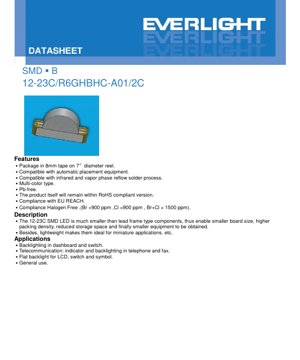
12-23C 系列代表一種緊湊嘅表面貼裝LED解決方案,專為需要微型化同高可靠性嘅現代電子應用而設計。呢個多色LED系列比傳統引線框架元件細好多,能夠大幅減少PCB佔用面積,提高封裝密度,最終有助於開發更細嘅終端用戶設備。佢嘅輕量化結構令佢特別適合空間受限同便攜式應用。
呢個系列嘅核心優勢在於佢嘅多功能性同符合當代製造同環保標準。器件以8mm載帶包裝,捲喺7吋直徑嘅捲盤上,確保兼容高速自動貼片組裝設備。佢哋適用於紅外線同氣相回流焊接流程,呢啲係大批量電子生產嘅標準。
環保同法規合規係一個關鍵特點。產品採用無鉛物料製造,符合RoHS指令,遵守歐盟REACH法規,並達到無鹵素標準(溴<900 ppm,氯<900 ppm,總和<1500 ppm)。呢點令佢哋適合全球多個有嚴格環保要求嘅市場。
2. 器件選擇同絕對最大額定值
2.1 器件選擇指南
呢個系列提供三種唔同顏色選擇,每種都基於唔同嘅半導體芯片物料:
- 代碼 R6(亮紅):採用AlGaInP(磷化鋁鎵銦)芯片技術。樹脂顏色係透明。
- 代碼 GH(亮綠):採用InGaN(氮化銦鎵)芯片技術。樹脂顏色係透明。
- 代碼 BH(藍):採用InGaN(氮化銦鎵)芯片技術。樹脂顏色係透明。
透明樹脂封裝可以實現最佳嘅光提取同真實色彩表現。
2.2 絕對最大額定值(Ta=25°C)
呢啲額定值定義咗壓力極限,超過呢啲極限可能會對器件造成永久損壞。唔建議喺呢啲極限或以上操作。
- 反向電壓(VR):5 V(所有代碼)
- 正向電流(IF):R6:25 mA,GH:25 mA,BH:20 mA
- 峰值正向電流(IFP,佔空比 1/10 @1kHz):R6:60 mA,GH:100 mA,BH:100 mA
- 功耗(Pd):R6:60 mW,GH:95 mW,BH:75 mW
- 靜電放電(ESD)人體模型(HBM):R6:2000 V,GH:150 V,BH:150 V。注意紅色(R6)LED嘅ESD穩健性明顯高過綠色同藍色變體,後者需要更小心處理。
- 工作溫度(Topr):-40°C 至 +85°C
- 儲存溫度(Tstg):-40°C 至 +90°C
- 焊接溫度(Tsol):回流焊接:峰值260°C,最多10秒。手動焊接:每端最多350°C,3秒。
3. 電光特性(Ta=25°C)
以下參數喺指定測試條件下得到保證。典型值代表生產分佈嘅中心。
3.1 發光強度同角度特性
- 發光強度(IV)@ IF=20mA:
- R6(紅):典型 90 mcd(最小 63 mcd)
- GH(綠):典型 180 mcd(最小 125 mcd)
- BH(藍):典型 50 mcd(最小 32 mcd)
- 視角(2θ1/2):所有顏色代碼典型為100度。呢個寬視角適合指示燈同背光應用,其中離軸角度嘅可見性好重要。
3.2 光譜特性
- 峰值波長(λp):R6:632 nm,GH:518 nm,BH:468 nm。
- 主波長(λd):R6:624 nm,GH:525 nm,BH:470 nm。主波長係人眼對LED顏色嘅單一波長感知。
- 光譜輻射帶寬(Δλ):R6:20 nm,GH:35 nm,BH:25 nm。呢個定義咗發射光嘅光譜純度或寬度。
3.3 電氣特性
- 正向電壓(VF)@ IF=20mA:
- R6:典型 2.0 V,最大 2.4 V
- GH:典型 3.3 V,最大 3.9 V
- BH:典型 3.3 V,最大 3.9 V
- 反向電流(IR)@ VR=5V:R6:最大 10 μA,GH/BH:最大 50 μA。
4. 性能曲線分析
規格書提供咗每個LED代碼(R6、GH、BH)嘅典型電光特性曲線。雖然文本中冇提供具體圖表數據點,但呢啲曲線通常說明正向電流同發光強度、正向電壓之間嘅關係,以及環境溫度對光輸出嘅影響。分析呢啲曲線對於理解器件喺非標準條件下(例如唔同驅動電流或溫度)嘅行為,以及優化電路設計以提高效率同壽命至關重要。設計師應該使用呢啲曲線來選擇適當嘅工作點,並模擬熱效應對性能嘅影響。
5. 機械同封裝資料
5.1 封裝尺寸
12-23C LED有一個緊湊嘅表面貼裝封裝。關鍵尺寸(單位mm,公差±0.1mm,除非另有說明)包括主體尺寸約為3.2mm(長)x 1.6mm(寬)x 1.4mm(高)。封裝有兩個陽極/陰極端子用於焊接。尺寸圖提供咗PCB焊盤圖案(佔位面積)設計嘅關鍵資料,確保正確嘅焊點形成同機械穩定性。遵循推薦嘅焊盤圖案對於可靠組裝同熱管理至關重要。
5.2 極性識別
陰極通常由封裝上嘅視覺標記識別,例如凹口、圓點或捲盤上嘅綠色標記。組裝期間正確嘅極性方向係確保正常功能嘅必要條件。
6. 焊接、組裝同儲存指引
6.1 關鍵注意事項
- 電流限制:必須同LED串聯一個外部限流電阻。LED嘅指數型I-V特性意味住電壓稍微增加會導致電流大幅增加,如果冇保護會立即燒毀。儲存條件:
- 器件對濕度敏感(MSL)。
開封前:儲存喺≤30°C同≤90% RH。
開封後:車間壽命喺≤30°C同≤60% RH下為1年。未使用嘅部件必須重新密封喺帶乾燥劑嘅防潮袋中。
如果乾燥劑指示劑變色或超過儲存時間,喺回流焊接前需要喺60±5°C烘烤24小時。6.2 焊接流程
- 回流曲線(無鉛):
- 提供詳細溫度曲線。關鍵參數包括:150-200°C之間預熱60-120秒,液相線以上(217°C)時間60-150秒,峰值溫度最高260°C,最多10秒,以及受控嘅升溫/降溫速率(分別最大3°C/s同6°C/s)。
- 回流次數:
唔好超過兩次回流焊接循環。
- 手動焊接:如有必要,使用烙鐵頭溫度<350°C、功率≤25W嘅烙鐵,並將每端接觸時間限制喺3秒以內。焊接每端之間至少間隔2秒。加熱期間避免對封裝施加機械應力。
- 維修:唔建議焊接後進行維修。如果無可避免,必須使用雙頭烙鐵同時加熱兩個端子,以防止熱機械應力。預先測試以確保維修過程唔會降低LED特性。
- 7. 包裝同訂購資料7.1 包裝規格
- LED以防潮包裝供應。標準包裝包括: 載帶:8mm寬,裝入捲盤。 捲盤:7吋直徑。每捲裝載數量為2000件。 外袋:密封喺含有乾燥劑嘅鋁質防潮袋內。 提供載帶袋同捲盤嘅詳細尺寸,以確保同自動送料器兼容。7.2 標籤說明
捲盤標籤包含可追溯性同分檔選擇嘅關鍵信息: CPN(客戶產品編號) P/N(產品編號):例如,12-23C/R6GHBHC-A01/2C QTY(包裝數量) CAT(發光強度等級) HUE(色度座標同主波長等級) REF(正向電壓等級) LOT No(批次號碼,用於追溯) 呢啲分檔信息允許設計師選擇參數嚴格控制嘅LED,以確保應用中性能一致。
8. 應用備註同設計考慮
8.1 典型應用
- 儀表板、開關同符號嘅背光。 通訊設備(電話、傳真機)中嘅狀態指示燈同鍵盤背光。 小型LCD顯示器嘅平面背光單元。 消費同工業電子產品中嘅通用指示燈。8.2 設計考慮
- 電路設計: 一定要包含串聯電阻。使用 R = (V供電 - Vf) / If 計算其值,其中Vf同If係規格書中嘅目標工作點。考慮電阻嘅額定功率。 熱管理: 雖然功耗低,但將結溫保持喺限值內係長期可靠性同穩定光輸出嘅關鍵。如果喺高環境溫度或接近最大電流下工作,請確保足夠嘅PCB銅面積或散熱孔。 ESD保護: 喺PCB上同處理程序中實施ESD保護措施,特別係對於更敏感嘅GH同BH(InGaN)LED。8.3 應用限制
- 呢個產品專為商業同一般工業應用而設計。未經事先諮詢,佢唔係專門認證或推薦用於高可靠性應用。呢啲包括但不限於: 軍事、航空航天或航空系統。 汽車安全或保安系統(例如安全氣囊、制動)。 生命維持或關鍵醫療設備。 對於呢類應用,需要具有唔同規格、認證同可靠性保證嘅產品。9. 技術比較同差異
10. 常見問題(FAQ)
Q1:R6、GH同BH代碼之間嘅主要區別係咩? A1:主要區別係半導體物料同由此產生嘅顏色。R6使用AlGaInP發出紅光(主波長624nm)並且正向電壓較低(約2.0V)。GH(綠)同BH(藍)使用InGaN,正向電壓較高(約3.3V),分別發出綠光(525nm)同藍光(470nm)。GH同BH代碼對ESD也更敏感。
- Q2:點解限流電阻係必須嘅? A2:LED係具有非線性、指數型電流-電壓關係嘅二極管。電壓稍微超過標稱Vf會導致電流非常大,可能具有破壞性嘅增加。串聯電阻提供線性關係,令電流對於給定電源電壓可預測且安全。
- Q3:我可以用手動焊接進行原型組裝嗎? A3:可以,但要極度小心。嚴格遵循指引:烙鐵頭<350°C,功率≤25W,每端接觸時間≤3秒,並且端子之間要冷卻。回流焊接係推薦且更可靠嘅方法。
- Q4:無鹵素係咩意思,點解佢重要? A4:無鹵素意味住物料含有非常低水平嘅溴(Br)同氯(Cl)。呢啲鹵素燃燒時會產生有毒同腐蝕性煙霧。無鹵素電子產品更安全、更環保,通常係某些法規同客戶規格嘅要求。
- Q5:我點樣解讀標籤上嘅分檔信息(CAT、HUE、REF)? A5:呢啲信息將具有相似性能嘅LED分組。為咗陣列中嘅外觀一致,你應該採購來自相同或相鄰HUE(顏色)同CAT(亮度)分檔嘅LED。REF(電壓)分檔對於電流調節應用中嘅電源設計可能好重要。
- 11. 操作原理同技術趨勢
- 11.1 基本操作原理 發光二極管(LED)係通過電致發光發光嘅半導體器件。當正向電壓施加喺p-n結兩端時,來自n型材料嘅電子同來自p型材料嘅空穴喺有源區複合。呢種複合以光子(光)嘅形式釋放能量。發射光嘅特定波長(顏色)由有源區中使用嘅半導體物料嘅帶隙能量決定。AlGaInP具有適合紅/橙/黃光嘅帶隙,而InGaN覆蓋綠、藍同白光(帶磷光體)光譜。
- 11.2 行業趨勢 像12-23C系列咁樣嘅SMD LED市場繼續受到微型化、更高效率(每瓦流明)、改善顏色一致性同更嚴格環保合規要求嘅推動。對於超緊湊設備,有朝向更細封裝尺寸(例如0201、01005)嘅趨勢。此外,為咗簡化設計,將控制電路(例如恆流驅動器)集成到LED封裝內變得越來越普遍。喺各種環境壓力下提高可靠性同延長壽命仍然係元件製造商同終端用戶嘅持續關注點。
. Application Notes and Design Considerations
.1 Typical Applications
- Backlighting for instrument panels, switches, and symbols.
- Status indicators and keypad backlighting in telecommunication equipment (phones, fax machines).
- Flat backlighting units for small LCD displays.
- General purpose indicator lights in consumer and industrial electronics.
.2 Design Considerations
- Circuit Design:Always include a series resistor. Calculate its value using R = (Vsupply- VF) / IF, where VFand IFare the target operating points from the datasheet. Consider power rating of the resistor.
- Thermal Management:While power dissipation is low, maintaining the junction temperature within limits is key for long-term reliability and stable light output. Ensure adequate PCB copper area or thermal vias if operating at high ambient temperatures or near maximum current.
- ESD Protection:Implement ESD protection measures on PCBs and in handling procedures, especially for the more sensitive GH and BH (InGaN) LEDs.
.3 Application Restrictions
This product is designed for commercial and general industrial applications. It isnotspecifically qualified or recommended for high-reliability applications without prior consultation. This includes, but is not limited to:
- Military, aerospace, or aviation systems.
- Automotive safety or security systems (e.g., airbags, braking).
- Life-supporting or critical medical equipment.
. Technical Comparison and Differentiation
The 12-23C series differentiates itself through its combination of a very compact form factor, multi-color availability from a single package outline, and full compliance with modern environmental regulations (RoHS, Halogen-Free). Compared to larger through-hole LEDs, it enables significant miniaturization. The clear resin package for all colors offers design flexibility. The provided ESD ratings (particularly high for the red variant) and detailed moisture sensitivity handling instructions reflect design for robust manufacturing processes. The inclusion of specific binning parameters (CAT, HUE, REF) on the label indicates a production process capable of delivering consistent color and brightness, which is critical for applications using multiple LEDs.
. Frequently Asked Questions (FAQ)
Q1: What is the primary difference between the R6, GH, and BH codes?
A1: The primary difference is the semiconductor material and resulting color. R6 uses AlGaInP for red light (624nm dominant) and has a lower forward voltage (~2.0V). GH (Green) and BH (Blue) use InGaN, have higher forward voltage (~3.3V), and emit green (525nm) and blue (470nm) light respectively. The GH and BH codes are also more sensitive to ESD.
Q2: Why is a current-limiting resistor mandatory?
A2: LEDs are diodes with a non-linear, exponential current-voltage relationship. A small increase in voltage beyond the nominal VFcauses a very large, potentially destructive, increase in current. A series resistor provides a linear relationship, making the current predictable and safe for a given supply voltage.
Q3: Can I use hand soldering for prototype assembly?
A3: Yes, but with extreme caution. Follow the guidelines strictly: iron tip <350°C, power ≤25W, contact time ≤3 seconds per terminal, and allow cooling between terminals. Reflow soldering is the recommended and more reliable method.
Q4: What does "halogen-free" mean and why is it important?
A4: Halogen-free means the materials contain very low levels of bromine (Br) and chlorine (Cl). These halogens, when burned, can produce toxic and corrosive fumes. Halogen-free electronics are safer and more environmentally friendly, often required by certain regulations and customer specifications.
Q5: How do I interpret the binning information (CAT, HUE, REF) on the label?
A5: This information groups LEDs with similar performance. For consistent appearance in an array, you should source LEDs from the same or adjacent HUE (color) and CAT (brightness) bins. The REF (voltage) bin can be important for power supply design in current-regulated applications.
. Operational Principles and Technology Trends
.1 Basic Operating Principle
Light Emitting Diodes (LEDs) are semiconductor devices that emit light through electroluminescence. When a forward voltage is applied across the p-n junction, electrons from the n-type material recombine with holes from the p-type material in the active region. This recombination releases energy in the form of photons (light). The specific wavelength (color) of the emitted light is determined by the bandgap energy of the semiconductor material used in the active region. AlGaInP has a bandgap suitable for red/orange/yellow light, while InGaN covers the green, blue, and white (with phosphor) spectrum.
.2 Industry Trends
The market for SMD LEDs like the 12-23C series continues to be driven by demands for miniaturization, higher efficiency (lumens per watt), improved color consistency, and stricter environmental compliance. There is a trend towards even smaller package sizes (e.g., 0201, 01005) for ultra-compact devices. Furthermore, integration of control circuitry (e.g., constant current drivers) within the LED package is becoming more common for simplified design. The push for higher reliability and longer lifetime under various environmental stresses remains a constant focus for component manufacturers and end-users alike.
LED規格術語詳解
LED技術術語完整解釋
一、光電性能核心指標
| 術語 | 單位/表示 | 通俗解釋 | 點解重要 |
|---|---|---|---|
| 光效(Luminous Efficacy) | lm/W(流明/瓦) | 每瓦電能發出嘅光通量,越高越慳電。 | 直接決定燈具嘅能效等級同電費成本。 |
| 光通量(Luminous Flux) | lm(流明) | 光源發出嘅總光量,俗稱"光亮度"。 | 決定燈具夠唔夠光。 |
| 發光角度(Viewing Angle) | °(度),例如120° | 光強降至一半時嘅角度,決定光束闊窄。 | 影響光照範圍同均勻度。 |
| 色溫(CCT) | K(開爾文),例如2700K/6500K | 光嘅顏色冷暖,低值偏黃/暖,高值偏白/冷。 | 決定照明氣氛同適用場景。 |
| 顯色指數(CRI / Ra) | 無單位,0–100 | 光源還原物體真實顏色嘅能力,Ra≥80為佳。 | 影響色彩真實性,用於商場、美術館等高要求場所。 |
| 色容差(SDCM) | 麥克亞當橢圓步數,例如"5-step" | 顏色一致性嘅量化指標,步數越細顏色越一致。 | 保證同一批燈具顏色冇差異。 |
| 主波長(Dominant Wavelength) | nm(納米),例如620nm(紅) | 彩色LED顏色對應嘅波長值。 | 決定紅、黃、綠等單色LED嘅色相。 |
| 光譜分佈(Spectral Distribution) | 波長 vs. 強度曲線 | 顯示LED發出嘅光喺各波長嘅強度分佈。 | 影響顯色性同顏色品質。 |
二、電氣參數
| 術語 | 符號 | 通俗解釋 | 設計注意事項 |
|---|---|---|---|
| 順向電壓(Forward Voltage) | Vf | LED點亮所需嘅最小電壓,類似"啟動門檻"。 | 驅動電源電壓需≥Vf,多個LED串聯時電壓累加。 |
| 順向電流(Forward Current) | If | 使LED正常發光嘅電流值。 | 常採用恆流驅動,電流決定亮度同壽命。 |
| 最大脈衝電流(Pulse Current) | Ifp | 短時間內可承受嘅峰值電流,用於調光或閃光。 | 脈衝寬度同佔空比需嚴格控制,否則過熱損壞。 |
| 反向電壓(Reverse Voltage) | Vr | LED能承受嘅最大反向電壓,超過則可能擊穿。 | 電路中需防止反接或電壓衝擊。 |
| 熱阻(Thermal Resistance) | Rth(°C/W) | 熱量從芯片傳到焊點嘅阻力,值越低散熱越好。 | 高熱阻需更強散熱設計,否則結溫升高。 |
| 靜電放電耐受(ESD Immunity) | V(HBM),例如1000V | 抗靜電打擊能力,值越高越不易被靜電損壞。 | 生產中需做好防靜電措施,尤其高靈敏度LED。 |
三、熱管理與可靠性
| 術語 | 關鍵指標 | 通俗解釋 | 影響 |
|---|---|---|---|
| 結溫(Junction Temperature) | Tj(°C) | LED芯片內部嘅實際工作溫度。 | 每降低10°C,壽命可能延長一倍;過高導致光衰、色漂移。 |
| 光衰(Lumen Depreciation) | L70 / L80(小時) | 亮度降至初始值70%或80%所需時間。 | 直接定義LED嘅"使用壽命"。 |
| 流明維持率(Lumen Maintenance) | %(例如70%) | 使用一段時間後剩餘亮度嘅百分比。 | 表徵長期使用後嘅亮度保持能力。 |
| 色漂移(Color Shift) | Δu′v′ 或 麥克亞當橢圓 | 使用過程中顏色嘅變化程度。 | 影響照明場景嘅顏色一致性。 |
| 熱老化(Thermal Aging) | 材料性能下降 | 因長期高溫導致嘅封裝材料劣化。 | 可能導致亮度下降、顏色變化或開路失效。 |
四、封裝與材料
| 術語 | 常見類型 | 通俗解釋 | 特點與應用 |
|---|---|---|---|
| 封裝類型 | EMC、PPA、陶瓷 | 保護芯片並提供光學、熱學介面嘅外殼材料。 | EMC耐熱好、成本低;陶瓷散熱優、壽命長。 |
| 芯片結構 | 正裝、倒裝(Flip Chip) | 芯片電極佈置方式。 | 倒裝散熱更好、光效更高,適用於高功率。 |
| 螢光粉塗層 | YAG、硅酸鹽、氮化物 | 覆蓋喺藍光芯片上,部分轉化為黃/紅光,混合成白光。 | 唔同螢光粉影響光效、色溫同顯色性。 |
| 透鏡/光學設計 | 平面、微透鏡、全反射 | 封裝表面嘅光學結構,控制光線分佈。 | 決定發光角度同配光曲線。 |
五、質量控制與分檔
| 術語 | 分檔內容 | 通俗解釋 | 目的 |
|---|---|---|---|
| 光通量分檔 | 代碼例如 2G、2H | 按亮度高低分組,每組有最小/最大流明值。 | 確保同一批產品亮度一致。 |
| 電壓分檔 | 代碼例如 6W、6X | 按順向電壓範圍分組。 | 便於驅動電源匹配,提高系統效率。 |
| 色區分檔 | 5-step MacAdam橢圓 | 按顏色坐標分組,確保顏色落喺極細範圍內。 | 保證顏色一致性,避免同一燈具內顏色不均。 |
| 色溫分檔 | 2700K、3000K等 | 按色溫分組,每組有對應嘅坐標範圍。 | 滿足唔同場景嘅色溫需求。 |
六、測試與認證
| 術語 | 標準/測試 | 通俗解釋 | 意義 |
|---|---|---|---|
| LM-80 | 流明維持測試 | 喺恆溫條件下長期點亮,記錄亮度衰減數據。 | 用於推算LED壽命(結合TM-21)。 |
| TM-21 | 壽命推演標準 | 基於LM-80數據推算實際使用條件下嘅壽命。 | 提供科學嘅壽命預測。 |
| IESNA標準 | 照明工程學會標準 | 涵蓋光學、電氣、熱學測試方法。 | 行業公認嘅測試依據。 |
| RoHS / REACH | 環保認證 | 確保產品不含有害物質(例如鉛、汞)。 | 進入國際市場嘅准入條件。 |
| ENERGY STAR / DLC | 能效認證 | 針對照明產品嘅能效同性能認證。 | 常用於政府採購、補貼項目,提升市場競爭力。 |