Table of Contents
- 1. Product Overview
- 2. In-Depth Technical Parameter Analysis
- 2.1 Absolute Maximum Ratings
- 2.2 Photometric and Electrical Characteristics
- 3. Binning System Explanation
- 3.1 Luminous and Radiant Flux Binning
- 3.2 Wavelength Binning
- 3.3 Forward Voltage Binning
- 4. Performance Curve Analysis
- 4.1 Relative Spectral Distribution
- 4.2 Forward Voltage vs. Forward Current (I-V Curve)
- 5. Mechanical and Packaging Information
- 6. Soldering and Assembly Guidelines
- 7. Application Recommendations
- 7.1 Typical Application Scenarios
- 7.2 Design Considerations
- 8. Technical Comparison and Differentiation
- 9. Frequently Asked Questions (Based on Technical Parameters)
- 10. Practical Application Case Studies
- 11. Operational Principle Introduction
- 12. Technology Trends and Context
- LED Specification Terminology
- Photoelectric Performance
- Electrical Parameters
- Thermal Management & Reliability
- Packaging & Materials
- Quality Control & Binning
- Testing & Certification
1. Product Overview
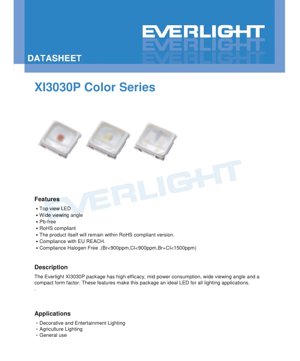
The XI3030P is a series of mid-power, surface-mount LED packages designed for a broad spectrum of lighting applications. Characterized by a compact 3.0mm x 3.0mm form factor, this series offers a combination of high efficacy and reliable performance. The primary design philosophy centers on providing a versatile light source suitable for integration into various lighting fixtures and systems where consistent color output and energy efficiency are paramount.
The core advantages of the XI3030P series include its wide viewing angle, which ensures uniform light distribution, and its compliance with major environmental and safety standards such as RoHS, REACH, and halogen-free requirements (Br<900ppm, Cl<900ppm, Br+Cl<1500ppm). The package is lead-free (Pb-free), aligning with modern manufacturing practices focused on sustainability. The target markets for this product are diverse, encompassing decorative and entertainment lighting, where vibrant and consistent colors are needed, agricultural lighting systems that may utilize specific spectral outputs (like deep red or far red), and general illumination applications requiring reliable, mid-power LED solutions.
2. In-Depth Technical Parameter Analysis
2.1 Absolute Maximum Ratings
The absolute maximum ratings define the operational boundaries beyond which permanent damage to the LED may occur. The maximum continuous forward current (IF) is specified at 200 mA. The thermal resistance from junction to solder point (Rth) is 15 °C/W, a critical parameter for thermal management design. The maximum allowable junction temperature (TJ) is 125°C for the Royal Blue variant and 115°C for all other colors (Far Red, Deep Red, Green, Amber, Orange, Red). This distinction is important for thermal design, especially in high-power or high-temperature environments. The operating temperature range is from -40°C to +85°C, and storage can be from -40°C to +100°C. The device can withstand a maximum soldering temperature of 260°C for a limited time during reflow, with a maximum of two allowable reflow cycles, which is standard for SMD components.
2.2 Photometric and Electrical Characteristics
The series offers seven distinct color options, each with specific photometric and electrical properties measured at a standard test current of 150 mA and a thermal pad temperature of 25°C.
- Green (515-530 nm): Offers a luminous flux range of 33-55 lumens with a forward voltage of 2.8-3.7V.
- Amber (580-595 nm): Provides 17-27 lumens with a forward voltage of 1.7-2.8V.
- Orange (605-620 nm): Delivers 24-45 lumens with a forward voltage of 1.5-2.8V.
- Red (615-630 nm): Outputs 16-27 lumens with a forward voltage of 1.5-2.8V.
- Royal Blue (450-460 nm): Specified in radiant flux (optical power), ranging from 190-280 mW, with a forward voltage of 2.5-3.1V.
- Deep Red (645-675 nm): Radiant flux from 100-160 mW, forward voltage 2.1-2.7V.
- Far Red (715-745 nm): Radiant flux from 70-110 mW, forward voltage 1.4-2.5V.
It is crucial to note the measurement tolerance for luminous/radiant flux is ±10%, and the dominant/peak wavelength tolerance is ±1 nm. The forward voltage is highly dependent on the semiconductor material and bandgap, hence the variation across colors.
3. Binning System Explanation
To ensure color consistency and electrical performance matching in production, the XI3030P series employs a comprehensive binning system across three key parameters.
3.1 Luminous and Radiant Flux Binning
Luminous flux bins (for visible light colors) use alphanumeric codes like L5, M3, N4, etc., with each bin covering a specific lumen range (e.g., L5: 14-15 lm, R1: 50-55 lm). Radiant flux bins (for Royal Blue, Deep Red, Far Red) use codes like R4, S1, T6, etc., covering specific milliwatt ranges (e.g., R4: 65-70 mW, T6: 260-280 mW). This allows designers to select LEDs with tightly grouped optical output for uniform lighting.
3.2 Wavelength Binning
Dominant wavelength (for colors perceived by the human eye) and peak wavelength (for monochromatic sources) are binned in 5nm or 10nm steps. For example, Green is binned in G51 (515-520nm), G52 (520-525nm), G53 (525-530nm). Deep Red has finer bins from D51 (640-645nm) to D57 (670-675nm). This precise binning is essential for applications requiring specific chromaticity or spectral properties, such as horticultural lighting or color-mixing systems.
3.3 Forward Voltage Binning
Forward voltage (VF) is binned in 0.1V increments, coded with four-digit numbers representing the min and max voltage (e.g., bin 1415 = 1.4V to 1.5V, bin 3637 = 3.6V to 3.7V). Matching VF bins in a series-connected string is critical for ensuring uniform current distribution and preventing individual LEDs from being overdriven.
4. Performance Curve Analysis
4.1 Relative Spectral Distribution
The provided graph shows the normalized spectral power distribution for all seven colors at 25°C. Key observations include the narrow, well-defined peaks for the monochromatic LEDs (Royal Blue, Deep Red, Far Red). The visible color LEDs (Green, Amber, Orange, Red) show broader spectral curves typical of phosphor-converted or direct semiconductor emission in those bands. The Far Red curve extends significantly into the near-infrared region, which is biologically active for plants.
4.2 Forward Voltage vs. Forward Current (I-V Curve)
The I-V curve plot illustrates the relationship between forward current and voltage for each color at 25°C. All curves exhibit the classic exponential diode characteristic. The turn-on voltage varies significantly by color, with Far Red having the lowest (starting ~1.4V) and Green/Royal Blue having the highest (starting ~2.5V). At the nominal operating current of 150mA, the voltage spread aligns with the binning tables. This curve is vital for driver design, as it determines the required supply voltage for a given string configuration and operating current.
5. Mechanical and Packaging Information
The XI3030P package has a footprint of approximately 3.0mm x 3.0mm with a typical height of 0.7mm. The datasheet provides separate dimensioned drawings for three groups, indicating slight internal design variations: one for Royal Blue, one for Green, and one for Far Red/Deep Red/Amber/Orange/Red. Critical mechanical notes include: all dimensions are in millimeters with a standard tolerance of ±0.2mm unless otherwise specified. The central thermal pad is designed for efficient heat sinking. A crucial warning is provided: the device must not be handled by the lens, as mechanical stress can cause failure. The polarity of the thermal pad connection differs between groups; for Royal Blue and Green, it is electrically common with the Cathode, while for the Far Red/Deep Red/Amber/Orange/Red group, it is common with the Anode. This must be carefully considered during PCB layout to avoid short circuits.
6. Soldering and Assembly Guidelines
The LED is suitable for reflow soldering processes. The maximum peak soldering temperature should not exceed 260°C, as defined in the Absolute Maximum Ratings. The component can withstand a maximum of two reflow cycles, which is typical for most SMD LEDs. It is imperative to follow the recommended reflow profile for lead-free soldering. Precautions include ensuring the PCB pad design matches the recommended footprint to facilitate proper soldering and heat dissipation. The warning against handling the lens applies during both assembly and subsequent handling. Storage should be within the specified temperature range of -40°C to +100°C, preferably in a dry, controlled environment to prevent moisture absorption, which could lead to \"popcorning\" during reflow.
7. Application Recommendations
7.1 Typical Application Scenarios
- Decorative and Entertainment Lighting: The wide color range and consistent binning make this series ideal for architectural accent lighting, stage lighting, and mood lighting where color quality and reliability are key.
- Agricultural Lighting: The availability of Deep Red (645-675nm) and Far Red (715-745nm) wavelengths is specifically significant for horticulture. These wavelengths are strongly absorbed by plant photoreceptors (phytochromes) and are crucial for influencing photomorphogenesis, flowering, and fruit development. The Green, Royal Blue, and Red LEDs can be used to create tailored spectral recipes for different plant growth stages.
- General Lighting: The Green, Amber, Orange, and Red LEDs can be used in combination with a blue pump and phosphor or in RGB/RGBW systems to create tunable white light or saturated color lighting for residential, commercial, or industrial spaces.
7.2 Design Considerations
Thermal Management: With a thermal resistance (Rth) of 15 °C/W, effective heat sinking is essential, especially when operating at or near the maximum current of 200mA. The junction temperature must be kept below the specified maximum (115°C or 125°C) to ensure long-term reliability and maintain luminous output. The central thermal pad must be properly soldered to a thermally conductive PCB pad connected to a heat dissipation path.
Electrical Design: Drivers should be constant-current type, set appropriately for the desired brightness and within the 0-200mA range. When connecting multiple LEDs in series, selecting devices from the same or adjacent forward voltage (VF) bins is highly recommended to ensure even current distribution. The differing thermal pad polarity between LED groups must be accounted for in the PCB design to avoid creating accidental shorts to the heatsink plane.
Optical Design: The wide viewing angle provides diffuse emission. For applications requiring directed beams, secondary optics (lenses or reflectors) will be necessary. The variation in luminous intensity across bins should be considered for applications demanding uniform luminance.
8. Technical Comparison and Differentiation
The XI3030P positions itself as a versatile mid-power LED. Compared to high-power LEDs (>1W), it typically offers better efficacy at lower drive currents and simplifies thermal management due to lower total heat dissipation per device. Compared to low-power or miniature LEDs, it provides significantly higher light output, making it suitable for primary illumination rather than just indicator functions. Its key differentiators within the mid-power segment are its comprehensive color portfolio (especially including agriculturally relevant far red and deep red), explicit halogen-free compliance, and detailed, multi-parameter binning system that gives lighting designers fine-grained control over color consistency and electrical matching. The separate mechanical drawings for different color groups also indicate optimized internal packaging for specific semiconductor materials, potentially leading to better performance and reliability for each color.
9. Frequently Asked Questions (Based on Technical Parameters)
Q: What is the difference between luminous flux and radiant flux listed in the datasheet?
A: Luminous flux (measured in lumens) quantifies the perceived power of light adjusted for the sensitivity of the human eye. It is used for Green, Amber, Orange, and Red. Radiant flux (measured in milliwatts) quantifies the total optical power emitted, regardless of visibility. It is used for Royal Blue, Deep Red, and Far Red, as the human eye has very low sensitivity to these wavelengths.
Q: Why are there different maximum junction temperatures for different colors?
A: The maximum junction temperature is determined by the materials and processes used to manufacture the LED chip. Different semiconductor compounds (e.g., InGaN for blue/green, AlInGaP for red/amber) have different thermal stability limits, hence the specified TJ of 125°C for Royal Blue (InGaN) and 115°C for the others (likely AlInGaP-based).
Q: How do I interpret the order code for a specific LED?
A: The order code (e.g., XI3030P/G3C-D1530P3R128371Z15/2N) encapsulates the product series (XI3030P), color (G for Green), flux bin, wavelength bin, and voltage bin information. Designers typically specify the required bins, and the full order code is generated accordingly for procurement.
Q: Can I drive this LED with a constant voltage source?
A: It is not recommended. LEDs are current-driven devices. Their forward voltage has a negative temperature coefficient and varies from unit to unit. A constant voltage source could lead to thermal runaway and catastrophic failure. Always use a constant-current driver or a circuit that actively regulates current.
10. Practical Application Case Studies
Case Study 1: Modular Horticultural Lighting Fixture
A manufacturer designs a linear grow light for vertical farming. They use a 2:1:1 ratio of Deep Red (XI3030P/D3C), Royal Blue (XI3030P/B3C), and Far Red (XI3030P/F3C) LEDs on an aluminum-core PCB. By selecting LEDs from tight wavelength bins (e.g., D54 for 655-660nm Deep Red), they ensure a precise spectral output optimized for the flowering stage of leafy greens. The 150mA drive current allows for efficient operation using standard mid-power LED drivers, and the low thermal resistance enables passive cooling via the fixture housing, meeting the IP65 rating requirement for humid environments.
Case Study 2: RGBW Architectural Linear Light
For a cove lighting system requiring tunable white light from 2700K to 6500K, a designer uses Red (XI3030P/R3C), Green (XI3030P/G3C), and Royal Blue (XI3030P/B3C) LEDs alongside a standard white LED on a single PCB. By meticulously selecting VF bins (e.g., 2728 for Red, 3031 for Green, 3031 for Blue), they create four parallel strings (R, G, B, W) that can be driven by a single, multi-channel constant-current driver with similar forward voltage requirements per channel, simplifying the power supply design and improving overall system efficiency.
11. Operational Principle Introduction
Light Emitting Diodes (LEDs) are semiconductor devices that emit light through electroluminescence. When a forward voltage is applied across the p-n junction, electrons from the n-type region recombine with holes from the p-type region in the active layer. This recombination process releases energy in the form of photons (light). The wavelength (color) of the emitted light is determined by the bandgap energy of the semiconductor material used in the active region. For the XI3030P series: Royal Blue and Green LEDs are typically based on Indium Gallium Nitride (InGaN) materials. Amber, Orange, Red, Deep Red, and Far Red LEDs are typically based on Aluminum Indium Gallium Phosphide (AlInGaP) materials. The \"top view\" and \"wide viewing angle\" features are achieved through the package design, which includes a molded lens that shapes the light output from the tiny semiconductor chip.
12. Technology Trends and Context
The XI3030P represents a mature and optimized segment of the LED market: the mid-power package. Current trends in this segment focus on several key areas: Increased Efficacy (lm/W): Ongoing improvements in internal quantum efficiency, light extraction, and phosphor technology continue to push the luminous output higher for the same electrical input. Improved Color Quality and Consistency: Tighter binning, as seen in this datasheet, and the development of new phosphor systems allow for better color rendering and more consistent light from fixture to fixture. Specialized Spectra: There is growing demand for LEDs with spectra tailored to non-visual applications, such as the horticultural (Deep Red, Far Red) offerings in this series, as well as for human-centric lighting that mimics natural daylight cycles. Integration and Miniaturization: While the 3030 footprint is standard, there is a parallel trend towards integrating multiple chips (e.g., RGB, or white + color) into a single package for simpler assembly. Reliability and Lifetime: Improvements in packaging materials and thermal management continue to extend the operational lifetime and reliability of LEDs, solidifying their position as the dominant lighting technology. The XI3030P, with its environmental compliance and robust specifications, is well-aligned with these industry-wide trends towards higher performance, specialization, and reliability.
LED Specification Terminology
Complete explanation of LED technical terms
Photoelectric Performance
| Term | Unit/Representation | Simple Explanation | Why Important |
|---|---|---|---|
| Luminous Efficacy | lm/W (lumens per watt) | Light output per watt of electricity, higher means more energy efficient. | Directly determines energy efficiency grade and electricity cost. |
| Luminous Flux | lm (lumens) | Total light emitted by source, commonly called "brightness". | Determines if the light is bright enough. |
| Viewing Angle | ° (degrees), e.g., 120° | Angle where light intensity drops to half, determines beam width. | Affects illumination range and uniformity. |
| CCT (Color Temperature) | K (Kelvin), e.g., 2700K/6500K | Warmth/coolness of light, lower values yellowish/warm, higher whitish/cool. | Determines lighting atmosphere and suitable scenarios. |
| CRI / Ra | Unitless, 0–100 | Ability to render object colors accurately, Ra≥80 is good. | Affects color authenticity, used in high-demand places like malls, museums. |
| SDCM | MacAdam ellipse steps, e.g., "5-step" | Color consistency metric, smaller steps mean more consistent color. | Ensures uniform color across same batch of LEDs. |
| Dominant Wavelength | nm (nanometers), e.g., 620nm (red) | Wavelength corresponding to color of colored LEDs. | Determines hue of red, yellow, green monochrome LEDs. |
| Spectral Distribution | Wavelength vs intensity curve | Shows intensity distribution across wavelengths. | Affects color rendering and quality. |
Electrical Parameters
| Term | Symbol | Simple Explanation | Design Considerations |
|---|---|---|---|
| Forward Voltage | Vf | Minimum voltage to turn on LED, like "starting threshold". | Driver voltage must be ≥Vf, voltages add up for series LEDs. |
| Forward Current | If | Current value for normal LED operation. | Usually constant current drive, current determines brightness & lifespan. |
| Max Pulse Current | Ifp | Peak current tolerable for short periods, used for dimming or flashing. | Pulse width & duty cycle must be strictly controlled to avoid damage. |
| Reverse Voltage | Vr | Max reverse voltage LED can withstand, beyond may cause breakdown. | Circuit must prevent reverse connection or voltage spikes. |
| Thermal Resistance | Rth (°C/W) | Resistance to heat transfer from chip to solder, lower is better. | High thermal resistance requires stronger heat dissipation. |
| ESD Immunity | V (HBM), e.g., 1000V | Ability to withstand electrostatic discharge, higher means less vulnerable. | Anti-static measures needed in production, especially for sensitive LEDs. |
Thermal Management & Reliability
| Term | Key Metric | Simple Explanation | Impact |
|---|---|---|---|
| Junction Temperature | Tj (°C) | Actual operating temperature inside LED chip. | Every 10°C reduction may double lifespan; too high causes light decay, color shift. |
| Lumen Depreciation | L70 / L80 (hours) | Time for brightness to drop to 70% or 80% of initial. | Directly defines LED "service life". |
| Lumen Maintenance | % (e.g., 70%) | Percentage of brightness retained after time. | Indicates brightness retention over long-term use. |
| Color Shift | Δu′v′ or MacAdam ellipse | Degree of color change during use. | Affects color consistency in lighting scenes. |
| Thermal Aging | Material degradation | Deterioration due to long-term high temperature. | May cause brightness drop, color change, or open-circuit failure. |
Packaging & Materials
| Term | Common Types | Simple Explanation | Features & Applications |
|---|---|---|---|
| Package Type | EMC, PPA, Ceramic | Housing material protecting chip, providing optical/thermal interface. | EMC: good heat resistance, low cost; Ceramic: better heat dissipation, longer life. |
| Chip Structure | Front, Flip Chip | Chip electrode arrangement. | Flip chip: better heat dissipation, higher efficacy, for high-power. |
| Phosphor Coating | YAG, Silicate, Nitride | Covers blue chip, converts some to yellow/red, mixes to white. | Different phosphors affect efficacy, CCT, and CRI. |
| Lens/Optics | Flat, Microlens, TIR | Optical structure on surface controlling light distribution. | Determines viewing angle and light distribution curve. |
Quality Control & Binning
| Term | Binning Content | Simple Explanation | Purpose |
|---|---|---|---|
| Luminous Flux Bin | Code e.g., 2G, 2H | Grouped by brightness, each group has min/max lumen values. | Ensures uniform brightness in same batch. |
| Voltage Bin | Code e.g., 6W, 6X | Grouped by forward voltage range. | Facilitates driver matching, improves system efficiency. |
| Color Bin | 5-step MacAdam ellipse | Grouped by color coordinates, ensuring tight range. | Guarantees color consistency, avoids uneven color within fixture. |
| CCT Bin | 2700K, 3000K etc. | Grouped by CCT, each has corresponding coordinate range. | Meets different scene CCT requirements. |
Testing & Certification
| Term | Standard/Test | Simple Explanation | Significance |
|---|---|---|---|
| LM-80 | Lumen maintenance test | Long-term lighting at constant temperature, recording brightness decay. | Used to estimate LED life (with TM-21). |
| TM-21 | Life estimation standard | Estimates life under actual conditions based on LM-80 data. | Provides scientific life prediction. |
| IESNA | Illuminating Engineering Society | Covers optical, electrical, thermal test methods. | Industry-recognized test basis. |
| RoHS / REACH | Environmental certification | Ensures no harmful substances (lead, mercury). | Market access requirement internationally. |
| ENERGY STAR / DLC | Energy efficiency certification | Energy efficiency and performance certification for lighting. | Used in government procurement, subsidy programs, enhances competitiveness. |