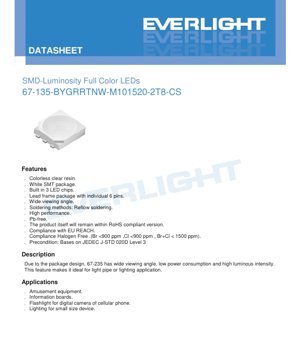
1. Product Overview
This document details the specifications for the 67-135-BYGRRTNW-M101520-2T8-CS, a surface-mount device (SMD) full-color LED. This component integrates three individual LED chips (Red, Green, Blue) within a single white diffuser resin package, enabling the generation of a wide spectrum of colors through additive color mixing. The device is designed for applications requiring compact size, high luminous intensity, and a wide viewing angle.
1.1 Core Advantages
The primary advantages of this LED stem from its package design and material selection. The use of a colorless clear resin with a white diffuser SMT package ensures excellent light diffusion and a consistent appearance. The integrated three-chip design simplifies circuit design by providing a single component for full-color output. The lead frame package with individual six pins allows for independent control of each color channel. Furthermore, the device is compliant with major environmental and safety standards, including RoHS, REACH, and Halogen-Free requirements (Br <900 ppm, Cl <900 ppm, Br+Cl < 1500 ppm).
1.2 Target Market and Applications
This LED is ideal for applications where space is limited and vibrant, multi-color indication or illumination is required. Its high performance and reliability make it suitable for consumer electronics, portable devices, and signage. Typical applications include backlighting for information boards, status indicators on amusement equipment, flashlight modules for mobile phone cameras, and general decorative or functional lighting in small electronic devices.
2. Technical Parameter Deep-Dive
The following sections provide a detailed, objective analysis of the device's key technical parameters as defined in the datasheet.
2.1 Absolute Maximum Ratings
These ratings define the limits beyond which permanent damage to the device may occur. Operating the LED under these conditions is not recommended. Key ratings include a continuous forward current (IF) of 30 mA per color channel (Blue/Yellow, Green, Red), a peak forward current (IFP) of 60 mA per channel at a 1/10 duty cycle and 1 kHz, and power dissipation (Pd) ranging from 82 mW to 102 mW depending on the chip. The maximum junction temperature (Tj) is 115°C, with an operating temperature range (Topr) of -40°C to +85°C. The device can withstand an ESD level of 2000V.
2.2 Electro-Optical Characteristics
These characteristics are measured at Ta=25°C and define the typical performance of the device under specified test conditions.
2.2.1 Luminous Intensity and Viewing Angle
The luminous intensity (Iv) varies by color. Under test conditions of IF=10mA for Blue, 15mA for Green, and 20mA for Red, the typical values are: Blue: 140-355 mcd, Green: 900-2240 mcd, Red: 450-1120 mcd. The combined mixed white output has a typical intensity of 1400-3550 mcd. The viewing angle (2θ1/2) is a wide 120 degrees, which is beneficial for applications requiring broad illumination or visibility.
2.2.2 Wavelength and Spectral Characteristics
The peak wavelength (λp) is typically 460 nm (Blue), 520 nm (Green), and 630 nm (Red). The dominant wavelength (λd) ranges are: Blue: 460-475 nm, Green: 520-535 nm, Red: 617.5-629.5 nm. The spectral radiation bandwidth (Δλ) is approximately 23 nm for Blue, 30 nm for Green, and 18 nm for Red. These parameters are critical for color accuracy and consistency in display or lighting applications.
2.2.3 Electrical Parameters
The forward voltage (VF) for the Blue and Green chips ranges from 2.40V to 3.40V at their respective test currents. The Red chip has a lower forward voltage range of 1.75V to 2.75V at 20mA. The device also includes an integrated Zener diode for protection, with a Zener voltage (VZ) between 5.30V and 7.00V at a test current (IZ) of 5mA.
3. Binning System Explanation
To ensure color and brightness consistency in production, the LEDs are sorted into bins.
3.1 Luminous Intensity Binning
The mixed white output is categorized into bins based on minimum and maximum luminous intensity values. The bin codes are AB (1400-1800 mcd), BA (1800-2240 mcd), BB (2240-2800 mcd), and CA (2800-3550 mcd). A tolerance of ±11% applies to the luminous intensity.
3.2 Chromaticity Coordinate Binning
The color output is precisely controlled through binning on the CIE 1931 chromaticity diagram. Nine bins (S1 through S9) are defined, each representing a small quadrilateral area on the x,y coordinate plane. The coordinates for each vertex of these bins are provided in the datasheet. The tolerance for chromaticity coordinates is ±0.01, ensuring tight color control for applications where precise color matching is essential.
4. Performance Curve Analysis
The datasheet includes several characteristic curves that illustrate the device's behavior under varying conditions.
4.1 Spectral Distribution and Radiation Pattern
A typical spectral distribution curve shows the relative intensity of light emitted across different wavelengths for each chip, overlayed with the standard human eye response curve V(λ). The diagram of radiation characteristics illustrates the spatial distribution of light intensity, which is related to the 120-degree viewing angle.
4.2 Current-Voltage (I-V) Characteristics
Separate curves for the BY (Blue), GR (Green), and RTN (Red) chips plot forward current against forward voltage. These curves are essential for designing the appropriate current-limiting circuitry for each channel, as the relationship is non-linear (exponential).
4.3 Dominant Wavelength vs. Forward Current
These curves show how the dominant wavelength of each chip may shift slightly with changes in the forward current. This information is important for applications requiring stable color output across different brightness levels.
4.4 Relative Luminous Intensity vs. Forward Current
This relationship is generally linear within the recommended operating range, showing how light output increases with current. Designers use this to achieve desired brightness levels.
4.5 Maximum Permissible Forward Current vs. Temperature
This derating curve is crucial for reliability. It shows how the maximum safe continuous forward current must be reduced as the ambient temperature increases. Operating above this curve can lead to overheating and reduced lifespan.
5. Mechanical and Package Information
5.1 Package Dimensions
The device has a specific SMD footprint. The package dimension drawing provides all critical measurements including length, width, height, pad sizes, and pin spacing. All tolerances are ±0.1mm unless otherwise specified. The unit of measurement is millimeters (mm). This information is vital for PCB layout design to ensure proper fit and soldering.
5.2 Pad Design and Polarity Identification
The six-pin lead frame allows for individual anode/cathode connections for each of the three LED chips. The datasheet's dimension diagram clearly indicates the pinout configuration, showing which pads correspond to the anode and cathode for the Red, Green, and Blue chips. Correct polarity must be observed during assembly to ensure proper function.
6. Soldering and Assembly Guidelines
6.1 Reflow Soldering Parameters
The recommended soldering method is reflow soldering. The maximum soldering temperature (Tsol) is 260°C for a duration of 10 seconds. This profile must be adhered to in order to prevent thermal damage to the LED package, solder joints, and the internal wire bonds.
6.2 Hand Soldering (If Applicable)
While reflow is preferred, hand soldering is specified as an alternative with stricter limits: a maximum temperature of 350°C for only 3 seconds. Extreme care must be taken to localize heat and avoid prolonged exposure.
6.3 Preconditioning and Moisture Sensitivity
The device is preconditioned based on JEDEC J-STD-020D Level 3. This indicates the component's sensitivity to moisture absorption before soldering. For reliable assembly, especially if the device has been exposed to ambient air for extended periods, proper baking procedures as per the JEDEC standard should be followed prior to reflow soldering.
6.4 Storage Conditions
The storage temperature range (Tstg) is -40°C to +100°C. Components should be stored in a dry, controlled environment, preferably in their original moisture-barrier bags with desiccant until ready for use.
7. Application Suggestions
7.1 Typical Application Circuits
Each color channel requires a series current-limiting resistor. The value is calculated using Ohm's Law: R = (Vsupply - VF) / IF, where VF is the forward voltage of the specific chip at the desired current (IF). Due to the different VF and recommended IF values for each color, three separate resistor values will typically be needed. A microcontroller or dedicated LED driver IC can be used for pulse-width modulation (PWM) to control brightness and create color mixes.
7.2 Design Considerations
- Thermal Management: Ensure adequate PCB copper area or thermal vias, especially if operating near maximum currents or in high ambient temperatures, to dissipate heat and maintain junction temperature within limits.
- Current Control: Always use constant current driving or a current-limiting resistor. Direct connection to a voltage source will cause excessive current and destroy the LED.
- Optical Design: The wide 120-degree viewing angle makes it suitable for direct viewing. For light pipe applications, consider the coupling efficiency and potential color mixing within the light guide.
- ESD Protection: While the device has a 2000V ESD rating, implementing additional ESD protection on sensitive lines in the end product is good practice for robustness.
8. Frequently Asked Questions (Based on Technical Parameters)
Q: Can I drive all three chips at the same 20mA current?
A: While possible, it is not recommended per the test conditions. The datasheet specifies optimal test currents of 10mA (Blue), 15mA (Green), and 20mA (Red) for the published photometric data. Driving the Blue and Green chips at 20mA will increase light output but also power dissipation and junction temperature, potentially affecting longevity and color stability. Always refer to the Absolute Maximum Ratings.
Q: How do I achieve pure white light?
A: Pure white is achieved by mixing the correct intensities of red, green, and blue light. Due to variations in human perception and chip efficiency, the currents needed are not equal. The typical mixed white intensity data (1400-3550 mcd) is measured with the specific current ratio of B:10mA, G:15mA, R:20mA. Fine-tuning through PWM or analog current adjustment may be necessary for a desired white point (e.g., cool white, warm white).
Q: What is the purpose of the integrated Zener diode?
A: The Zener diode is connected in parallel with the LED chip(s), likely in a reverse-biased orientation. It acts as a voltage clamp to protect the sensitive LED junction from transient voltage spikes or electrostatic discharge (ESD) events that could otherwise cause damage.
9. Operating Principle
The device operates on the principle of electroluminescence in semiconductor materials. The three integrated chips are made from different semiconductor compounds: AlGaInP for the Red chip, and InGaN for the Green and Blue chips. When a forward voltage is applied across the p-n junction of a chip, electrons and holes recombine, releasing energy in the form of photons (light). The specific bandgap energy of the semiconductor material determines the wavelength (color) of the emitted light. By independently controlling the intensity of these three primary colors (Red, Green, Blue), a vast array of secondary colors can be produced through additive color mixing directly within the device's diffuser package.
LED Specification Terminology
Complete explanation of LED technical terms
Photoelectric Performance
| Term | Unit/Representation | Simple Explanation | Why Important |
|---|---|---|---|
| Luminous Efficacy | lm/W (lumens per watt) | Light output per watt of electricity, higher means more energy efficient. | Directly determines energy efficiency grade and electricity cost. |
| Luminous Flux | lm (lumens) | Total light emitted by source, commonly called "brightness". | Determines if the light is bright enough. |
| Viewing Angle | ° (degrees), e.g., 120° | Angle where light intensity drops to half, determines beam width. | Affects illumination range and uniformity. |
| CCT (Color Temperature) | K (Kelvin), e.g., 2700K/6500K | Warmth/coolness of light, lower values yellowish/warm, higher whitish/cool. | Determines lighting atmosphere and suitable scenarios. |
| CRI / Ra | Unitless, 0–100 | Ability to render object colors accurately, Ra≥80 is good. | Affects color authenticity, used in high-demand places like malls, museums. |
| SDCM | MacAdam ellipse steps, e.g., "5-step" | Color consistency metric, smaller steps mean more consistent color. | Ensures uniform color across same batch of LEDs. |
| Dominant Wavelength | nm (nanometers), e.g., 620nm (red) | Wavelength corresponding to color of colored LEDs. | Determines hue of red, yellow, green monochrome LEDs. |
| Spectral Distribution | Wavelength vs intensity curve | Shows intensity distribution across wavelengths. | Affects color rendering and quality. |
Electrical Parameters
| Term | Symbol | Simple Explanation | Design Considerations |
|---|---|---|---|
| Forward Voltage | Vf | Minimum voltage to turn on LED, like "starting threshold". | Driver voltage must be ≥Vf, voltages add up for series LEDs. |
| Forward Current | If | Current value for normal LED operation. | Usually constant current drive, current determines brightness & lifespan. |
| Max Pulse Current | Ifp | Peak current tolerable for short periods, used for dimming or flashing. | Pulse width & duty cycle must be strictly controlled to avoid damage. |
| Reverse Voltage | Vr | Max reverse voltage LED can withstand, beyond may cause breakdown. | Circuit must prevent reverse connection or voltage spikes. |
| Thermal Resistance | Rth (°C/W) | Resistance to heat transfer from chip to solder, lower is better. | High thermal resistance requires stronger heat dissipation. |
| ESD Immunity | V (HBM), e.g., 1000V | Ability to withstand electrostatic discharge, higher means less vulnerable. | Anti-static measures needed in production, especially for sensitive LEDs. |
Thermal Management & Reliability
| Term | Key Metric | Simple Explanation | Impact |
|---|---|---|---|
| Junction Temperature | Tj (°C) | Actual operating temperature inside LED chip. | Every 10°C reduction may double lifespan; too high causes light decay, color shift. |
| Lumen Depreciation | L70 / L80 (hours) | Time for brightness to drop to 70% or 80% of initial. | Directly defines LED "service life". |
| Lumen Maintenance | % (e.g., 70%) | Percentage of brightness retained after time. | Indicates brightness retention over long-term use. |
| Color Shift | Δu′v′ or MacAdam ellipse | Degree of color change during use. | Affects color consistency in lighting scenes. |
| Thermal Aging | Material degradation | Deterioration due to long-term high temperature. | May cause brightness drop, color change, or open-circuit failure. |
Packaging & Materials
| Term | Common Types | Simple Explanation | Features & Applications |
|---|---|---|---|
| Package Type | EMC, PPA, Ceramic | Housing material protecting chip, providing optical/thermal interface. | EMC: good heat resistance, low cost; Ceramic: better heat dissipation, longer life. |
| Chip Structure | Front, Flip Chip | Chip electrode arrangement. | Flip chip: better heat dissipation, higher efficacy, for high-power. |
| Phosphor Coating | YAG, Silicate, Nitride | Covers blue chip, converts some to yellow/red, mixes to white. | Different phosphors affect efficacy, CCT, and CRI. |
| Lens/Optics | Flat, Microlens, TIR | Optical structure on surface controlling light distribution. | Determines viewing angle and light distribution curve. |
Quality Control & Binning
| Term | Binning Content | Simple Explanation | Purpose |
|---|---|---|---|
| Luminous Flux Bin | Code e.g., 2G, 2H | Grouped by brightness, each group has min/max lumen values. | Ensures uniform brightness in same batch. |
| Voltage Bin | Code e.g., 6W, 6X | Grouped by forward voltage range. | Facilitates driver matching, improves system efficiency. |
| Color Bin | 5-step MacAdam ellipse | Grouped by color coordinates, ensuring tight range. | Guarantees color consistency, avoids uneven color within fixture. |
| CCT Bin | 2700K, 3000K etc. | Grouped by CCT, each has corresponding coordinate range. | Meets different scene CCT requirements. |
Testing & Certification
| Term | Standard/Test | Simple Explanation | Significance |
|---|---|---|---|
| LM-80 | Lumen maintenance test | Long-term lighting at constant temperature, recording brightness decay. | Used to estimate LED life (with TM-21). |
| TM-21 | Life estimation standard | Estimates life under actual conditions based on LM-80 data. | Provides scientific life prediction. |
| IESNA | Illuminating Engineering Society | Covers optical, electrical, thermal test methods. | Industry-recognized test basis. |
| RoHS / REACH | Environmental certification | Ensures no harmful substances (lead, mercury). | Market access requirement internationally. |
| ENERGY STAR / DLC | Energy efficiency certification | Energy efficiency and performance certification for lighting. | Used in government procurement, subsidy programs, enhances competitiveness. |