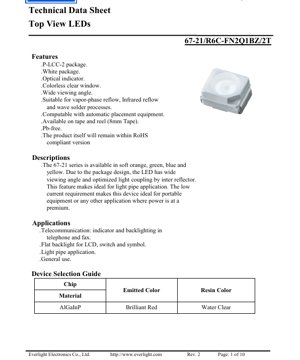
1. Product Overview
The 67-21 series represents a family of Top View LEDs designed for general-purpose indicator and backlighting applications. These components are housed in a compact P-LCC-2 (Plastic Leaded Chip Carrier) package with a white body and a colorless clear window. This design is optimized to provide a wide viewing angle, making the LEDs particularly suitable for applications where light needs to be visible from various angles, such as in light pipes. The series is available in multiple emitted colors, including soft orange, green, blue, and yellow, with the specific model in this datasheet being a brilliant red variant based on AlGaInP chip material. A key advantage of this series is its low current requirement, which makes it an excellent choice for battery-powered or power-sensitive portable equipment.
1.1 Core Features and Advantages
The primary features of the 67-21 series LEDs contribute to their versatility and ease of use in modern electronics manufacturing. The P-LCC-2 surface-mount package facilitates automated placement using standard pick-and-place equipment, significantly improving assembly efficiency and consistency. The package is designed with an inter-reflector that optimizes light coupling and output, enhancing brightness and uniformity. Furthermore, these LEDs are constructed with a Pb-free (lead-free) composition and comply with RoHS (Restriction of Hazardous Substances) directives, meeting contemporary environmental and regulatory standards. Their compatibility with various soldering processes, including vapor-phase reflow, infrared reflow, and wave soldering, provides flexibility in production line setup. The components are supplied on 8mm tape and reel, which is the standard for automated assembly lines, ensuring smooth handling and feeding during manufacturing.
1.2 Target Applications and Markets
The 67-21 series LEDs find use in a broad spectrum of applications due to their reliable performance and compact form factor. A primary market is telecommunications, where they serve as status indicators and backlighting for keys or displays in devices like telephones and fax machines. They are also commonly employed for flat backlighting of LCDs and for illuminating switches and symbols on control panels. Their wide viewing angle and efficient light coupling make them the ideal choice for light pipe applications, where light needs to be guided from the LED to a visible point on a device's exterior. Finally, their general-purpose nature makes them suitable for countless other indicator roles in consumer electronics, industrial controls, automotive interiors, and home appliances.
2. Technical Parameter Analysis
This section provides a detailed, objective interpretation of the key electrical, optical, and thermal parameters specified in the datasheet. Understanding these values is crucial for proper circuit design and ensuring long-term reliability.
2.1 Absolute Maximum Ratings
The Absolute Maximum Ratings define the stress limits beyond which permanent damage to the LED may occur. These are not conditions for normal operation. The maximum reverse voltage (V_R) is 5V, indicating the LED can withstand brief reverse bias up to this level. The continuous forward current (I_F) rating is 25 mA. For pulsed operation, a peak forward current (I_FP) of 60 mA is allowed under a duty cycle of 1/10 at 1 kHz. The maximum power dissipation (P_d) is 60 mW, calculated from the forward voltage and current. The device can handle an electrostatic discharge (ESD) of 2000V per the Human Body Model (HBM), which is a standard level for basic component handling. The operating temperature range (T_opr) is from -40°C to +85°C, and the storage temperature (T_stg) extends slightly to -40°C to +90°C.
2.2 Electro-Optical Characteristics
The Electro-Optical Characteristics are measured at a standard test condition of 25°C ambient temperature and a forward current of 10 mA. For the brilliant red variant, the luminous intensity (I_v) has a typical value, with a minimum of 36 mcd and a maximum of 90 mcd. The viewing angle (2θ1/2), defined as the angle where intensity drops to half of its peak value, is a wide 120 degrees. The peak wavelength (λ_p) is typically 632 nm, while the dominant wavelength (λ_d) ranges from 621 nm to 631 nm. The spectral bandwidth (Δλ) is typically 20 nm. The forward voltage (V_F) at 10 mA ranges from a minimum of 1.75V to a maximum of 2.35V, with a typical value implied within this range. The reverse current (I_R) is guaranteed to be 10 μA or less when a 5V reverse bias is applied.
2.3 Thermal and Soldering Characteristics
Thermal management is indirectly addressed through the forward current derating curve, which shows how the maximum permissible continuous forward current must be reduced as the ambient temperature increases above 25°C. The datasheet specifies soldering temperature profiles to prevent thermal damage during assembly. For reflow soldering, the LED can withstand a peak temperature of 260°C for up to 10 seconds. For hand soldering, a temperature of 350°C at the iron tip is permissible for a maximum of 3 seconds. Adhering to these guidelines is essential to maintain the integrity of the plastic package and the internal wire bonds.
3. Binning System Explanation
To ensure consistency in mass production, LEDs are sorted into bins based on key parameters. The 67-21 series uses a binning system for luminous intensity, dominant wavelength, and forward voltage.
3.1 Luminous Intensity Binning
Luminous intensity is grouped into several bins identified by codes like N2, P1, P2, and Q1. Each bin defines a specific range of minimum and maximum intensity values measured in millicandelas (mcd) at 10 mA. For example, bin Q1 covers intensities from 72 mcd to 90 mcd. Designers can select a specific bin code to guarantee a minimum brightness level for their application.
3.2 Dominant Wavelength Binning
Dominant wavelength, which correlates with perceived color, is also binned. The bins, such as FF1 and FF2, define tight ranges in nanometers (nm). For instance, bin FF1 covers wavelengths from 621 nm to 626 nm, and FF2 covers 626 nm to 631 nm. This allows for precise color matching across multiple LEDs in a single product, which is critical for applications requiring uniform appearance.
3.3 Forward Voltage Binning
Forward voltage is binned into groups labeled 0, 1, and 2 under a main group 'B'. Group 0 covers 1.75V to 1.95V, Group 1 covers 1.95V to 2.15V, and Group 2 covers 2.15V to 2.35V. Knowing the voltage bin can be important for designing efficient current-limiting circuits, especially in battery-powered devices where every millivolt counts.
4. Performance Curve Analysis
The datasheet includes several typical characteristic curves that provide deeper insight into the LED's behavior under varying conditions.
4.1 Relative Luminous Intensity vs. Forward Current
This curve shows that light output is not linearly proportional to current. It increases rapidly at lower currents but tends to saturate at higher currents. This non-linearity is important for PWM (Pulse Width Modulation) dimming designs, where average current controls brightness.
4.2 Forward Voltage vs. Forward Current & Forward Current Derating
The V-I curve demonstrates the diode's exponential relationship. The derating curve is critical for reliability; it mandates a reduction in the maximum allowable continuous forward current as the ambient temperature rises above 25°C to prevent overheating and accelerated degradation.
4.3 Relative Luminous Intensity vs. Ambient Temperature & Spectrum Distribution
The intensity vs. temperature curve shows that light output generally decreases as temperature increases, a characteristic of most LEDs. The spectrum distribution plot confirms the monochromatic nature of the light, centered around the peak wavelength with the specified bandwidth.
4.4 Radiation Diagram
This polar plot visually confirms the wide 120-degree viewing angle, showing how light intensity is distributed spatially. The pattern is typically Lambertian or near-Lambertian for this type of package.
5. Mechanical and Packaging Information
5.1 Package Dimensions and Tolerances
The LED package has specific dimensions, including body size, lead spacing, and overall height. The drawing indicates a typical P-LCC-2 footprint. Unless otherwise noted, dimensional tolerances are ±0.1 mm, which is standard for molded plastic components. The cathode is typically identified by a marker on the package or a specific lead shape.
5.2 Tape and Reel Specifications
For automated assembly, the LEDs are supplied on 8mm wide carrier tape wound onto reels. The datasheet provides detailed dimensions for the carrier pocket, pitch, and reel hub. Each reel contains 2000 pieces. Proper reel dimensions are necessary for compatibility with automated feeder systems on placement machines.
5.3 Moisture-Sensitive Packaging
The components are packaged in a moisture-resistant aluminum bag with a desiccant inside. A humidity indicator card (HIC) is included to show if the bag's internal humidity has exceeded safe levels. This packaging is essential to prevent \"popcorning\" or delamination during the high-temperature reflow soldering process, which can occur if moisture is absorbed by the plastic package.
6. Soldering and Assembly Guidelines
Correct handling and soldering are vital for yield and reliability. The LEDs are compatible with vapor-phase, infrared reflow, and wave soldering processes. The specified reflow profile with a peak of 260°C for 10 seconds must be followed. For manual soldering, a controlled iron at 350°C should contact the lead for no more than 3 seconds. Components should be stored in their original moisture-proof bags until use. Once the bag is opened, if the humidity indicator shows a warning, the parts should be baked according to standard IPC/JEDEC guidelines before soldering.
7. Reliability Testing
The datasheet lists a comprehensive set of reliability tests performed under specific conditions with a 90% confidence level and an LTPD (Lot Tolerance Percent Defective) of 10%. Tests include reflow soldering resistance, temperature cycling (-40°C to +100°C), thermal shock, high and low temperature storage, DC operating life at elevated current (20mA), and high temperature/high humidity (85°C/85% RH) testing. Each test is conducted for a specified duration (e.g., 1000 hours) on a sample of 22 pieces with zero failures allowed (Ac/Re = 0/1). Passing these tests indicates a robust product suitable for demanding applications.
8. Application Design Considerations
8.1 Circuit Design
A current-limiting resistor is mandatory when driving the LED from a voltage source. The resistor value (R) is calculated as R = (V_supply - V_F) / I_F, where V_F is the LED's forward voltage (use max value for a safe design) and I_F is the desired forward current (not to exceed 25 mA DC). For example, with a 5V supply and a V_F of 2.35V at 20 mA, R = (5 - 2.35) / 0.02 = 132.5 Ω (use 130 Ω or 150 Ω standard value). For reverse voltage protection, especially in AC-coupled or poorly regulated circuits, a parallel protection diode may be considered, though the LED itself can tolerate up to 5V in reverse.
8.2 Thermal Management
While the LED itself has low power dissipation, proper PCB layout can aid heat dissipation. Ensure the solder pads connected to the LED's thermal pad (if present) or leads have sufficient copper area to act as a heat sink. Avoid operating at the absolute maximum current and temperature simultaneously; refer to the derating curve.
8.3 Optical Integration
For light pipe applications, the LED should be positioned accurately under the pipe's input surface. The wide viewing angle helps capture more light into the pipe. Consider potential light leakage and use opaque barriers if necessary to prevent cross-talk between adjacent indicators. The clear, colorless window ensures minimal color distortion.
9. Comparison and Differentiation
Compared to simpler radial-leaded LEDs, the 67-21 series offers the significant advantage of surface-mount technology (SMT), enabling smaller, lighter, and more automated assembly. Its wide 120-degree viewing angle is superior to many narrower-angle SMT LEDs, making it uniquely suited for light pipes and wide-area indication. The low forward voltage (especially in the lower bins) is advantageous for low-voltage battery operation compared to some blue or white LEDs which have higher V_F. The comprehensive binning system provides better color and brightness consistency than unbinned or loosely binned generic LEDs.
10. Frequently Asked Questions (FAQs)
10.1 What is the difference between peak wavelength and dominant wavelength?
Peak wavelength (λ_p) is the wavelength at which the spectral power distribution is maximum. Dominant wavelength (λ_d) is the single wavelength of monochromatic light that would match the perceived color of the LED. For narrow-spectrum LEDs like this red one, they are often very close, but λ_d is more relevant for color specification.
10.2 Can I drive this LED without a current-limiting resistor?
No. An LED is a current-driven device. Connecting it directly to a voltage source will cause excessive current to flow, quickly exceeding the maximum rating (25 mA) and destroying the device. A series resistor or constant-current driver is always required.
10.3 How do I interpret the label on the reel or bag?
The label includes codes for CAT (Luminous Intensity Rank), HUE (Dominant Wavelength Rank), and REF (Forward Voltage Rank). These correspond directly to the bin codes outlined in sections 3.1, 3.2, and 3.3. For example, a label showing CAT: Q1, HUE: FF2, REF: 1 specifies an LED from the highest brightness bin (72-90 mcd), the upper wavelength bin (626-631 nm), and the middle voltage bin (1.95-2.15V).
10.4 Is this LED suitable for outdoor use?
The operating temperature range of -40°C to +85°C covers most outdoor conditions. However, the package is not specifically rated for waterproofing or high UV resistance. For direct outdoor exposure, additional environmental protection (conformal coating, sealed enclosures) would be necessary to protect against moisture, dust, and sunlight degradation.
11. Practical Use Case Example
Scenario: Designing a status indicator panel for a network router. The panel has multiple icons (Power, Internet, Wi-Fi) that need to be illuminated. Space is limited on the PCB. The 67-21 series LED is an ideal choice. Its SMT P-LCC-2 package saves space compared to through-hole LEDs. The wide 120-degree viewing angle ensures the icons are clearly visible from various angles in a room. A light pipe is designed for each icon to guide light from the LED mounted on the main PCB to the front panel. The designer selects LEDs from the same intensity (e.g., P2) and wavelength (e.g., FF2) bins to ensure uniform brightness and color across all indicators. A simple driver circuit with a current-limiting resistor is used for each LED, connected to a GPIO pin on the router's microcontroller for individual control. The low current consumption (e.g., 10 mA per LED) minimizes the load on the system's power supply.
12. Technical Principle Introduction
Light Emitting Diodes (LEDs) are semiconductor devices that emit light through electroluminescence. When a forward voltage is applied across the p-n junction, electrons from the n-type region recombine with holes from the p-type region in the active layer. This recombination releases energy in the form of photons (light). The specific wavelength (color) of the emitted light is determined by the bandgap energy of the semiconductor material used. The 67-21 series red LED uses an AlGaInP (Aluminum Gallium Indium Phosphide) chip, which is a common material system for producing high-efficiency red, orange, and yellow light. The plastic package serves to protect the fragile semiconductor die, provide a mechanical structure for the leads, and incorporate a lens or dome that shapes the light output beam, resulting in the wide viewing angle characteristic.
13. Industry Trends and Developments
The LED industry continues to evolve towards higher efficiency, smaller packages, and greater integration. While the 67-21 series represents a mature and reliable technology, trends in indicator LEDs include the development of even smaller form factors (e.g., chip-scale packages), higher brightness at lower currents, and broader adoption of multi-color (RGB) LEDs in a single package for dynamic color indication. There is also a growing emphasis on improved color consistency and tighter binning directly from manufacturers to reduce calibration needs for end-users. Furthermore, the drive for sustainability pushes for further reduction in material usage and energy consumption throughout the lifecycle of the component. The principles of wide viewing angle, reliable performance, and compatibility with automated assembly seen in the 67-21 series remain foundational to these advancements.
LED Specification Terminology
Complete explanation of LED technical terms
Photoelectric Performance
| Term | Unit/Representation | Simple Explanation | Why Important |
|---|---|---|---|
| Luminous Efficacy | lm/W (lumens per watt) | Light output per watt of electricity, higher means more energy efficient. | Directly determines energy efficiency grade and electricity cost. |
| Luminous Flux | lm (lumens) | Total light emitted by source, commonly called "brightness". | Determines if the light is bright enough. |
| Viewing Angle | ° (degrees), e.g., 120° | Angle where light intensity drops to half, determines beam width. | Affects illumination range and uniformity. |
| CCT (Color Temperature) | K (Kelvin), e.g., 2700K/6500K | Warmth/coolness of light, lower values yellowish/warm, higher whitish/cool. | Determines lighting atmosphere and suitable scenarios. |
| CRI / Ra | Unitless, 0–100 | Ability to render object colors accurately, Ra≥80 is good. | Affects color authenticity, used in high-demand places like malls, museums. |
| SDCM | MacAdam ellipse steps, e.g., "5-step" | Color consistency metric, smaller steps mean more consistent color. | Ensures uniform color across same batch of LEDs. |
| Dominant Wavelength | nm (nanometers), e.g., 620nm (red) | Wavelength corresponding to color of colored LEDs. | Determines hue of red, yellow, green monochrome LEDs. |
| Spectral Distribution | Wavelength vs intensity curve | Shows intensity distribution across wavelengths. | Affects color rendering and quality. |
Electrical Parameters
| Term | Symbol | Simple Explanation | Design Considerations |
|---|---|---|---|
| Forward Voltage | Vf | Minimum voltage to turn on LED, like "starting threshold". | Driver voltage must be ≥Vf, voltages add up for series LEDs. |
| Forward Current | If | Current value for normal LED operation. | Usually constant current drive, current determines brightness & lifespan. |
| Max Pulse Current | Ifp | Peak current tolerable for short periods, used for dimming or flashing. | Pulse width & duty cycle must be strictly controlled to avoid damage. |
| Reverse Voltage | Vr | Max reverse voltage LED can withstand, beyond may cause breakdown. | Circuit must prevent reverse connection or voltage spikes. |
| Thermal Resistance | Rth (°C/W) | Resistance to heat transfer from chip to solder, lower is better. | High thermal resistance requires stronger heat dissipation. |
| ESD Immunity | V (HBM), e.g., 1000V | Ability to withstand electrostatic discharge, higher means less vulnerable. | Anti-static measures needed in production, especially for sensitive LEDs. |
Thermal Management & Reliability
| Term | Key Metric | Simple Explanation | Impact |
|---|---|---|---|
| Junction Temperature | Tj (°C) | Actual operating temperature inside LED chip. | Every 10°C reduction may double lifespan; too high causes light decay, color shift. |
| Lumen Depreciation | L70 / L80 (hours) | Time for brightness to drop to 70% or 80% of initial. | Directly defines LED "service life". |
| Lumen Maintenance | % (e.g., 70%) | Percentage of brightness retained after time. | Indicates brightness retention over long-term use. |
| Color Shift | Δu′v′ or MacAdam ellipse | Degree of color change during use. | Affects color consistency in lighting scenes. |
| Thermal Aging | Material degradation | Deterioration due to long-term high temperature. | May cause brightness drop, color change, or open-circuit failure. |
Packaging & Materials
| Term | Common Types | Simple Explanation | Features & Applications |
|---|---|---|---|
| Package Type | EMC, PPA, Ceramic | Housing material protecting chip, providing optical/thermal interface. | EMC: good heat resistance, low cost; Ceramic: better heat dissipation, longer life. |
| Chip Structure | Front, Flip Chip | Chip electrode arrangement. | Flip chip: better heat dissipation, higher efficacy, for high-power. |
| Phosphor Coating | YAG, Silicate, Nitride | Covers blue chip, converts some to yellow/red, mixes to white. | Different phosphors affect efficacy, CCT, and CRI. |
| Lens/Optics | Flat, Microlens, TIR | Optical structure on surface controlling light distribution. | Determines viewing angle and light distribution curve. |
Quality Control & Binning
| Term | Binning Content | Simple Explanation | Purpose |
|---|---|---|---|
| Luminous Flux Bin | Code e.g., 2G, 2H | Grouped by brightness, each group has min/max lumen values. | Ensures uniform brightness in same batch. |
| Voltage Bin | Code e.g., 6W, 6X | Grouped by forward voltage range. | Facilitates driver matching, improves system efficiency. |
| Color Bin | 5-step MacAdam ellipse | Grouped by color coordinates, ensuring tight range. | Guarantees color consistency, avoids uneven color within fixture. |
| CCT Bin | 2700K, 3000K etc. | Grouped by CCT, each has corresponding coordinate range. | Meets different scene CCT requirements. |
Testing & Certification
| Term | Standard/Test | Simple Explanation | Significance |
|---|---|---|---|
| LM-80 | Lumen maintenance test | Long-term lighting at constant temperature, recording brightness decay. | Used to estimate LED life (with TM-21). |
| TM-21 | Life estimation standard | Estimates life under actual conditions based on LM-80 data. | Provides scientific life prediction. |
| IESNA | Illuminating Engineering Society | Covers optical, electrical, thermal test methods. | Industry-recognized test basis. |
| RoHS / REACH | Environmental certification | Ensures no harmful substances (lead, mercury). | Market access requirement internationally. |
| ENERGY STAR / DLC | Energy efficiency certification | Energy efficiency and performance certification for lighting. | Used in government procurement, subsidy programs, enhances competitiveness. |