1. Introduction & Overview
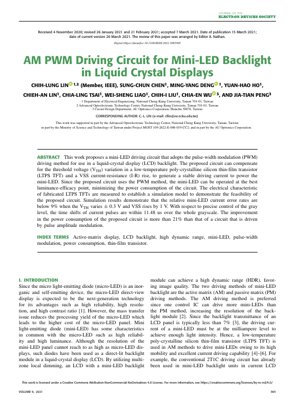
This paper presents a significant advancement in backlight technology for Liquid Crystal Displays (LCDs). It addresses a critical bottleneck in achieving High Dynamic Range (HDR) with mini-LED backlights: the non-uniform driving current caused by inherent variations in the manufacturing of Low-Temperature Polycrystalline Silicon Thin-Film Transistors (LTPS TFTs) and voltage drops across power lines. The authors propose an innovative Active-Matrix (AM) driving circuit that employs Pulse-Width Modulation (PWM) instead of the more common Pulse Amplitude Modulation (PAM). The core innovation lies in the circuit's ability to compensate for threshold voltage ($V_{TH}$) shifts in the driving TFT and power supply ($V_{SS}$) variations, thereby generating a stable current for the mini-LED. This stability is crucial for eliminating visual artifacts ("mura") and enabling precise local dimming. Furthermore, by operating the mini-LED at its optimal luminance-efficacy point via PWM, the design achieves a substantial reduction in power consumption—over 21% compared to PAM-driven circuits—while maintaining excellent grayscale control.
Current Error Rate
< 9%
Under $V_{TH}$ ±0.3V & $V_{SS}$ +1V variation
Power Saving
> 21%
vs. Pulse Amplitude Modulation (PAM)
Timing Precision
< 11.48 µs
Pulse shift across full grayscale
2. Core Technology & Methodology
2.1 The Challenge: TFT Non-Uniformity & IR Drop
The pursuit of high-resolution, multi-zone mini-LED backlights for LCD HDR is hampered by two fundamental hardware limitations. First, the Excimer Laser Annealing (ELA) process used to create LTPS TFTs results in non-uniform grain boundaries, causing significant spatial variation in the transistor's threshold voltage ($V_{TH}$). Second, the parasitic resistance in long power lines feeding an array of pixels causes a current-resistance (I-R) voltage drop (or rise for $V_{SS}$), meaning pixels farther from the power source receive a different voltage. In a conventional voltage-programmed current source circuit (like a simple 2T1C), these variations directly translate into non-uniform driving currents for the mini-LEDs, creating visible brightness inconsistencies—a fatal flaw for HDR imaging which demands pristine uniformity in dark areas.
2.2 The Proposed AM PWM Circuit Solution
The proposed circuit ingeniously shifts the problem domain. Instead of trying to perfect a stable analog current source (which is highly sensitive to $V_{TH}$ and $V_{SS}$), it uses a digital PWM approach. The core idea is to generate a driving current pulse whose amplitude is intentionally made dependent on $V_{TH}$ and $V_{SS}$, but whose width is modulated in an inverse, compensatory manner. The circuit design ensures that the total charge delivered per frame ($Q = I \times t_{pulse}$) remains constant despite variations in the instantaneous current (I). By carefully designing the feedback and timing mechanisms within the pixel circuit, the pulse width is automatically adjusted to compensate for changes in current amplitude, ensuring consistent light output. This "digital correction" is more robust to process variations than purely analog compensation schemes.
2.3 Technical Details & Mathematical Model
The operation can be abstracted into a charge-balancing principle. The driving TFT (e.g., in a saturated region) delivers a current to the mini-LED and an integrating capacitor. This current is given by: $$I_D = \frac{1}{2} \mu C_{ox} \frac{W}{L} (V_{GS} - V_{TH})^2$$ where $V_{GS}$ is affected by $V_{SS}$ (I-R drop). A variation $\Delta V_{TH}$ or $\Delta V_{SS}$ causes a change $\Delta I_D$. The proposed circuit includes a monitoring/comparison mechanism that detects the voltage on the integrating capacitor. The pulse is terminated when this voltage reaches a reference, meaning the pulse width $t_{pulse}$ satisfies: $$\int_0^{t_{pulse}} I_D(t) dt = Q_{target} = constant$$ If $I_D$ decreases due to higher $V_{TH}$ or lower $V_{DD}$, $t_{pulse}$ automatically increases to deliver the same total charge $Q_{target}$, and vice-versa. This ensures the luminance, which is proportional to $Q_{target}$, remains stable.
3. Experimental Results & Performance
3.1 Simulation Setup & Model
The feasibility was validated through SPICE simulations using a realistic LTPS TFT model. The model parameters were extracted from actual fabricated TFTs to accurately reflect the statistical $V_{TH}$ distribution and mobility variations expected from the ELA process. Simulations tested the circuit's performance across corners: typical, fast (low $V_{TH}$), and slow (high $V_{TH}$) TFTs, combined with nominal and shifted $V_{SS}$ levels.
3.2 Key Performance Metrics
- Current Uniformity: Measured as the relative error in the mini-LED current under worst-case perturbations.
- Grayscale Linearity: Evaluated by the timing shift of current pulses across the entire grayscale range (0-255).
- Power Efficiency: Calculated by comparing the total energy consumption per frame of the PWM circuit against an equivalent PAM circuit achieving the same luminance.
3.3 Results & Charts
Chart 1: Current Error vs. $V_{TH}$/$V_{SS}$ Variation – A bar or line chart would show that for a $V_{TH}$ shift of ±0.3V and a $V_{SS}$ rise of 1V (simulating severe I-R drop), the relative error in the output current is contained below 9%. In contrast, a conventional 2T1C circuit would show errors exceeding 30-40% under the same conditions.
Chart 2: Pulse Width vs. Grayscale – A graph plotting commanded grayscale value against generated pulse width would demonstrate high linearity. The critical metric is the maximum deviation from the ideal timing, which is reported as within 11.48 µs across all grayscales, indicating precise digital-to-time conversion.
Chart 3: Power Consumption Comparison – A comparative histogram would clearly show the proposed PWM circuit consuming over 21% less power than the PAM benchmark. This is because PWM allows the LED to be driven at its peak efficacy current continuously, modulating light output with time, whereas PAM often operates the LED at less efficient current levels for lower brightness.
4. Analysis Framework & Case Study
Framework: The "Robustness vs. Complexity" Trade-off in Display Pixel Design.
This paper provides a perfect case study for this framework. We can analyze display pixel circuits along two axes: 1) Robustness to Process/Operating Variations (e.g., $V_{TH}$ shift, IR drop), and 2) Circuit Complexity (transistor count, control signal requirements, layout area).
- Simple 2T1C (PAM): Low complexity (2 transistors), but very low robustness. Sensitive to all variations, leading to mura. Common in early OLED and simple backlights.
- Complex Voltage-Programmed AMOLED Pixels (4T2C, 5T2C, etc.): High robustness. Use internal feedback to compensate $V_{TH}$ and sometimes $IR$ drop. However, high complexity (more TFTs, capacitors, and control lines) reduces aperture ratio and yield.
- Proposed AM PWM Circuit: Positions itself in a sweet spot. It achieves high robustness (compensates for both $V_{TH}$ and $V_{SS}$) with moderate complexity. The transistor count is likely higher than 2T1C but potentially lower than the most complex AMOLED pixels, as it replaces precise analog voltage generation with digital timing control. The case study shows that for applications where light output is integrated over time (like LCD backlights or potentially micro-LED displays), a digitally-compensated PWM strategy can be a more area- and power-efficient path to uniformity than purely analog compensation.
5. Critical Analysis & Expert Insight
Core Insight: Lin et al. have executed a brilliant pivot. They've recognized that winning the losing battle for perfect analog uniformity in LTPS is less efficient than embracing a digital control paradigm. The real innovation isn't just another compensation circuit; it's the strategic decision to use PWM as the primary control variable, making the system inherently less sensitive to the analog imperfections that plague display manufacturing. This is reminiscent of the shift in data conversion from purely analog to oversampled, noise-shaped architectures (like in audio DACs) to circumvent component mismatch.
Logical Flow: The argument is sound: 1) Mini-LED backlights need stable current for HDR. 2) LTPS TFTs and power networks are inherently non-uniform. 3) Therefore, compensation is mandatory. 4) Existing analog compensation (from AMOLED) works but is complex. 5) Our solution: Let the current vary, but control time precisely to keep total charge constant. 6) Result: Robust uniformity + added benefit of power savings from optimal LED operating point. The logic is compelling and well-supported by simulation.
Strengths & Flaws:
Strengths: The dual compensation ($V_{TH}$ and IR) is a major win. The >21% power saving is a tangible, market-ready advantage. The concept is elegant and potentially scalable to micro-LED direct-view displays, where uniformity is an even bigger challenge, as noted in research from key players like PlayNitride and VueReal. The use of established LTPS technology eases manufacturing adoption.
Flaws & Questions: The paper is simulation-only. Real-world validation with a physical array, measuring actual mura reduction, is the critical next step. The analysis of circuit complexity (transistor count, layout area impact on backlight module design) is light. How does the switching frequency of the PWM affect EMI? For very high refresh rates (e.g., 240Hz gaming displays), does the required minimum pulse width for deep grayscales become a limiting factor? The 11.48 µs shift, while small, needs context—what percentage of the frame time is this at various refresh rates?
Actionable Insights: For display panel makers (like co-author AUO), this is a blueprint for next-gen backlight driver ICs. They should immediately prototype a small test array. For equipment and materials companies, this reinforces the continued value of LTPS technology, potentially extending its lifecycle against competing backplanes like oxide TFTs for this application. For researchers, the "digital compensation via PWM" principle should be explored for direct-view micro-LED displays, potentially simplifying the daunting transfer and binning requirements. The industry should monitor if this approach can be integrated with time-domain image processing techniques, similar to concepts explored in computational displays.
6. Future Applications & Development Directions
The implications of this work extend beyond mini-LED LCD backlights:
- Micro-LED Direct-View Displays: This is the most promising direction. Micro-LEDs suffer from even greater efficiency and wavelength binning variations. A PWM-based active-matrix circuit that compensates for both TFT non-uniformity and LED intrinsic variation could dramatically reduce the cost and complexity of the mass transfer process by relaxing the binning requirements. Research from institutions like MIT and Stanford has highlighted compensation as a key enabler for micro-LED commercialization.
- Transparent and Flexible Displays: On flexible substrates, TFT characteristics shift with bending stress. A robust digital compensation method like this could maintain image uniformity under mechanical deformation.
- High-Brightness Display Applications: For automotive displays or augmented reality (AR) waveguides that require extremely high brightness, operating LEDs at peak efficacy (as enabled by PWM) is crucial for managing heat and power budgets.
- Sensor-Integrated Displays: Future displays with embedded optical sensors (for fingerprint, ambient light, or health sensing) require extremely stable and noise-free illumination. A uniform, digitally-controlled backlight is ideal for such applications.
- Development Needs: Future work must focus on: a) Silicon verification with large-format test arrays, b) Minimizing circuit area to maximize backlight zone density, c) Investigating the use of newer TFT technologies (like metal oxide) within this PWM framework, and d) Developing advanced timing controllers that can interface seamlessly with this pixel-level PWM architecture.
7. References
- C.-L. Lin et al., "AM PWM Driving Circuit for Mini-LED Backlight in Liquid Crystal Displays," IEEE Journal of the Electron Devices Society, vol. 9, pp. 365-373, 2021. DOI: 10.1109/JEDS.2021.3065905.
- H. Chen et al., "Active Matrix Micro-LED Displays: Progress and Prospects," Journal of the Society for Information Display, vol. 29, no. 5, pp. 339-359, 2021.
- Z. Liu et al., "Review of Recent Progress on Micro-LEDs for High-Density Displays," IEEE Transactions on Electron Devices, vol. 68, no. 5, pp. 2022-2032, 2021.
- S. R. Forrest, "The path to ubiquitous and low-cost organic electronic appliances on plastic," Nature, vol. 428, pp. 911–918, 2004. (Seminal work on OLEDs, highlighting early uniformity challenges).
- J. G. R. et al., "A Voltage-Programmed Pixel Circuit for AMOLED Displays Compensating for Threshold Voltage and Mobility Variations," IEEE Transactions on Electron Devices, vol. 58, no. 10, pp. 3347-3352, 2011. (Example of complex analog compensation).
- International Committee for Display Metrology (ICDM), "Information Display Measurements Standard (IDMS),". (Authority on display performance metrics like uniformity and HDR).
- PlayNitride Inc., "PixeLED® Display Technology," [Online]. Available: https://www.playnitride.com/. (Industry leader in micro-LED technology).
- VueReal Inc., "Micro Solid-State Printing," [Online]. Available: https://vuereal.com/. (Company focusing on micro-LED transfer and integration solutions).