Table of Contents
- 1. Product Overview
- 2. Detailed Technical Parameters
- 2.1 Absolute Maximum Ratings
- 2.2 Electro-Optical Characteristics
- 3. Performance Curve Analysis
- 3.1 Spectral Sensitivity
- 3.2 Relationship Between Dark Current and Ambient Temperature
- 3.3 Relationship Between Reverse Photocurrent and Irradiance
- 3.4 Relationship Between Terminal Capacitance and Reverse Voltage
- 3.5 Relationship Between Response Time and Load Resistance
- 3.6 Relationship Between Power Consumption and Ambient Temperature
- 4. Mechanical and Packaging Information
- 4.1 Package Dimensions
- 4.2 Polarity Identification
- 5. Welding and Assembly Guide
- 6. Packaging and Ordering Information
- 6.1 Packaging Specifications
- 6.2 Label Specifications
- 7. Application Recommendations
- 7.1 Typical Application Scenarios
- 7.2 Design Considerations
- 8. Technical Comparison and Differentiation
- 9. Frequently Asked Questions (Based on Technical Parameters)
- 10. Practical Design and Usage Cases
- 11. Introduction to Working Principles
- 12. Teknoloji Trendleri ve Arka Plan
1. Product Overview
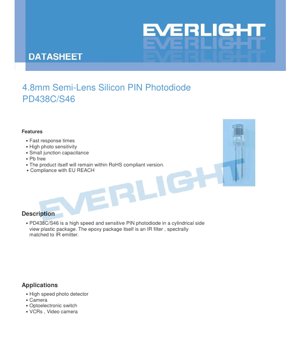
PD438C/S46 is a high-performance silicon PIN photodiode designed for applications requiring fast response and high sensitivity to infrared light. It features a compact cylindrical side-view plastic package with a diameter of 4.8mm. A key characteristic of this device is that its epoxy package itself acts as an integrated infrared filter. Its spectral characteristics match those of common infrared emitters, enhancing its performance in infrared detection systems by filtering out unwanted visible light.
This photodiode is characterized by fast response time, high photosensitivity, and low junction capacitance, making it suitable for high-speed optical detection. It is manufactured using lead-free materials and complies with relevant environmental regulations.
2. Detailed Technical Parameters
2.1 Absolute Maximum Ratings
This device is designed to operate reliably within the specified limits. Exceeding these ratings may cause permanent damage.
- Reverse Voltage (VR):32 V - The maximum reverse bias voltage that can be applied across the photodiode pins.
- Power Dissipation (Pd):150 mW - The maximum power the device can dissipate under specified conditions, primarily in the form of heat.
- Operating Temperature (Topr):-40°C to +85°C - The ambient temperature range over which the device is guaranteed to meet its published specifications.
- Storage Temperature (Tstg):-40°C to +100°C - The safe temperature range for storage when the device is not powered.
- Soldering temperature (Tsol):260°C, duration not exceeding 5 seconds, which complies with typical lead-free reflow soldering process requirements.
2.2 Electro-Optical Characteristics
These parameters at ambient temperature (Ta) measured at 25°C, defining the core performance of the photodiode.
- Spectral bandwidth (λ0.5):840 nm to 1100 nm. This defines the wavelength range over which the photodiode responsivity is at least half of its peak value. It is primarily sensitive to light in the near-infrared region.
- Peak sensitivity wavelength (λp):940 nm (typical). The wavelength of light to which the photodiode is most sensitive. This matches the common emission wavelength of many infrared LEDs.
- Open-circuit voltage (VOC):0.35 V (typical value), measured when irradiated at a wavelength of 940nm and an irradiance (Ee) of 5 mW/cm². This is the voltage generated by the photodiode without an external load.
- Short-circuit current (ISC):18 µA (typical), at Ee= 1 mW/cm², λp=940nm condition. This is the photocurrent when the output is short-circuited.
- Reverse photocurrent (IL):18 µA (typical, minimum 10.2 µA), at Ee= 1 mW/cm², λp=940nm, kuma a cikin yanayin baya-baya na baya (VR) yana 5V. Wannan shine babban ma'auni na aiki a cikin yanayin photoconductive.
- Dark current (Id):5 nA (na yau da kullun, matsakaicin 30 nA), a cikin VR= 10V kuma cikin duhu gaba ɗaya. Wannan shine ƙaramin raɗaɗin raɗaɗi wanda ke gudana ko da babu haske, kuma shine maɓalli na ma'auni na sigina zuwa amo.
- Reverse breakdown voltage (BVR):Minimum value 32V, typical value 170V, measured at a reverse current of 100 µA. This indicates the voltage at which the junction breaks down.
- Total capacitance (Ct):18 pF (typical), at VR= 3V and a test frequency of 1 MHz. Lower capacitance enables faster response time.
- Rise/fall time (tr/tf):50 ns / 50 ns (typical), under the conditions of VR= 10V and load resistance (RL) of 1 kΩ. This specifies the response speed of the photodiode to optical pulses.
The tolerance for key parameters is specified as: luminous intensity ±10%, dominant wavelength ±1nm, forward voltage ±0.1V.
3. Performance Curve Analysis
The datasheet provides several characteristic curves illustrating performance under different conditions. These are crucial for design engineers.
3.1 Spectral Sensitivity
A curve plotting relative sensitivity versus wavelength. It confirms the peak sensitivity at approximately 940nm and shows the spectral response gradually declining at the boundaries of the 840-1100nm range. The integrated epoxy lens acts as a filter, attenuating the response outside the target infrared band.
3.2 Relationship Between Dark Current and Ambient Temperature
This curve typically shows that dark current (Id) increases exponentially with rising temperature. Understanding this relationship is crucial for applications operating over a wide temperature range, as it defines the lower limit (noise floor) of detectable light.
3.3 Reverse Photocurrent vs. Irradiance (Ee)
) RelationshipLThe graph shows the linear relationship between the generated photocurrent (I
) and the incident optical power density. Under specified conditions, the photodiode operates in a highly linear region, which is crucial for analog optical measurement applications.
3.4 Relationship Between Terminal Capacitance and Reverse VoltagetJunction capacitance (C
) decreases as the reverse bias voltage increases. This is a fundamental characteristic of a PN junction. Designers can use a higher bias voltage to reduce capacitance, thereby improving bandwidth and response speed, at the cost of a slight increase in dark current.
3.5 Relationship Between Response Time and Load ResistanceLThis curve shows how the rise/fall time is affected by the external load resistance (RL) The effect of the value. A smaller R
usually leads to a faster response but results in a smaller output voltage swing. This graph helps optimize the trade-off between speed and amplitude in circuit design.
3.6 Relationship Between Power Consumption and Ambient Temperature
It shows the derating of maximum allowable power dissipation with increasing ambient temperature. Above 25°C, the device cannot dissipate the full 150mW, and the maximum power must be linearly reduced to zero when the maximum junction temperature is reached.
4. Mechanical and Packaging Information
4.1 Package Dimensions
The PD438C/S46 employs a cylindrical side-view plastic package with a nominal diameter of 4.8mm. The dimension drawing specifies the body diameter, length, lead pitch, and lead diameter. An important note indicates that all dimensional tolerances are ±0.25mm unless otherwise specified on the drawing. The side-view configuration is ideal for applications where the optical path is parallel to the PCB surface.
4.2 Polarity Identification
Polarity is typically indicated on the package or in the drawings. For photodiodes, when operating in reverse bias (photoconductive mode), the cathode is usually connected to the positive supply voltage, and the anode is connected to the circuit ground or the input of a transimpedance amplifier. Correct polarity is crucial for proper operation.
5. Welding and Assembly Guide
- This device is suitable for standard surface-mount assembly processes.Reflow soldering:
- The recommended maximum soldering temperature is 260°C. The duration that the device leads are exposed to this peak temperature or higher should not exceed 5 seconds. This conforms to typical lead-free reflow profiles (e.g., IPC/JEDEC J-STD-020).Hand soldering:
- If manual soldering is necessary, a temperature-controlled soldering iron should be used. The contact time for each pin should be minimized to prevent excessive heat transfer to the sensitive semiconductor chip.Cleaning:
- Standard PCB cleaning processes can be used, but the compatibility of the cleaning agent with the plastic packaging material should be verified.Storage Conditions:
The device should be stored in its original moisture barrier bag, at a temperature between -40°C and +100°C, and with low humidity to prevent pin oxidation and package moisture absorption.
6. Packaging and Ordering Information
6.1 Packaging Specifications
The standard packaging process is as follows: 500 pieces are packed in one bag. Five bags are placed into one inner box. Finally, ten inner boxes are loaded into one master (outer) carton. This results in a total of 25,000 pieces per master carton.
6.2 Label Specifications
- Label on packaging contains key information for traceability and identification:CPN:
- Customer Product Number (if assigned).P/N:
- Manufacturer's part number (e.g., PD438C/S46).QTY:
- Quantity of devices in the package.CAT, HUE, REF:
- They are codes for luminous intensity grade, dominant wavelength grade, and forward voltage grade, indicating performance binning.LOT No:
- Production batch number, used for traceability.REF:
Reference number used to identify the label.
7. Application Recommendations
- 7.1 Typical Application ScenariosHigh-Speed Photodetectors:
- Suitable for optical data links, encoders, and pulse detection, its 50ns response time is a key advantage.Camera applications:
- Can be used in autofocus systems, light metering, or as an infrared presence detector.Photoelectric switches:
- For object detection, slot sensors, and limit switches. The integrated infrared filter helps suppress ambient light interference.Video recorders and cameras:
Historically used for tape counter sensors, remote control receivers, or other internal optical sensing functions.
- 7.2 Design ConsiderationsBias Voltage:
- It is recommended to operate in photoconductive mode (with reverse bias applied) to achieve high-speed and linear operation. A typical bias voltage is 5V to 10V to balance speed (lower capacitance) and noise (lower dark current).Circuit Topology:
- Don kama daidai saurin gudu da layin layi, ana amfani da amplifier mai jujjuyawa don canza wutar lantarki zuwa wutar lantarki. Dole ne a zaɓi resistor da capacitor na amsawa a cikin TIA bisa ga bandwidth da ake buƙata da capacitance na diode na haske.Daidaitawar gani:
- Kunshe na gefe yana buƙatar ƙirar injiniya mai hankali, don tabbatar da daidaitawar daidai da tushen haske (yawanci kuma gefen infrared LED).Ambient Light Suppression:
Although the epoxy resin acts as an infrared filter, additional optical filtering or modulation/demodulation techniques may be required for environments with strong infrared light sources, such as sunlight.
8. Technical Comparison and Differentiation
- PD438C/S46 yana ba da fa'idodi masu mahimmanci a cikin rukuninsa:Haɗaɗɗen tace infrared:
- Ba kamar yawancin photodiodes na asali waɗanda ke buƙatar tacewa daban ba, epoxy ɗin haɗawa an tsara shi don tacewa, yana sauƙaƙa haɗawa da rage adadin abubuwan.Side-view package:
- The 4.8mm cylindrical side-view package is a specific form factor optimized for applications where the optical path is parallel to the PCB, providing a compact and directional field of view.Balanced performance:
- It offers a good balance between speed (50ns), sensitivity (18 µA at 1 mW/cm²), and dark current (5 nA), making it a versatile choice for general-purpose infrared detection.Robust Ratings:
With a reverse voltage rating of 32V and a wide operating temperature range (-40°C to +85°C), it is suitable for industrial and automotive environments (per disclaimer, for non-safety-critical applications).
9. Frequently Asked Questions (Based on Technical Parameters)
Q: What is the difference between operating in photovoltaic mode (zero bias) and photoconductive mode (reverse bias)?RA: In photovoltaic mode (VOC=0V), the photodiode generates its own voltage (see VR). It has very low dark current, but higher capacitance and slower response. Photoconductive mode (applying Vr) widens the depletion region, reduces capacitance, and speeds up the response (see tf/td), at the cost of a small but constant dark current (I
). For high-speed detection, photoconductive mode is preferred.LQ: How to understand the "reverse photocurrent (I
)" parameter?
A: This is the most useful parameter in circuit design. It tells you that under specific illumination conditions (1 mW/cm² at 940nm wavelength) and with 5V reverse bias applied, you can typically expect to obtain 18 µA of photocurrent. Your amplifier circuit must be designed to handle this current range. The minimum value of 10.2 µA is important for worst-case design.
Q: Why is dark current important?
A: Dark current is the primary noise source in photodiodes when no light is present. It sets the lower limit for detectable light. A lower dark current (typically 5 nA for this device) means the sensor can detect fainter light signals. Note that dark current approximately doubles for every 10°C increase in temperature.
Q: Can I use it with light sources other than 940nm?
A: Yes, but sensitivity will be reduced. Please refer to the spectral sensitivity curve. The photodiode will respond to light from approximately 840nm to 1100nm, but if the wavelength is not near the 940nm peak, the output current for the same optical power will be lower.
10. Practical Design and Usage Cases
- Case: Designing an Infrared Proximity Sensor for an Automatic Faucet.System Block Diagram:
- An infrared LED (emitting 940nm light) and a PD438C/S46 photodiode are placed side-by-side behind a translucent window. The LED is pulse-driven. When no object is present, most of the infrared light scatters. When a hand approaches the faucet, the reflected infrared light enters the photodiode.Component Selection Rationale:
- The PD438C/S46 was chosen because its peak sensitivity at 940nm matches the LED. The integrated infrared filter in its package helps suppress ambient visible light from overhead lighting, reducing false triggers. The side-view package allows both the emitter and detector to lie flat on the PCB, facing outward.Circuit Design:
- The photodiode is reverse-biased with 5V. Its output is connected to a transimpedance amplifier. The amplifier's gain (feedback resistor) is set so that the expected reflected signal (a portion of 18 µA/mW/cm²) produces a usable voltage. A comparator following the amplifier detects when this voltage exceeds a set threshold.Optimization:
Select the LED pulse frequency and duration to avoid the frequency of ambient light flicker (e.g., 100Hz from mains-powered lighting). The system only looks for signals synchronized with the LED pulses, thereby providing excellent noise immunity.
11. Introduction to Working Principles
A PIN photodiode is a semiconductor device featuring a wide, lightly doped intrinsic (I) region sandwiched between P-type and N-type regions. When photons with energy greater than the semiconductor bandgap (for silicon, wavelengths less than approximately 1100nm) strike the device, they can generate electron-hole pairs in the intrinsic region. Under the influence of the built-in electric field (photovoltaic mode) or an applied reverse bias field (photoconductive mode), these charge carriers are separated, producing a photocurrent proportional to the incident light intensity. Compared to a standard PN photodiode, the wide intrinsic region in the PIN structure reduces junction capacitance (enabling faster response) and increases the volume for photon absorption (enhancing sensitivity).
12. Teknoloji Trendleri ve Arka Plan
- Silicon PIN photodiode kamar PD438C/S46, near-infrared detection reliable, cost-effective solution ti. Wannan fanni current trends sun haɗa da:Integration:
- Moving towards integrated solutions that combine photodiodes, amplifiers, and sometimes even LED drivers and digital logic into a single package or chip (e.g., Opto-ASICs).Miniaturization:
- Developing photodiodes in smaller surface-mount packages (e.g., chip-scale packages) for space-constrained applications like mobile devices.Specialized Materials:
- For wavelengths beyond silicon's cutoff (around 1100nm), materials like InGaAs are used. However, silicon remains dominant in the visible and near-infrared spectrum due to its low cost and mature manufacturing processes.Performance Enhancement:
Ongoing research focuses on further reducing capacitance and dark current through advanced doping profiles and device structures to enhance speed and sensitivity. PD438C/S46 represents a well-optimized, application-specific component within this broader technological context, offering a practical balance of performance, size, and cost for a wide range of industrial and consumer infrared sensing tasks.
Detailed Explanation of LED Specification Terminology
Complete Explanation of LED Technical Terminology
I. Core Indicators of Photoelectric Performance
| Terminology | Unit/Representation | Popular Explanation | Why It Is Important |
|---|---|---|---|
| Luminous Efficacy | lm/W (lumens per watt) | The luminous flux emitted per watt of electrical energy, the higher the more energy-efficient. | Directly determines the energy efficiency class and electricity cost of the luminaire. |
| Luminous Flux | lm (lumen) | The total amount of light emitted by a light source, commonly known as "brightness". | Determine if the lamp is bright enough. |
| Viewing Angle | ° (degrees), such as 120° | The angle at which light intensity drops to half, determining the beam's width. | Affects the illumination range and uniformity. |
| Color Temperature (CCT) | K (Kelvin), e.g., 2700K/6500K | The warmth or coolness of light color; lower values are yellowish/warm, higher values are whitish/cool. | Determines the lighting atmosphere and suitable application scenarios. |
| Color Rendering Index (CRI / Ra) | No unit, 0–100 | The ability of a light source to reproduce the true colors of objects, Ra≥80 is recommended. | Affects color fidelity, used in high-demand places such as shopping malls and art galleries. |
| Color Tolerance (SDCM) | MacAdam Ellipse Steps, e.g., "5-step" | Quantitative indicator of color consistency, smaller step value indicates better color consistency. | Ensure no color difference among luminaires from the same batch. |
| Dominant Wavelength | nm (nanometer), e.g., 620nm (red) | The wavelength value corresponding to the color of a colored LED. | Determine the hue of monochromatic LEDs such as red, yellow, and green. |
| Spectral Distribution | Wavelength vs. Intensity Curve | Shows the intensity distribution of light emitted by an LED across various wavelengths. | Affects color rendering and color quality. |
II. Electrical Parameters
| Terminology | Symbols | Popular Explanation | Design Considerations |
|---|---|---|---|
| Forward Voltage | Vf | Minimum voltage required to turn on an LED, similar to a "starting threshold". | The driving power supply voltage must be ≥ Vf, and the voltage adds up when multiple LEDs are connected in series. |
| Forward Current | If | The current value that allows the LED to emit light normally. | An da yawanci ake amfani da tuƙi mai tsayayyen kwarara, kwararar wutar lantarki tana ƙayyadaddun haske da tsawon rayuwa. |
| Matsakaicin ƙarfin kwararar bugun jini (Pulse Current) | Ifp | Peak current that can be withstood in a short time, used for dimming or flashing. | Pulse width and duty cycle must be strictly controlled, otherwise overheating damage will occur. |
| Reverse Voltage | Vr | The maximum reverse voltage that an LED can withstand; exceeding it may cause breakdown. | A cikin da'ira, ya kamata a hana haɗin baya ko kuma ƙarfin lantarki mai ƙarfi. |
| Thermal Resistance | Rth (°C/W) | The resistance to heat flow from the chip to the solder joint. A lower value indicates better heat dissipation. | High thermal resistance requires a more robust heat dissipation design; otherwise, the junction temperature will increase. |
| Electrostatic Discharge Immunity (ESD Immunity) | V (HBM), such as 1000V | Anti-static strike capability, the higher the value, the less susceptible to damage from static electricity. | Anti-static measures must be implemented during production, especially for high-sensitivity LEDs. |
III. Thermal Management and Reliability
| Terminology | Key Metrics | Popular Explanation | Impact |
|---|---|---|---|
| Junction Temperature | Tj (°C) | The actual operating temperature inside the LED chip. | For every 10°C reduction, the lifespan may double; excessively high temperatures cause lumen depreciation and color shift. |
| Lumen Depreciation | L70 / L80 (hours) | The time required for brightness to drop to 70% or 80% of its initial value. | Directly defines the "service life" of an LED. |
| Lumen Maintenance | % (e.g., 70%) | Percentage of remaining brightness after a period of use. | Characterizes the ability to maintain brightness after long-term use. |
| Color Shift | Δu′v′ or MacAdam Ellipse | The degree of color change during use. | Affects the color consistency of the lighting scene. |
| Thermal Aging | Material performance degradation | Degradation of packaging materials due to long-term high temperature. | May lead to decreased brightness, color shift, or open-circuit failure. |
IV. Encapsulation and Materials
| Terminology | Common Types | Popular Explanation | Characteristics and Applications |
|---|---|---|---|
| Package Type | EMC, PPA, Ceramic | The housing material that protects the chip and provides optical and thermal interfaces. | EMC has good heat resistance and low cost; ceramic has excellent heat dissipation and long lifespan. |
| Chip structure | Front-side, Flip Chip | Chip Electrode Layout. | Flip-chip offers better heat dissipation and higher luminous efficacy, suitable for high-power applications. |
| Phosphor coating | YAG, Silicate, Nitride | Covered on the blue light chip, partially converted into yellow/red light, mixed into white light. | Different phosphors affect luminous efficacy, color temperature, and color rendering. |
| Lens/Optical Design | Flat, Microlens, Total Internal Reflection | Optical structure on the encapsulation surface, controlling light distribution. | Determines the emission angle and light distribution curve. |
V. Quality Control and Binning
| Terminology | Grading Content | Popular Explanation | Purpose |
|---|---|---|---|
| Luminous Flux Grading | Codes such as 2G, 2H | Grouped by brightness level, each group has a minimum/maximum lumen value. | Ensure uniform brightness for products within the same batch. |
| Voltage binning | Codes such as 6W, 6X | Grouped by forward voltage range. | Facilitates driver power matching and improves system efficiency. |
| Color Grading | 5-step MacAdam Ellipse | Group by color coordinates to ensure colors fall within a minimal range. | Ensure color consistency to avoid uneven colors within the same luminaire. |
| Color temperature binning | 2700K, 3000K, etc. | Grouped by color temperature, each group has a corresponding coordinate range. | To meet the color temperature requirements of different scenarios. |
Six, Testing and Certification
| Terminology | Standard/Test | Popular Explanation | Meaning |
|---|---|---|---|
| LM-80 | Lumen Maintenance Test | Long-term illumination under constant temperature conditions, recording brightness attenuation data. | Used to estimate LED lifetime (combined with TM-21). |
| TM-21 | Standard for Life Projection | Projecting the lifespan under actual use conditions based on LM-80 data. | Provide scientific life prediction. |
| IESNA standard | Standard of the Illuminating Engineering Society | Covers optical, electrical, and thermal testing methods. | Industry-recognized testing basis. |
| RoHS / REACH | Environmental certification | Ensure the product does not contain harmful substances (e.g., lead, mercury). | Access conditions for entering the international market. |
| ENERGY STAR / DLC | Energy Efficiency Certification | Energy efficiency and performance certification for lighting products. | Yawan da ake amfani da shi a cikin sayayyar gwamnati da ayyukan tallafi, don haɓaka gasar kasuwa. |