Table of Contents
- 1. Product Overview
- 1.1 Core Advantages
- 1.2 Target Market
- 2. Technical Parameter Deep Dive
- 2.1 Physical and Optical Characteristics
- 2.2 Electrical Parameters
- 2.3 Thermal Considerations
- 3. Binning System Explanation The datasheet indicates that the devices are "Categorized for luminous intensity." This refers to a binning process where displays are sorted and grouped based on their measured light output at a specified test current. This ensures that units within the same bin have very similar brightness levels, which is critical for applications using multiple displays where visual uniformity is required. 4. Performance Curve Analysis
- 4.1 Spectrum Distribution
- 4.2 Luminous Intensity vs. Forward Current (I-V Curve)
- 4.3 Temperature Dependency
- 5. Mechanical and Package Information
- 5.1 Package Dimensions
- 5.2 Pad Design and Polarity Identification
- 6. Soldering and Assembly Guidelines
- 6.1 Precautions and Storage Conditions
- 6.2 Soldering Considerations
- 7. Packaging and Ordering Information
- 7.1 Packaging Specifications
- 7.2 Label Explanation
- 8. Application Recommendations
- 8.1 Typical Application Scenarios
- 8.2 Design Considerations
- 9. Technical Comparison
- 9.1 Differentiation Advantages
- 9.2 Trade-offs
- 10. Frequently Asked Questions (Based on Technical Parameters)
- 11. Practical Use Case
- 12. Operating Principle
- 13. Technology Trends
1. Product Overview
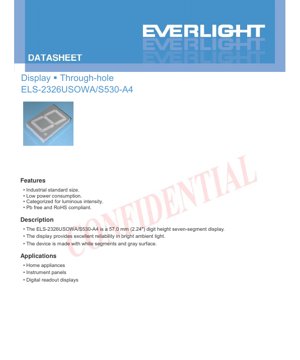
The ELS-2326USOWA/S530-A4 is a high-brightness, seven-segment alphanumeric display designed for clear readability in various lighting conditions. Its primary function is to provide digital readouts for electronic devices and instrumentation.
1.1 Core Advantages
This display offers several key advantages for designers and engineers. It features an industrial-standard footprint, ensuring compatibility with existing PCB layouts and sockets. The device is engineered for low power consumption, making it suitable for battery-powered or energy-conscious applications. Furthermore, the segments are categorized for luminous intensity, providing consistency in brightness across production batches. The product is also compliant with Pb-free and RoHS environmental directives.
1.2 Target Market
Nunin nuni na ayyukan da ke buƙatar amintacce, sauƙin karanta lambobi ko iyakantattun fitarwa na haruffa. Ƙarfinsa da bayyananniyarsa sun sa ya zama manufa don haɗawa cikin kayan aikin gida, nau'ikan allunan kayan aiki, da nunin karatun lambobi na gabaɗaya inda ake fifita hawan rami don ɗorewa da sauƙin haɗawa.
2. Technical Parameter Deep Dive
Cikakken bincike na ƙayyadaddun na'urar yana da mahimmanci don daidaitaccen ƙira da aikace-aikacen da'ira.
2.1 Physical and Optical Characteristics
The display has a digit height of 57.0 millimeters (2.24 inches), which is considered a large format, offering excellent visibility from a distance. The device is constructed with white light-emitting segments against a gray surface, which enhances contrast and reduces glare in bright ambient light, thereby improving overall reliability and user experience.
2.2 Electrical Parameters
While the provided excerpt mentions "Absolute Maximum Ratings," the specific values for forward voltage, current, and power dissipation are not detailed in the given content. Designers must consult the full datasheet for these critical parameters to ensure the display is driven within its safe operating area (SOA) to prevent premature failure.
2.3 Thermal Considerations
Thermal management is implicitly addressed through the absolute maximum ratings, which typically include parameters like storage temperature, operating temperature, and soldering temperature. Adherence to these limits is essential for maintaining LED lifespan and performance stability.
3. Binning System Explanation
The datasheet indicates that the devices are "Categorized for luminous intensity." This refers to a binning process where displays are sorted and grouped based on their measured light output at a specified test current. This ensures that units within the same bin have very similar brightness levels, which is critical for applications using multiple displays where visual uniformity is required.
4. Binciken Lanƙwasa Aiki
PDF din yana ambaton sashin "Lanƙwasa Halayen Lantarki da Gani na Yau da Kullun," wanda yawanci zai ƙunshi bayanan hoto masu mahimmanci don fahimtar halayen na'urar a ƙarƙashin yanayi daban-daban.
4.1 Spectrum Distribution
The "Spectrum Distribution" curve, measured at Ta=25°C, would plot the relative intensity of the emitted light against wavelength. For a white LED display, this curve would show a broad spectrum, likely peaking in the blue region (from the LED chip) with a broader emission in the yellow/red region from the phosphor coating, combining to produce white light. The shape and peak wavelength of this curve determine the perceived color temperature (e.g., cool white, neutral white) of the display.
4.2 Luminous Intensity vs. Forward Current (I-V Curve)
Although not explicitly shown in the excerpt, a standard characteristic curve would illustrate the relationship between the forward current (If) applied to an LED segment and its resulting luminous intensity (Iv). This curve is non-linear; brightness increases with current but at a diminishing rate. It also helps define the optimal drive current for balancing brightness with efficiency and longevity.
4.3 Temperature Dependency
Another crucial curve would show how luminous intensity degrades as the junction temperature of the LED increases. Typically, LED output decreases as temperature rises. Understanding this relationship is vital for applications operating in high-temperature environments, as it may necessitate thermal design or brightness compensation in the drive circuitry.
5. Mechanical and Package Information
5.1 Package Dimensions
The datasheet includes a "Package Dimension" diagram. This provides the critical physical measurements of the display module, including overall length, width, height, digit spacing, lead (pin) spacing, and lead diameter. The note specifies that tolerances are ±0.25mm unless otherwise stated. These dimensions are mandatory for creating accurate PCB footprints and ensuring proper fit within an enclosure.
5.2 Pad Design and Polarity Identification
The dimension drawing will precisely define the recommended solder pad layout on the PCB. The "Internal Circuit Diagram" shows the electrical connection of the individual segments (a-g) and the common anode or cathode points. This diagram is essential for correctly wiring the display to the driver circuit. The physical package or the diagram will also indicate polarity (e.g., a marking for pin 1) to prevent incorrect insertion during assembly.
6. Soldering and Assembly Guidelines
While specific reflow profiles are not provided in the excerpt, general guidelines for handling LEDs apply.
6.1 Precautions and Storage Conditions
The document strongly emphasizes Electrostatic Discharge (ESD) protection. The LED dice are sensitive to static electricity, which can cause latent or catastrophic damage. Recommended measures include using grounded wrist straps, ESD-safe footwear and workstations, conductive floor mats, and proper grounding of all equipment. The LEDs should be stored in their original conductive packaging in a controlled, low-humidity environment until use.
6.2 Soldering Considerations
For through-hole components, wave soldering or manual soldering is typical. The temperature and duration should be controlled to avoid thermal shock to the epoxy resin and the internal LED chips. The leads should not be subjected to excessive mechanical stress during insertion or soldering.
7. Packaging and Ordering Information
7.1 Packaging Specifications
The device follows a specific packing process: 10 pieces are packed in one tube, 10 tubes are placed in one box, and 2 boxes are packed in one master carton. This totals 200 pieces per carton. This information is vital for inventory planning, production line feeding, and understanding minimum order quantities.
7.2 Label Explanation
The packing label contains several codes:
- CPN: Customer's Product Number (for internal tracking).
- P/N: The manufacturer's Product Number (ELS-2326USOWA/S530-A4).
- QTY: The quantity of devices in that specific package.
- CAT: The Luminous Intensity Rank or bin code.
- HUE/REF: Likely references for color or other optical characteristics.
- LOT No: Traceability code linking the devices to a specific manufacturing batch.
8. Application Recommendations
8.1 Typical Application Scenarios
This display is well-suited for:
- Home Appliances: Timers on ovens, microwaves, washing machines, or air conditioners.
- Instrument Panels: Readouts for test equipment, industrial controllers, or power supplies.
- Digital Readout Displays: Standalone counters, clocks, or simple measurement displays.
8.2 Design Considerations
Drive Circuitry: A constant current source is generally preferred over a constant voltage source to drive LED segments, as it provides stable brightness and protects the LEDs from current spikes. The circuit must be designed to ensure the LEDs are only subjected to forward bias. The datasheet explicitly warns against applying continuous reverse voltage, which can cause internal migration and permanent damage.
Current Limiting Resistors: When using a voltage source with series resistors, the resistor value must be carefully calculated based on the forward voltage (Vf) of the LED segment and the desired current, factoring in the power supply voltage.
Multiplexing: For multi-digit displays, a multiplexing technique is often used to control many segments with fewer I/O pins. This involves rapidly cycling power to each digit. The persistence of vision makes all digits appear lit simultaneously. The driver IC must be capable of supplying the higher peak current required during each digit's brief on-time.
9. Technical Comparison
Compared to smaller SMD (Surface Mount Device) seven-segment displays, this through-hole version offers distinct advantages and trade-offs.p>
9.1 Differentiation Advantages
Durability and Serviceability: Through-hole mounting generally provides stronger mechanical bonds, making the display more resistant to vibration and physical stress. It is also easier to replace manually if needed.
Visibility: The 57.0mm digit height is significantly larger than most SMD alternatives, offering superior visibility for applications where the user may be at a distance.
Heat Dissipation: The leads can act as additional thermal paths to the PCB, potentially offering slightly better heat dissipation than some SMD packages, depending on the design.
9.2 Trade-offs
Board Space and Automation: Through-hole components require drilling holes in the PCB, consume more board space on the top side, and are less suited to fully automated pick-and-place assembly lines compared to SMD parts.
Profile: The overall assembly will have a higher profile than an SMD-based design.
10. Frequently Asked Questions (Based on Technical Parameters)
Q1: What is the purpose of the luminous intensity categorization (binning)?
A1: Binning yana tabbatar da daidaiton gani. Idan kana amfani da nuni da yaya a gefe (misali, a cikin agogon lambobi da yawa), siyan na'urori daga rukunin ƙarfi ɗaya yana ba da garantin cewa za su sami haske kusan iri ɗaya, yana hana wani lamba ya bayyana duhu ko haske fiye da maƙwabtansa.
Q2: Shin zan iya tuƙa wannan nuni kai tsaye daga fil ɗin microcontroller?
A2: Gabaɗaya, a'a. Fil ɗin microcontroller GPIO na yau da kullun zai iya samar ko nutsar da ƙayyadadden igiyar ruwa kawai (sau da yawa 20-40mA), wanda wataƙila bai isa ga babban yanki na lamba ba. Bugu da ƙari, haɗa LED kai tsaye zuwa fil ɗin ba tare da resistor mai iyakancewa igiyar ruwa ba yana haifar da haɗarin lalata duka LED da microcontroller. Ana buƙatar da'irar tuƙi ta waje (ta amfani da transistors, na'urorin LED tuƙi na musamman, ko tushen igiyar ruwa akai).
Q3: Why is ESD protection so heavily emphasized?
A3: The semiconductor junctions inside the LED are extremely sensitive to high-voltage electrostatic discharges, which can occur simply from human handling. ESD damage may not cause immediate failure but can severely degrade the LED's performance and lifespan. Following ESD protocols is a critical step in ensuring product reliability.
11. Practical Use Case
Scenario: Designing a Simple Industrial Timer.
An engineer is designing a countdown timer for a manufacturing process. The timer needs to be readable from several meters away in a well-lit factory. The ELS-2326USOWA/S530-A4 is selected for its large digit size and high contrast gray/white design.
Implementation: A 4-digit version is planned. The engineer uses the package dimensions to create the PCB footprint. A dedicated LED driver IC with multiplexing capability is chosen to control the 28 segments (7 segments x 4 digits) efficiently. The driver is configured to supply the appropriate constant current as specified in the full datasheet. Current-limiting resistors are sized accordingly. The circuit includes reverse voltage protection diodes as per the datasheet warning. During assembly, the production line uses ESD-safe practices. The final product provides a clear, reliable, and uniform display for the operator.
12. Operating Principle
A seven-segment display is an assembly of light-emitting diodes (LEDs) arranged in a figure-eight pattern. Each of the seven segments (labeled a through g) is an individual LED (or a series/parallel combination of LED chips). An additional LED is often used for the decimal point (dp). In a common-anode display, all the anodes of the segment LEDs are connected together to a common positive voltage pin. To illuminate a specific segment, its cathode is connected to a lower voltage (ground) through a current-limiting circuit. In a common-cathode display, the opposite is true. By selectively turning on different combinations of these seven segments, the numerals 0-9 and some letters (like A, C, E, F) can be formed. The white color in this specific model is achieved by using a blue or ultraviolet LED chip coated with a broad-spectrum phosphor that emits white light.
13. Technology Trends
While through-hole displays like this one remain relevant for specific durability and serviceability requirements, the overall trend in electronics is toward miniaturization and surface-mount technology (SMT). SMD LED displays offer smaller footprints, lower profiles, and are better suited for high-speed, automated assembly. Furthermore, advancements in LED chip technology continue to improve luminous efficacy (more light output per watt of electrical input), allowing for brighter displays with lower power consumption or enabling the use of smaller chips for the same brightness. There is also a growing integration of display drivers and controllers into more complex system-on-chip (SoC) solutions. However, for applications demanding large, robust, and easily serviceable numeric readouts, through-hole segmented displays maintain a solid position in the component ecosystem.
LED Specification Terminology
Complete explanation of LED technical terms
Photoelectric Performance
| Term | Unit/Representation | Simple Explanation | Why Important |
|---|---|---|---|
| Luminous Efficacy | lm/W (lumens per watt) | Light output per watt of electricity, higher means more energy efficient. | Directly determines energy efficiency grade and electricity cost. |
| Luminous Flux | lm (lumens) | Total light emitted by source, commonly called "brightness". | Determines if the light is bright enough. |
| Viewing Angle | ° (degrees), e.g., 120° | Kwanin da ƙarfin haske ya ragu zuwa rabi, yana ƙayyade faɗin katako. | Yana shafar kewayon haskakawa da daidaito. |
| CCT (Color Temperature) | K (Kelvin), e.g., 2700K/6500K | Warmth/coolness of light, lower values yellowish/warm, higher whitish/cool. | Determines lighting atmosphere and suitable scenarios. |
| CRI / Ra | Unitless, 0–100 | Ability to render object colors accurately, Ra≥80 is good. | Affects color authenticity, used in high-demand places like malls, museums. |
| SDCM | MacAdam ellipse steps, e.g., "5-step" | Color consistency metric, smaller steps mean more consistent color. | Ensures uniform color across same batch of LEDs. |
| Dominant Wavelength | nm (nanometers), e.g., 620nm (red) | Wavelength corresponding to color of colored LEDs. | Determines hue of red, yellow, green monochrome LEDs. |
| Spectral Distribution | Wavelength vs intensity curve | Shows intensity distribution across wavelengths. | Affects color rendering and quality. |
Electrical Parameters
| Term | Symbol | Simple Explanation | Design Considerations |
|---|---|---|---|
| Forward Voltage | Vf | Minimum voltage to turn on LED, like "starting threshold". | Driver voltage must be ≥Vf, voltages add up for series LEDs. |
| Forward Current | If | Current value for normal LED operation. | Usually constant current drive, current determines brightness & lifespan. |
| Max Pulse Current | Ifp | Peak current tolerable for short periods, used for dimming or flashing. | Pulse width & duty cycle must be strictly controlled to avoid damage. |
| Reverse Voltage | Vr | Max reverse voltage LED can withstand, beyond may cause breakdown. | Circuit must prevent reverse connection or voltage spikes. |
| Thermal Resistance | Rth (°C/W) | Resistance to heat transfer from chip to solder, lower is better. | High thermal resistance requires stronger heat dissipation. |
| ESD Immunity | V (HBM), e.g., 1000V | Ability to withstand electrostatic discharge, higher means less vulnerable. | Anti-static measures needed in production, especially for sensitive LEDs. |
Thermal Management & Reliability
| Term | Key Metric | Simple Explanation | Impact |
|---|---|---|---|
| Junction Temperature | Tj (°C) | Actual operating temperature inside LED chip. | Every 10°C reduction may double lifespan; too high causes light decay, color shift. |
| Lumen Depreciation | L70 / L80 (hours) | Time for brightness to drop to 70% or 80% of initial. | Directly defines LED "service life". |
| Lumen Maintenance | % (e.g., 70%) | Percentage of brightness retained after time. | Indicates brightness retention over long-term use. |
| Color Shift | Δu′v′ or MacAdam ellipse | Degree of color change during use. | Affects color consistency in lighting scenes. |
| Thermal Aging | Material degradation | Deterioration due to long-term high temperature. | May cause brightness drop, color change, or open-circuit failure. |
Packaging & Materials
| Term | Common Types | Simple Explanation | Features & Applications |
|---|---|---|---|
| Package Type | EMC, PPA, Ceramic | Housing material protecting chip, providing optical/thermal interface. | EMC: good heat resistance, low cost; Ceramic: better heat dissipation, longer life. |
| Chip Structure | Front, Flip Chip | Chip electrode arrangement. | Flip chip: kona mafuta bora, ufanisi mkubwa, kwa nguvu kubwa. |
| Phosphor Coating | YAG, Silicate, Nitride | Covers blue chip, converts some to yellow/red, mixes to white. | Different phosphors affect efficacy, CCT, and CRI. |
| Lens/Optics | Flat, Microlens, TIR | Optical structure on surface controlling light distribution. | Determines viewing angle and light distribution curve. |
Quality Control & Binning
| Term | Binning Content | Simple Explanation | Purpose |
|---|---|---|---|
| Luminous Flux Bin | Code e.g., 2G, 2H | Grouped by brightness, each group has min/max lumen values. | E kia mau tonu te marama i roto i te pūhui kotahi. |
| Voltage Bin | Code e.g., 6W, 6X | Grouped by forward voltage range. | Facilitates driver matching, improves system efficiency. |
| Color Bin | 5-step MacAdam ellipse | Grouped by color coordinates, ensuring tight range. | Guarantees color consistency, avoids uneven color within fixture. |
| CCT Bin | 2700K, 3000K etc. | Grouped by CCT, each has corresponding coordinate range. | Meets different scene CCT requirements. |
Testing & Certification
| Term | Standard/Test | Simple Explanation | Significance |
|---|---|---|---|
| LM-80 | Lumen maintenance test | Long-term lighting at constant temperature, recording brightness decay. | Used to estimate LED life (with TM-21). |
| TM-21 | Life estimation standard | Estimates life under actual conditions based on LM-80 data. | Provides scientific life prediction. |
| IESNA | Illuminating Engineering Society | Covers optical, electrical, thermal test methods. | Industry-recognized test basis. |
| RoHS / REACH | Environmental certification | Yana tabbatar da babu abubuwa masu cutarwa (gubar, mercury). | Bukatar shiga kasuwa a duniya. |
| ENERGY STAR / DLC | Ilimin ingancin makamashi | Ilimin ingancin makamashi da aiki don hasken wuta. | Used in government procurement, subsidy programs, enhances competitiveness. |