Table of Contents
- 1. Product Overview
- 1.1 Core Advantages and Target Market
- 2. Detailed Technical Parameters
- 2.1 Absolute Maximum Ratings
- 2.2 Electro-Optical Characteristics
- 3. Explanation of the Grading System
- 3.1 Luminous Intensity Grading
- 3.2 Forward Voltage Binning
- 3.3 Chromaticity Coordinate Binning
- 4. Mechanical and Packaging Information
- 4.1 Package Size
- 4.2 Packaging and Handling
- 5. Welding and Assembly Guide
- 5.1 Storage and Moisture Protection Requirements
- 5.2 Welding Process
- 6. Application Suggestions and Design Considerations
- 6.1 Typical Application Scenarios
- 6.2 Key Design Considerations
- 7. Technical Comparison and Differentiation
- 8. Frequently Asked Questions (Based on Technical Parameters)
- 9. Practical Design and Usage Cases
- 10. Working Principles and Technology Trends
- 10.1 Basic Working Principles
- 10.2 Objective Technology Trends
1. Product Overview
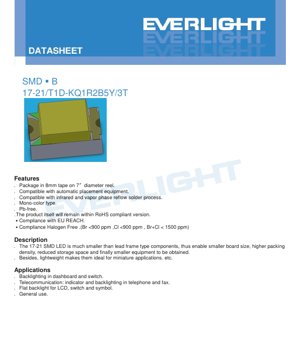
17-21/T1D-KQ1R2B5Y/3T is a compact surface-mount device (SMD) LED, specifically designed for modern electronic applications that require miniaturization and high reliability. This monochrome LED emits pure white light, achieved through an InGaN chip encapsulated in yellow diffused resin. Its primary advantage lies in a significantly reduced footprint compared to traditional lead-frame LEDs, thereby increasing component assembly density on printed circuit boards (PCBs), reducing device storage space, and ultimately contributing to the development of smaller and lighter end-user equipment. The component is fully RoHS compliant, adheres to EU REACH regulations, and is manufactured as a halogen-free product, with bromine and chlorine content strictly controlled below industry standards.
1.1 Core Advantages and Target Market
The design philosophy of the 17-21 SMD LED centers on supporting miniaturization. Its small physical size directly translates to less required board space, enabling designers to create more compact products. The lightweight nature of the package makes it particularly suitable for portable and miniature applications where every gram counts. The device is supplied on 8mm carrier tape mounted on 7-inch diameter reels, ensuring compatibility with high-speed, automated pick-and-place assembly equipment, which is crucial for mass production. Its compatibility with infrared and vapor phase reflow soldering processes provides manufacturing flexibility. Key target markets include consumer electronics, automotive interiors (especially dashboard and switch backlighting), telecommunications equipment for status indication, and general backlighting for LCDs and control panels.
2. Detailed Technical Parameters
This section provides a detailed and objective analysis of the key electrical, optical, and thermal parameters defined in the datasheet, explaining their significance for circuit design and reliability.
2.1 Absolute Maximum Ratings
Absolute maximum ratings define the stress limits that may cause permanent damage to the LED. These are not normal operating conditions but thresholds that must never be exceeded.
- Reverse Voltage (VR): 5V- Applying a reverse bias exceeding 5V may cause immediate junction breakdown. The datasheet clearly states that this device is not designed for reverse operation; this rating is primarily for IR (reverse current) test conditions. In applications where reverse voltage is possible, external circuit protection (such as a parallel diode) is typically required.
- Forward Current (IF): 10mA- This is the recommended maximum continuous DC current to ensure long-term reliable operation. Exceeding this current increases junction temperature, accelerates luminous flux degradation, and significantly shortens device lifetime.
- Peak Forward Current (IFP): 100mA- The LED can withstand short-duration current pulses up to 100mA (at 1kHz with a 1/10 duty cycle). This pertains to pulsed operation or transient surges and should not be used for calculating steady-state power dissipation.
- Power Dissipation (Pd): 40mW- This is the maximum power the package can dissipate as heat when the ambient temperature (Ta) is 25°C. The actual power dissipation is calculated as: Forward Voltage (VF) * Forward Current (IF). Careful thermal management is required when operating near or exceeding this limit.
- Operating and Storage Temperature:The device has an operating temperature rating of -40°C to +85°C and a storage temperature range of -40°C to +90°C. This wide range makes it suitable for automotive and industrial environments.
- Soldering Temperature:Two temperature profiles are specified: reflow soldering at 260°C for 10 seconds (typical lead-free process) and hand soldering at 350°C for 3 seconds. Adhering to these limits is crucial to prevent damage to internal chip bonding or the plastic package.
2.2 Electro-Optical Characteristics
These parameters are measured under standard test conditions (Ta=25°C, IF=5mA) and define the LED's performance.
- Luminous Intensity (Iv): 72.0 - 180.0 mcd (typical)- Wannan shine adadin haske da ake iya gani da ake fitarwa a wani takamaiman shugabanci. Faɗin yanki mai faɗi sosai (72 zuwa 180 mcd) yana nuna cewa LED ana rarrabe su zuwa "matakai" daban-daban bisa ga fitar da aka auna, wanda za a yi bayani dalla-dalla a sashe na gaba. Gwajin na'urar lantarki na 5mA ya kasance ƙasa da matsakaicin ƙimar iyaka, yana ba da isasshen aminci don aunawa.
- Viewing Angle (2θ1/2): 150° (typical)- This is the angle at which the luminous intensity is half of the 0° (axial) intensity. A 150° viewing angle is very wide, producing a diffuse emission pattern similar to a Lambertian source, suitable for area lighting and backlighting requiring uniform light distribution, rather than a focused beam.
- Forward Voltage (VF): 2.7V - 3.1V (Max)- This is the voltage drop across the LED when driven by a 5mA test current. This variation stems from semiconductor process tolerances and is also managed through binning. Since VF is not a fixed value, a series current-limiting resistor must always be used to set the operating current.
- Reverse Current (IR): 50 μA (Max)- This is the leakage current when a 5V reverse bias is applied. In a healthy device, this current is typically very small.
3. Explanation of the Grading System
To ensure consistency in mass production, LEDs are tested and grouped or "binned" according to performance. The 17-21/T1D-KQ1R2B5Y/3T uses a multi-parameter binning system, as indicated by the code "KQ1R2B5Y".
3.1 Luminous Intensity Grading
The luminous intensity is divided into four distinct bins (Q1, Q2, R1, R2). When specifying or ordering, the "R2" in the part number indicates the selected bin.
- Gear Q1:72.0 - 90.0 mcd
- Gear Q2:90.0 - 112.0 mcd
- Gear R1:112.0 - 140.0 mcd
- Gear R2:140.0 - 180.0 mcd
This allows designers to select the appropriate brightness level based on their application, with higher gears typically used in situations where maximum light output is crucial.
3.2 Forward Voltage Binning
Forward voltage is binned from 2.7V to 3.1V in 0.1V steps. The "B5" in the part number corresponds to one of these bins. Using matched VF bins in the design helps ensure uniform current distribution when multiple LEDs are connected in parallel.
- Bin 29:2.7 - 2.8V
- Gear 30:2.8 - 2.9V
- Gear 31:2.9 - 3.0V
- Gear 32:3.0 - 3.1V
3.3 Chromaticity Coordinate Binning
The color of white light is defined by its chromaticity coordinates (x, y) on the CIE 1931 chromaticity diagram. The datasheet defines four quadrilateral bins (3, 4, 5, 6) on this chart. The "Y" in the part number may refer to the yellow diffusing resin and the associated color bin (e.g., bin 5). The specified tolerance is ±0.01 for both the x and y coordinates, which is a standard tolerance for white LEDs, ensuring consistency in perceived color within a batch.
4. Mechanical and Packaging Information
4.1 Package Size
17-21 SMD LED yana amfani da kulle-kulle mai kauri mai kauri. Girman mahimmanci (naúrar: mm) sun haɗa da: tsayin jiki na yau da kullun kusan 1.6mm, faɗin kusan 0.8mm, tsayin kusan 0.6mm. Cikakken zanen kulle-kulle yana ba da madaidaicin girma, gami da wurin ginin allon da ƙimar ƙima (sai dai idan an faɗi daban, ±0.1mm). An yiwa cathode alama a sarari, wannan yana da mahimmanci don daidaitaccen alkibla yayin haɗawa. Ƙananan girma yana buƙatar ƙirar ginin allon PCB daidai, don tabbatar da ingantaccen gini da kwanciyar hankali na inji.
4.2 Packaging and Handling
The components are delivered in Moisture Sensitive Device (MSD) packaging. They are supplied in embossed carrier tape (8mm pitch), wound on 7-inch reels, with 3000 pieces per reel. The packaging includes desiccant and is sealed in an aluminum moisture barrier bag. The reel label contains key information: Customer Part Number (CPN), Manufacturer Part Number (P/N), Quantity (QTY), and specific binning codes for luminous intensity (CAT), chromaticity (HUE), and forward voltage (REF).
5. Welding and Assembly Guide
Proper handling and soldering are crucial for the reliability of SMD components.
5.1 Storage and Moisture Protection Requirements
LED din ya kasance mai hankali ga danshi (yana nufin matakin MSL). Kada a buɗe jakar kafin a shirya amfani da kayan. Bayan an buɗe, dole ne a adana LED ɗin da ba a yi amfani da shi ba a cikin yanayin ≤30°C da ≤60% RH, kuma a yi amfani da shi cikin sa'o'i 168 (kwanaki 7). Idan ya wuce wannan taga na lokaci ko kuma mai nuna busasshiyar ya nuna cikakkiya, to kafin amfani da shi yana buƙatar gasa a 60±5°C na tsawon sa'o'i 24, don kawar da ruwan da aka sha, don hana faruwar "tsawa" yayin aikin haɗa guduma.
5.2 Welding Process
Haɗa guduma ta hanyar sake guduma:A lead-free reflow temperature profile with a peak temperature of 260°C and a duration not exceeding 10 seconds is specified. Components should not undergo more than two reflow cycles. Stress must be avoided on the LED body during the heating process.
Hand soldering:如有必要,可以使用烙铁头温度≤350°C、每个端子焊接时间≤3秒进行手工焊接,建议使用低功率烙铁(≤25W)。建议端子之间有>2秒的冷却间隔。规格书强烈警告,手工焊接通常会导致损坏。
Rework:It is not recommended to perform rework after soldering. If unavoidable, a dedicated dual-tip soldering iron must be used to heat both terminals simultaneously to prevent thermal stress on the chip. The impact on LED characteristics must be evaluated beforehand.
6. Application Suggestions and Design Considerations
6.1 Typical Application Scenarios
- Backlighting:With its wide viewing angle and uniform light distribution, it is ideal for backlighting instrument cluster gauges, membrane switches, keyboards, and symbols.
- Status Indication:Perfect for power, connection, or function status indicators in telecommunications equipment (telephones, fax machines), consumer electronics, and industrial control.
- LCD Backlight:Side-lit or direct-lit backlighting suitable for small monochrome or color LCD displays.
- General indication.Any application requiring a compact, reliable, and bright white indicator light.
6.2 Key Design Considerations
- Current limiting is mandatory:LEDs are current-driven devices. A series resistor must always be used to set the forward current. The datasheet warns that without a current-limiting resistor, small variations in the supply voltage can cause large and destructive changes in current. The resistor value is calculated using Ohm's Law: R = (Supply Voltage - LED Forward Voltage) / Desired Current. For conservative design, always use the maximum VF value from the binning or the datasheet.
- Thermal Management:Although the package is small, the power consumption (up to 40mW) generates heat. For continuous operation at high currents (close to 10mA), ensure the PCB has adequate thermal dissipation design, especially when multiple LEDs are clustered together. High junction temperature will reduce light output and lifespan.
- ESD Protection:The device has a relatively low ESD HBM rating of 150V. Standard ESD precautions should be followed during handling and assembly.
- Optical Design:The 150° viewing angle and yellow diffusing resin create a soft, wide beam. For focused illumination, an external lens or light guide is required. When used behind a diffuser panel, the diffusing resin helps achieve a uniform appearance.
7. Technical Comparison and Differentiation
The 17-21 package belongs to the ultra-miniature SMD LED category. Its primary differentiation lies in achieving a relatively high luminous intensity (up to 180 mcd) within an extremely small footprint (1.6x0.8mm). Compared to larger SMD LEDs (e.g., 3528, 5050), it offers superior space savings, but total light output or power handling capability may be lower. Compared to smaller chip LEDs, operation is more straightforward due to its package form and integrated lens. Clear binning for intensity, voltage, and chromaticity provides a level of performance consistency that is crucial for applications requiring a uniform appearance, such as backlight arrays.
8. Frequently Asked Questions (Based on Technical Parameters)
Q: If it can withstand a 100mA pulse, why is the forward current limited to 10mA?
A: The 10mA rating is for continuous operation to ensure long-term reliability and maintain specified optical performance. The 100mA pulse rating is for short pulses (e.g., 0.1ms within every 1ms). Continuous operation at high current increases junction temperature, leading to accelerated degradation of the phosphor and semiconductor, which can cause premature dimming or failure.
Q: How to choose a suitable current-limiting resistor?
A: Use the formula R = (Power Supply Voltage - VF) / IF. For a 5V supply and a target current of 5mA, using the maximum VF of 3.1V for safety: R = (5 - 3.1) / 0.005 = 380 ohms. The nearest standard value (390 ohms) would be a good choice. Always verify the resistor's power rating: P = I^2 * R.
Q: Can I drive this LED directly with a microcontroller GPIO pin?
A: Possibly, but with caution. A typical GPIO pin can source/sink 20-25mA. You must include a series resistor. Also, ensure the microcontroller's output voltage is high enough to overcome the LED's VF (2.7-3.1V). A 3.3V microcontroller might work at the low end of the VF range, but a 5V supply is more reliable. Never connect an LED directly between a pin and ground without a resistor.
Q: What do "Lead-Free" and "Halogen-Free" mean for my application?
答:“无铅”意味着可焊性表面处理不含铅,符合RoHS等环保法规。“无卤素”(Br <900ppm, Cl <900ppm, Br+Cl <1500ppm)意味着塑料封装材料含有极少的卤素,如果器件暴露在极端高温或火灾中,可以减少有毒烟雾的排放,改善环境和安全性能。
9. Practical Design and Usage Cases
Scenario: Designing a backlit keyboard for medical equipment.
Design requires installation of 12 white indicator lights behind silicone rubber keys. Space on double-sided PCB is extremely limited. 17-21 LED was chosen for its minimal footprint. Designer selected R2 luminous intensity grade to ensure good visibility in bright environments. All LEDs are specified to the same VF grade (e.g., 30) to promote uniform brightness in a parallel configuration (each parallel branch driven by a current-limiting resistor, not all 12 sharing one resistor). PCB layout places thermal pads per datasheet drawing. Instruct assembly factory to follow specified reflow temperature profile and keep components in sealed bags before placement. After assembly, the 150° wide viewing angle ensures even illumination for each key without hotspots.
10. Working Principles and Technology Trends
10.1 Basic Working Principles
This is a phosphor-converted white LED. Its core is a semiconductor chip made of indium gallium nitride (InGaN), which emits blue or near-ultraviolet spectrum light when forward biased (electroluminescence). This primary light is then absorbed by a phosphor layer—in this case, a yellow-emitting phosphor suspended in a diffusing resin encapsulant. The phosphor re-emits light at a longer wavelength (yellow). The unconverted blue light from the chip and the converted yellow light from the phosphor combine to create the perception of "white" light. The exact hue (cool white, pure white, warm white) is determined by the composition and quantity of the phosphor used, which is controlled during the manufacturing process to achieve a specified chromaticity bin.
10.2 Objective Technology Trends
The overall trend in SMD LED technology continues to develop towards several key objectives:Kuwadzirisa kushanda zvakanaka (lm/W):Kuwedzera kubuda kwechiedza pachikamu chimwe chete chemagetsi, kuderedza kushandiswa kwesimba uye kupisa.Kuvimbika kwakanyanya uye hupenyu hurefu:Hana'ina mea a me ka hoʻopaʻa ʻana, e hoʻomanawanui i nā wela kiʻekiʻe a me nā manawa holo lōʻihi, me ka emi haʻahaʻa loa o ka hōʻeha kukui.Hoʻomaikaʻi i ka like o ke kala a me ke ʻano o ka hōʻike kala:Nā ʻokoʻa hoʻokaʻawale ʻoi aku koʻikoʻi, a me ka hoʻomohala ʻana i nā phosphor e hāʻawi i nā waiwai CRI kiʻekiʻe, no ka mālamalama keʻokeʻo kūlohelohe.Hoʻemi hou ʻana:Develop smaller package sizes while maintaining or increasing light output.Integrated Solutions:LEDs with built-in current regulators, controllers, or multiple chips in a single package are growing to simplify circuit design. The 17-21 LED represents a mature, cost-effective node in this ongoing evolution, optimized for reliable performance in space-constrained, high-volume applications.
Detailed Explanation of LED Specification Terminology
Complete Explanation of LED Technical Terminology
I. Core Indicators of Photoelectric Performance
| Terminology | Unit/Representation | Popular Explanation | Why It Is Important |
|---|---|---|---|
| Luminous Efficacy | lm/W | The luminous flux emitted per watt of electrical power, higher values indicate greater energy efficiency. | Directly determines the energy efficiency rating and electricity cost of the lighting fixture. |
| Luminous Flux | lm (Lumen) | Total light output from a light source, commonly known as "brightness". | Determines if a luminaire is bright enough. |
| Viewing Angle | ° (degrees), e.g., 120° | The angle at which luminous intensity drops to half, determining the beam width. | Affects the illumination range and uniformity. |
| Color Temperature (CCT) | K (Kelvin), e.g., 2700K/6500K | The warmth or coolness of light color; lower values are yellowish/warm, higher values are whitish/cool. | Determines the lighting ambiance and suitable application scenarios. |
| Color Rendering Index (CRI / Ra) | Unitless, 0–100 | The ability of a light source to restore the true color of an object, Ra≥80 is recommended. | Affects color authenticity, used in high-demand places such as shopping malls and art galleries. |
| Color tolerance (SDCM) | MacAdam ellipse steps, e.g., "5-step" | A quantitative metric for color consistency; a smaller step number indicates better color consistency. | Ensure no color variation among luminaires from the same batch. |
| Dominant Wavelength | nm (nanometer), e.g., 620nm (red) | Rangi ya LED ya rangi inayolingana na thamani ya urefu wa wimbi. | Inaamua rangi ya LED moja kama nyekundu, manjano, kijani, n.k. |
| Spectral Distribution | Wavelength vs. Intensity Curve | Shows the intensity distribution of light emitted by an LED across various wavelengths. | Affects color rendering and color quality. |
II. Electrical Parameters
| Terminology | Symbol | Popular Explanation | Design Considerations |
|---|---|---|---|
| Forward Voltage | Vf | The minimum voltage required to light up an LED, similar to a "starting threshold". | The driving power supply voltage must be ≥ Vf, and the voltage accumulates when multiple LEDs are connected in series. |
| Forward Current | If | The current value that makes the LED emit light normally. | Constant current drive is often used, as the current determines brightness and lifespan. |
| Maximum Pulse Current (Pulse Current) | Ifp | Peak current that can be withstood for a short period, used for dimming or flashing. | Pulse width and duty cycle must be strictly controlled to prevent overheating damage. |
| Reverse Voltage | Vr | The maximum reverse voltage that an LED can withstand; exceeding this may cause breakdown. | The circuit needs to prevent reverse connection or voltage surges. |
| Thermal Resistance | Rth(°C/W) | The resistance to heat transfer from the chip to the solder joint; a lower value indicates better heat dissipation. | High thermal resistance requires a stronger heat dissipation design; otherwise, the junction temperature will increase. |
| Electrostatic Discharge Immunity (ESD Immunity) | V (HBM), e.g., 1000V | ESD strike resistance, the higher the value, the less susceptible to ESD damage. | Anti-static measures must be implemented during production, especially for high-sensitivity LEDs. |
III. Thermal Management and Reliability
| Terminology | Key Indicators | Popular Explanation | Impact |
|---|---|---|---|
| Junction Temperature | Tj (°C) | The actual operating temperature inside the LED chip. | For every 10°C reduction, the lifespan may double; excessively high temperatures cause lumen depreciation and chromaticity shift. |
| Lumen Depreciation | L70 / L80 (hours) | Time required for brightness to drop to 70% or 80% of its initial value. | Directly define the "useful life" of an LED. |
| Lumen Maintenance | % (e.g., 70%) | The percentage of remaining brightness after a period of use. | Characterization of luminance maintenance capability after long-term use. |
| Color Shift | Δu′v′ or MacAdam ellipse | The degree of color change during use. | Affects the color consistency of the lighting scene. |
| Thermal Aging | Material performance degradation | Deterioration of packaging materials due to prolonged high temperatures. | May lead to decreased brightness, color changes, or open-circuit failure. |
IV. Packaging and Materials
| Terminology | Common Types | Popular Explanation | Features and Applications |
|---|---|---|---|
| Package Types | EMC, PPA, Ceramic | A housing material that protects the chip and provides optical and thermal interfaces. | EMC has good heat resistance and low cost; ceramic has excellent heat dissipation and long lifespan. |
| Chip structure | Front side, Flip Chip | Chip electrode arrangement method. | Flip Chip offers better heat dissipation and higher luminous efficacy, suitable for high-power applications. |
| Phosphor coating | YAG, silicate, nitride | Coated on the blue LED chip, partially converted to yellow/red light, mixed to form white light. | Different phosphors affect luminous efficacy, color temperature, and color rendering. |
| Lens/Optical Design | Planar, microlens, total internal reflection | Optical structure on the encapsulation surface, controlling light distribution. | Determines the emission angle and light distribution curve. |
V. Quality Control and Binning
| Terminology | Binning Content | Popular Explanation | Purpose |
|---|---|---|---|
| Luminous Flux Binning | Codes such as 2G, 2H | Group by brightness level, each group has a minimum/maximum lumen value. | Ensure consistent brightness for products within the same batch. |
| Voltage binning | Codes such as 6W, 6X | Grouped by forward voltage range. | Facilitates driver power matching, improving system efficiency. |
| Color binning. | 5-step MacAdam ellipse | Group by color coordinates to ensure colors fall within an extremely small range. | Ensure color consistency to avoid color unevenness within the same luminaire. |
| Color temperature binning | 2700K, 3000K, etc. | Group by color temperature, each group has a corresponding coordinate range. | Meet the color temperature requirements of different scenarios. |
VI. Testing and Certification
| Terminology | Standard/Test | Popular Explanation | Significance |
|---|---|---|---|
| LM-80 | Lumen Maintenance Test | Long-term operation under constant temperature conditions, recording data on brightness attenuation. | Used to estimate LED lifespan (combined with TM-21). |
| TM-21 | Life Prediction Standard | Life estimation under actual operating conditions based on LM-80 data. | Provide scientific life prediction. |
| IESNA Standard | Illuminating Engineering Society Standard | Covering optical, electrical, and thermal testing methods. | Industry-recognized testing basis. |
| RoHS / REACH | Environmental Certification | Ensure the product does not contain hazardous substances (e.g., lead, mercury). | Conditions for entering the international market. |
| ENERGY STAR / DLC | Energy efficiency certification. | Energy Efficiency and Performance Certification for Lighting Products. | Commonly used in government procurement and subsidy programs to enhance market competitiveness. |