Table of Contents
- 1. Product Overview
- 1.1 Core Advantages and Target Market
- 2. In-depth Technical Parameter Analysis
- 2.1 Absolute Maximum Ratings
- 2.2 Electro-Optical Characteristics
- 2.3 Electrical Characteristics
- 3. Binning System Description
- 4. Performance Curve Analysis
- 4.1 Spectral Distribution
- 4.2 Radiation Pattern
- 5. Mechanical and Packaging Information
- 5.1 Package Dimensions and Pin Configuration
- 6. Soldering and Assembly Guide
- 6.1 Reflow Soldering Temperature Profile
- 6.2 Storage and Moisture Sensitivity
- 6.3 Nufa'u
- 7. Packaging and Ordering Information
- 7.1 Reel and Carrier Tape Specifications
- 7.2 Label Information
- 8. Application Design Recommendations
- 8.1 Typical Application Circuit
- 8.2 Data Protocol and Timing
- 8.3 Long-chain Design Considerations
- 9. Technical Comparison and Differentiation
- 10. Frequently Asked Questions (Based on Technical Parameters)
- 10.1 How many of these LEDs can be connected in series at most?
- 10.2 Can I drive these LEDs with a 3.3V microcontroller?
- 10.3 Why is there a 5mA current limit? Can I increase the brightness?
- 11. Practical Application Examples
- 12. Working Principles
- 13. Teknoloji Trendleri
1. Product Overview
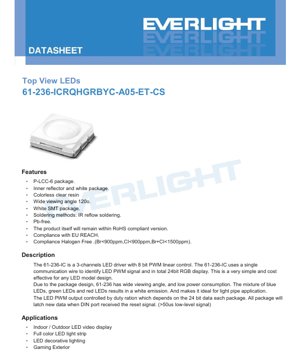
61-236-IC is a highly integrated surface-mount LED driver specifically designed for full-color RGB applications. It integrates three independent LED chips (red, green, blue) with a dedicated control IC within a single P-LCC-6 package. This integration simplifies PCB design by eliminating the need for external driving components for each color channel. The device is designed for applications requiring vibrant color mixing, dynamic lighting effects, and reliable performance in a compact form factor.
1.1 Core Advantages and Target Market
The primary advantage of the 61-236-IC lies in its system-level simplicity. It employs a single-wire data transmission protocol, which significantly reduces the number of control lines required from a microcontroller or main controller compared to traditional parallel RGB LED interfaces. This makes it a cost-effective solution for scalable designs. Its 120-degree wide viewing angle, achieved through an internal reflector and transparent resin, ensures uniform light distribution, making it an ideal choice for light guide tube applications and decorative lighting where multi-angle visibility is crucial.
The target market includes indoor and outdoor full-color LED displays, decorative and architectural lighting strips, gaming peripherals, and any application requiring addressable, multi-color LED points. The device complies with RoHS, REACH, and halogen-free standards, ensuring it meets stringent international environmental and safety regulations.
2. In-depth Technical Parameter Analysis
This section provides a detailed breakdown of the device's operational limits and performance characteristics under specified conditions.
2.1 Absolute Maximum Ratings
These ratings define the stress limits that may cause permanent damage to the device. Operation at or beyond these limits is not guaranteed.
- Supply Voltage (Vdd):4.2V to 5.5V. This defines the operating voltage range for the internal control circuitry. A stable 5V supply is typically used.
- Output Voltage (Vout):17V. This is the maximum voltage that the driver output stage can withstand, related to the LED forward voltage.
- Input Voltage (Vin):-0.5V to Vdd+0.5V. This specifies the safe voltage range for the data input (Din) and set pins to prevent latch-up or damage.
- LED output current (Iout):5 mA. This is the maximum constant current for each color channel (red, green, blue). Exceeding this current may cause LED performance degradation or failure.
- Operating temperature (Topr):-25°C to +85°C. The ambient temperature range for reliable device operation.
- Storage temperature (Tstg):-40°C to +90°C. The safe temperature range when the device is not powered.
- ESD (Electrostatic Discharge):2000V (Human Body Model). Indicates the level of electrostatic protection, suggesting careful handling during assembly.
- Soldering Temperature (Tsol):Reflow soldering: maximum 260°C for 10 seconds; Hand soldering: maximum 350°C for 3 seconds. These are critical parameters for PCB assembly to avoid thermal damage to the package or chip.
2.2 Electro-Optical Characteristics
Measured under Ta=25°C, IF=5mA per channel, these parameters define the light output and color characteristics.
- Luminous Intensity (Iv):
- Red (RQH): 90 mcd (minimum) to 280 mcd (maximum).
- Green (GR): 280 mcd (minimum) to 900 mcd (maximum).
- Blue (BY): 71 mcd (min) to 224 mcd (max).
- Viewing angle (2θ1/2):120 degrees (typical value). Defined as the full angle at which the luminous intensity drops to half of its peak value. Wide viewing angle is a key characteristic.
- Dominant Wavelength (λd):
- Red (RQH): 617.5 nm to 629.5 nm.
- Green (GR): 525 nm to 540 nm.
- Blue (BY): 462 nm to 474 nm.
2.3 Electrical Characteristics
Defined at Ta=-20~+70°C, Vdd=4.5~5.5V, Vss=0V.
- Output Current (IOL):5 mA (Typical). Regulated current supplied to each LED.
- Input Current (II):±1 μA (Maximum). Extremely low leakage current on the data input pin.
- Input voltage logic level:
- VIH (Logic High): Minimum 3.3V.
- VIL (Logic Low): Maximum 0.3*Vdd (e.g., 1.65V when Vdd=5.5V).
- Hysteresis Voltage (VH):0.35V (typical). Provides noise immunity for the data input by creating a voltage gap between the high and low level switching thresholds.
- IDDdyn (Dynamic Power Supply Current):2.5 mA (typical). Current consumed by internal control logic during data transfer and PWM operation.
3. Binning System Description
The datasheet implies a multi-parameter binning system to ensure color and luminance consistency in production applications. While not explicitly detailed in a single table, the following bins can be inferred from the parameter ranges:
- Luminous Intensity (CAT):Devices are binned based on measured light output (mcd) for each color (red, green, blue). This is crucial for achieving uniform brightness among multiple units in a display or light strip.
- Peak Wavelength (HUE):LEDs are binned according to their peak wavelength (nm). This ensures a consistent color point (e.g., the same shade of red or blue) among all devices in an assembly, which is crucial for precise color mixing and display quality.
- Forward Voltage (REF):Although not listed in the main table, the packaging materials section mentions "forward voltage grade," indicating that chips may also be classified based on their forward voltage (Vf) characteristics to ensure uniform power distribution in series/parallel strings.
When ordering, specific bin codes (CAT, HUE, REF) can usually be requested to match application requirements.
4. Performance Curve Analysis
Datasheet contains typical performance curves, providing insights into behavior beyond single-point specifications.
4.1 Spectral Distribution
The provided graph shows the relative luminous intensity of the red (RQH), green (GR), and blue (BY) chips across the visible spectrum. Key observations:
- Kila mkunjo inaonyesha kilele dhahiri na nyembamba kinacholingana na urefu wa wimbi lake kuu, kuthibitisha usawa mzuri wa rangi.
- Mionzi nyekundu inazingatia katika eneo la urefu wa wimbi refu (~620-630nm), kijani katika sehemu ya kati (~525-540nm), na bluu katika eneo la urefu wa wimbi fupi (~462-474nm).
- Mwingiliano kati ya wigo wa rangi ni mdogo sana, jambo linalofaa kwa kuunda anuwai pana ya rangi wakati wa kuchanganya rangi.
4.2 Radiation Pattern
The "Radiation Pattern" illustrates the spatial distribution of light. The curve for a wide-viewing-angle LED like this is typically broad and Lambertian-like (cosine distribution), confirming the 120-degree specification. Intensity is highest when viewed directly along the axis (0 degrees) and smoothly decreases towards the edges (±60 degrees).
5. Mechanical and Packaging Information
5.1 Package Dimensions and Pin Configuration
The device is housed in a P-LCC-6 (Plastic Leaded Chip Carrier, 6-pin) package. The detailed dimension drawing specifies length, width, height, lead pitch, and pad size, with a general tolerance of ±0.1mm. This information is crucial for PCB pad design.
Pin Definition:
- Vss:Internal circuit grounding connection.
- NA:Not connected / No internal connection.
- Di:Control data signal input. Receives serial data stream.
- Do:Control data signal output. Transmits data stream to the next device in the daisy chain.
- NA:Not connected / No internal connection.
- Vdd:Positive power supply input (4.2V to 5.5V).
6. Soldering and Assembly Guide
6.1 Reflow Soldering Temperature Profile
The datasheet provides a specific lead-free reflow soldering temperature profile:
- Preheating:150–200°C, for 60–120 seconds. Maximum ramp rate: 3°C/sec.
- Reflow (above liquidus):Temperature must exceed 217°C for 60–150 seconds. Peak temperature must not exceed 260°C, and the time above 260°C must not exceed 10 seconds.
- Cooling:Maximum cooling rate: 6°C/sec. Time above 255°C should not exceed 30 seconds.
6.2 Storage and Moisture Sensitivity
The device is packaged in a moisture barrier bag with desiccant.
- Before opening:Store at ≤30°C and ≤90% relative humidity (RH).
- Shop life:After opening the sealed bag, soldering must be completed within 24 hours under shop conditions (typically around 30°C/60% RH).
- Baking:If the bag has been opened for more than 24 hours, or if the desiccant indicator shows saturation, it needs to be baked at 60°C ±5°C for 24 hours to remove absorbed moisture and prevent the "popcorn" phenomenon (package cracking) during the reflow soldering process.
6.3 Nufa'u
- Current Limitation:The internal driver provides constant current. However, the absolute maximum rating for Iout is 5mA. The application circuit must ensure that operating conditions do not exceed this limit. Under normal 5V operation, the driver itself does not require an external series resistor for current limiting, but care must be taken in the power supply design.
- Mechanical Stress:Avoid applying mechanical stress to the package during soldering or handling. Do not bend the PCB near the component after assembly.
7. Packaging and Ordering Information
7.1 Reel and Carrier Tape Specifications
Components are supplied in embossed carrier tape format, wound on reels for automated surface-mount assembly.
- Packaging quantity:800 pieces per reel.
- Detailed drawings of reel dimensions, carrier tape pocket dimensions (width, pitch, depth), and cover tape specifications are provided to ensure compatibility with SMT equipment.
7.2 Label Information
Reel labels contain critical information for traceability and correct assembly:
- Customer Part Number (CPN)
- Manufacturer Part Number (P/N): e.g., 61-236-ICRQHGRBYC-A 05-ET-CS
- Quantity (QTY)
- Bin Code: CAT (Intensity), HUE (Wavelength), REF (Voltage)
- LOT No. for traceability
8. Application Design Recommendations
8.1 Typical Application Circuit
The datasheet presents a standard 5V application circuit. A microcontroller (MCU) or dedicated controller sends serial data to the Din pin of the first LED driver. The Dout pin of each driver is connected to the Din pin of the next, forming a daisy chain. A single power supply (5V) powers all Vdd pins, and all Vss pins are connected to ground. It is recommended to use a small RC filter (e.g., 100Ω resistor and 100nF capacitor) on the data line near the MCU to suppress high-frequency noise and improve signal integrity, especially in longer chains or noisy environments.
8.2 Data Protocol and Timing
The device uses a proprietary single-wire return-to-zero protocol.
- Data Frame:Kowane na'ura yana da 24-bit, an tsara shi azaman 8-bit kore, 8-bit ja, da 8-bit shuɗi (G7-G0, R7-R0, B7-B0). Wannan yana ba da damar matakan ƙarfi 256 (0-255) a kowane tashar launi.
- Lokacin bit:
- Logic '0': Lokacin matakin girma (T0H) = 0.30 µs ±80ns, lokacin matakin ƙasa (T0L) = 0.90 µs ±80ns.
- Logic '1': High-level time (T1H) = 0.90 µs ±80ns, low-level time (T1L) = 0.30 µs ±80ns.
- The total bit period for both logic '0' and '1' is 1.2 µs, with a data rate of approximately 833 kHz.
- Reset/Latch signal:A low-level pulse on the Din line lasting longer than 50 µs (RES) indicates the end of a data frame. Upon receiving this reset signal, all devices in the chain simultaneously latch the 24-bit data they have just received into their output registers and update their PWM outputs. This ensures all LEDs in the display update synchronously, preventing "ghosting" or "rainbow" effects during data refresh.
8.3 Long-chain Design Considerations
For applications with many devices connected in series (e.g., long LED strips):
- Power Injection:5V power must be injected at multiple points along the chain to prevent voltage drop, which can cause LEDs far from the power source to dim or experience color shift. Use thick power traces or separate power wires.
- Data Signal Integrity:Long data lines may suffer from signal degradation (increased rise/fall times, ringing). Using a buffer IC or a low-value series resistor (e.g., 33-100Ω) at the driver input helps match impedance and reduce reflections.
- Refresh Rate:Total Update Time = (Number of LEDs * 24 bits * 1.2 µs) + Reset Time. For a chain of 100 LEDs, it is approximately ~2.88 ms + ~0.05 ms = ~2.93 ms, allowing a refresh rate exceeding 300 Hz, which is sufficient for most visual applications.
9. Technical Comparison and Differentiation
Compared to discrete solutions (separate RGB LED + external constant current driver or resistor + multiplexing logic), the 61-236-IC offers significant advantages:
- Reduced component count:Integrating three LEDs and their drivers into a single package saves PCB space and assembly costs.
- Simplified Control:The single-wire daisy-chain protocol significantly reduces the need for MCU GPIOs—only one pin is required to control hundreds of LEDs, whereas basic PWM control requires three pins per RGB LED.
- Integrated Current Control:Provides stable, regulated current for each LED chip, ensuring consistent brightness and color, unaffected by minor forward voltage (Vf) variations between individual LEDs. This eliminates the need for current-limiting resistors and associated power losses.
- Synchronous Update:The global latch/reset function enables perfectly synchronized color changes across the entire display, a feature difficult to achieve with multiplexed discrete LEDs.
10. Frequently Asked Questions (Based on Technical Parameters)
10.1 How many of these LEDs can be connected in series at most?
The specification does not stipulate rigid electrical limits. The actual limits are determined by the following factors:Data Timing:通过多个器件的累积传播延迟。对于非常长的链 (>500-1000),数据信号可能会劣化,需要信号调理或分段。 2.Power Distribution:Ensuring sufficient voltage (5V) for each device in the chain requires careful design of the power bus and the placement of multiple injection points.Refresh Rate Requirement:More LEDs mean a longer frame update time, which may become noticeable if the refresh rate for dynamic content drops below 60-100 Hz.
10.2 Can I drive these LEDs with a 3.3V microcontroller?
Spec sheet inabainisha voltage ya chini ya kuingiza kwa kiwango cha juu (VIH) kama 3.3V. Kiwango cha juu cha mantiki cha 3.3V kutoka kwa microcontroller kinakidhi hii spec ya chini haswa. Hata hivyo, kufanya kazi kwenye ukingo wa spec hakuna ukingo wa kelele. Katika mazingira yenye viunganishi vifupi na yaliyodhibitiwa, inaweza kufanya kazi. Kwa utendakazi unaotegemewa, hasa katika mnyororo mrefu au mazingira yenye kelele, inashauriwa kwa nguvu kutumia microcontroller ya 5V au kibadilishaji cha kiwango (mfano, MOSFET rahisi au IC maalum) kubadilisha ishara ya 3.3V kuwa ishara thabiti ya 5V.
10.3 Why is there a 5mA current limit? Can I increase the brightness?
The 5mA limit is determined by the design of the internal constant current driver and the thermal/electrical characteristics of the integrated LED chip. Exceeding this absolute maximum rating risks overheating the driver IC or LED chip, leading to accelerated luminous flux degradation (dimming over time) or catastrophic failure. Brightness should be controlled via the 8-bit PWM duty cycle (0-255), not by increasing the current. For higher brightness requirements, a different LED product with a higher current rating should be selected.
11. Practical Application Examples
Scenario: Design a short addressable LED sign.The designer is creating a small sign with 50 independently controllable RGB pixels for displaying animations and text.
- Component Selection:61-236-IC i ananima saboda haɗakar direbobi, faɗin kallon gani don tabbatar da kyakkyawan gani da sauƙin sarrafa sarkar daisy.
- Zane na PCB:Tsarin PCB ya ƙunshi fale-falen gudanarwa 50 na P-LCC-6. Layin bayanai (Din/Do) yana haɗawa daga mai haɗin MCU zuwa kowane pixel a jere. Yi amfani da babban Layer na wutar lantarki 5V da Layer na ƙasa. Sanya babban capacitor na 100µF da ƴan capacitor na 0.1µF na decoupling kusa da wurin shigar wutar lantarki.
- Firmware:对MCU(例如ARM Cortex-M或ESP32)进行编程,以生成精确的1.2 µs位时序。一个缓冲区数组保存所有50个像素的24位颜色值。固件顺序传输1200位 (50 * 24),然后发送一个>50µs的低电平脉冲来锁存数据。
- Assembly:Place components using SMT equipment according to the specified reflow soldering profile. After assembly, test the sign by sending various color patterns to ensure all pixels are correct and respond synchronously.
12. Working Principles
The 61-236-IC operates based on a simple and straightforward working principle. Internally, it contains a shift register and a latch for each color channel. The serial data stream received at the Din pin is shifted into a 24-bit shift register according to the timing of the signal edges. Once a reset pulse is detected, the contents of the shift register are transferred in parallel to three 8-bit hold latches (one for red, green, and blue). These latched values directly control the duty cycle of three independent PWM generators. Each PWM generator drives a constant current source connected to its respective LED chip (red, green, or blue). The constant current source ensures that when the PWM signal is high, the LED receives a stable 5mA current, unaffected by minor variations in the LED forward voltage. The combination of the three PWM-modulated primary colors at each point produces the desired mixed color. The data is simultaneously shifted out to the Dout pin, allowing the same data stream to propagate to the next device in the chain with minimal delay.
13. Teknoloji Trendleri
Devices like the 61-236-IC represent a mature and widely adopted approach in the field of addressable RGB LEDs. The trend in this field is moving towards higher integration and more intelligent features:
- Higher Bit Depth:Evolving from 8-bit per channel (256 levels) to 10-bit, 12-bit, and even 16-bit PWM to achieve smoother color gradients and professional-grade color accuracy, especially in high-end displays and architectural lighting.
- Integrated Memory & Patterns:Some newer drivers include built-in memory to store pre-programmed lighting patterns or animations, offloading this task from the main controller for standalone operation.
- Higher Data Rates & Protocols:Adoption of faster, more robust serial communication protocols (such as SDI with differential signaling) to support longer cable lengths, higher pixel counts, and refresh rates suitable for high-speed video.
- Improved Efficiency and Thermal Management:Development of more efficient drivers to reduce power lost as heat, enabling the use of brighter LEDs or denser packaging. This includes advanced thermal design within the package.
- Extended Color Gamut:Integrate additional LED colors beyond RGB, such as white (W), amber (A), or lime (L), to create RGBW or RGBAW modules capable of producing a wider range of colors, including more natural whites and pastel tones.
Detailed Explanation of LED Specification Terminology
Complete Interpretation of LED Technical Terminology
I. Core Indicators of Photoelectric Performance
| Terminology | Unit/Representation | Popular Explanation | Aiseā e Taua ai |
|---|---|---|---|
| Luminous Efficacy | lm/W (lumens per watt) | The luminous flux emitted per watt of electrical power. A higher value indicates greater energy efficiency. | It directly determines the energy efficiency rating of the luminaire and the electricity cost. |
| Luminous Flux | lm (lumen) | The total amount of light emitted by a light source, commonly known as "brightness". | Determines whether a luminaire is bright enough. |
| Viewing Angle | ° (degree), e.g., 120° | The angle at which luminous intensity drops to half, determining the beam width. | Affects the range and uniformity of illumination. |
| Color Temperature (CCT) | K (Kelvin), such as 2700K/6500K | Haske launin sanyi ko zafi, ƙananan ƙima sun fi rawaya/sanyi, manyan ƙima sun fi fari/sanyi. | Yana ƙayyade yanayin haske da yanayin da ya dace. |
| Color Rendering Index (CRI / Ra) | Unitless, 0–100 | The ability of a light source to reproduce the true colors of objects, with Ra≥80 being preferable. | Affects color fidelity, used in high-demand places such as shopping malls and art galleries. |
| Color tolerance (SDCM) | MacAdam ellipse step, such as "5-step" | A quantitative metric for color consistency; a smaller step number indicates better color consistency. | Ensure no color difference among luminaires from the same batch. |
| Dominant Wavelength | nm (nanometer), e.g., 620nm (red) | Wavelength values corresponding to the colors of colored LEDs. | Determines the hue of monochromatic LEDs such as red, yellow, and green. |
| Spectral Distribution | Wavelength vs. Intensity Curve | Shows the intensity distribution of light emitted by an LED at each wavelength. | Affects color rendering and color quality. |
II. Electrical Parameters
| Terminology | Symbol | Popular Explanation | Design Considerations |
|---|---|---|---|
| Forward Voltage (Forward Voltage) | Vf | The minimum voltage required to light up an LED, similar to a "starting threshold". | The driving power supply voltage must be ≥ Vf; the voltages add up when multiple LEDs are connected in series. |
| Forward Current | If | The current value that makes the LED emit light normally. | Constant current drive is often used, as the current determines brightness and lifespan. |
| Maximum Pulse Current | Ifp | The peak current that can be withstood for a short period of time, used for dimming or flashing. | Pulse width and duty cycle must be strictly controlled, otherwise overheating damage will occur. |
| Reverse Voltage | Vr | Maximum reverse voltage that an LED can withstand; exceeding it may cause breakdown. | Reverse connection or voltage surges must be prevented in the circuit. |
| Thermal Resistance (Thermal Resistance) | Rth (°C/W) | The resistance to heat flow from the chip to the solder joint. A lower value indicates better heat dissipation. | High thermal resistance requires stronger heat dissipation design, otherwise junction temperature will rise. |
| Electrostatic Discharge Immunity (ESD Immunity) | V (HBM), such as 1000V | Electrostatic discharge immunity; a higher value indicates greater resistance to damage from static electricity. | Anti-static measures must be implemented during production, especially for high-sensitivity LEDs. |
III. Thermal Management and Reliability
| Terminology | Key Indicators | Popular Explanation | Impact |
|---|---|---|---|
| Junction Temperature | Tj (°C) | The actual operating temperature inside the LED chip. | For every 10°C reduction, the lifespan may double; excessively high temperatures cause lumen depreciation and color shift. |
| Lumen Depreciation | L70 / L80 (hours) | The time required for the brightness to drop to 70% or 80% of its initial value. | Directly define the "service life" of LED. |
| Lumen Maintenance | % (e.g., 70%) | The percentage of remaining brightness after a period of use. | Characterizes the ability to maintain brightness after long-term use. |
| Color Shift | Δu′v′ or MacAdam ellipse | The degree of color change during use. | Affects the color consistency of the lighting scene. |
| Thermal Aging | Material performance degradation | Degradation of packaging materials due to long-term high temperature. | Zai iya haifar da raguwar haske, canjin launi ko gazawar bude hanya. |
IV. Kullewa da Kayan aiki
| Terminology | Nau'o'in gama gari | Popular Explanation | Characteristics and Applications |
|---|---|---|---|
| Package Types | EMC, PPA, Ceramic | The housing material that protects the chip and provides optical and thermal interfaces. | EMC offers good heat resistance and low cost; ceramic provides superior heat dissipation and long lifespan. |
| Chip Structure | Front-side, Flip Chip | Chip electrode arrangement method. | Flip-chip offers better heat dissipation and higher luminous efficacy, suitable for high-power applications. |
| Phosphor coating. | YAG, silicate, nitride | Coated on the blue LED chip, partially converted to yellow/red light, mixed to form white light. | Different phosphors affect luminous efficacy, color temperature, and color rendering. |
| Lens/Optical Design | Flat, microlens, total internal reflection | Optical structure on the packaging surface, controlling light distribution. | Determines the emission angle and light distribution curve. |
V. Quality Control and Grading
| Terminology | Grading Content | Popular Explanation | Purpose |
|---|---|---|---|
| Luminous Flux Binning | Codes such as 2G, 2H | Group by brightness level, each group has a minimum/maximum lumen value. | Ensure consistent brightness for products in the same batch. |
| Voltage binning | Code such as 6W, 6X | Grouped by forward voltage range. | Ease of matching the driving power supply, improving system efficiency. |
| Color binning | 5-step MacAdam ellipse | Group by color coordinates to ensure colors fall within an extremely small range. | Ensure color consistency to avoid color unevenness within the same luminaire. |
| Color Temperature Grading | 2700K, 3000K, etc. | Group by color temperature, each group has a corresponding coordinate range. | Meet the color temperature requirements of different scenarios. |
VI. Testing and Certification
| Terminology | Standard/Test | Popular Explanation | Meaning |
|---|---|---|---|
| LM-80 | Lumen Maintenance Test | Long-term operation under constant temperature conditions, recording luminance attenuation data. | For estimating LED lifetime (in conjunction with TM-21). |
| TM-21 | Lifetime projection standard | Estimating lifespan under actual usage conditions based on LM-80 data. | Providing scientific life prediction. |
| IESNA Standard | Illuminating Engineering Society Standard | Covers optical, electrical, and thermal testing methods. | Industry-recognized testing basis. |
| RoHS / REACH | Environmental Certification | Ensure the product does not contain harmful substances (such as lead, mercury). | Entry requirements for the international market. |
| ENERGY STAR / DLC | Energy efficiency certification | Energy efficiency and performance certification for lighting products. | Commonly used in government procurement and subsidy programs to enhance market competitiveness. |