Yaliyomo
- 1. Muhtasari wa Bidhaa
- 1.1 Core Advantages and Target Market
- 2. In-depth Technical Parameter Analysis
- 2.1 Absolute Maximum Ratings
- 2.2 Electrical Characteristics
- 2.3 Transmission Characteristics
- 3. Grading System Description
- 4. Performance Curve Analysis
- 5. Mechanical and Packaging Information
- 6. Soldering and Assembly Guidelines
- 7. Ordering and Packaging Information
- 8. Application Recommendations
- 8.1 Typical Application Circuit
- 8.2 Mambo ya Kuzingatia katika Ubunifu
- 9. Ulinganisho wa Kiufundi na Tofauti
- 10. Maswali Yanayoulizwa Mara kwa Mara (FAQ)
- 11. Utafiti wa Kesi ya Ubunifu Unaotumika
- 12. Kanuni ya Uendeshaji
- 13. Mielekeo ya Teknolojia
- Ufafanuzi wa Istilahi za Vigezo vya LED
- I. Viashiria Muhimu vya Utendaji wa Mwangaza na Umeme
- II. Vigezo vya Umeme
- III. Udhibiti wa Joto na Uthabiti
- IV. Ufungaji na Nyenzo
- V. Udhibiti wa Ubora na Uainishaji
- VI. Uchunguzi na Uthibitishaji
1. Muhtasari wa Bidhaa
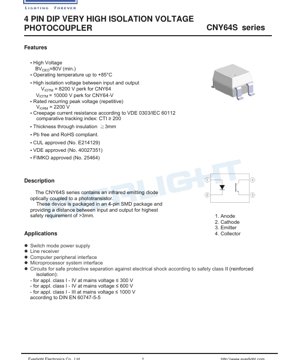
Mfululizo wa CNY64S unawakilisha aina ya viunganishi vya mwanga (vihifadhi mwanga) vya utendaji wa hali ya juu, vilivyobuniwa mahsusi kwa matumizi yanayohitaji utengano mkali wa umeme na usafirishaji thabiti wa ishara. Kiini cha kifaa hiki kinaundwa na diode inayotoa mwanga wa infrared ya gallium arsenide (GaAs LED) iliyounganishwa kwa mwanga na transistor ya mwanga ya silikoni ya aina NPN. Usanidi huu huruhusu usafirishaji wa ishara za umeme kati ya saketi mbili, huku ukidumisha kiwango cha juu cha utengano wa umeme, kuzuia vitanzi vya ardhini, usafirishaji wa kelele, na mafuriko ya voltage ya juu kuharibu vipengele nyeti.
Lengo kuu la kubuni la mfululizo wa CNY64S ni kutoaUtengano wa Usalama UlioimarishwaThis is achieved by combining sufficient creepage and clearance distances (ensured by encapsulation with insulation penetration thickness ≥3mm) and high dielectric strength materials. The device employs a compact 4-pin dual in-line package (DIP), a through-hole mounting method that provides mechanical stability and facilitates manual or wave soldering processes. This series is characterized by its extremely high isolation voltage ratings, making it suitable for industrial, power supply, and medical equipment where user safety and system integrity are paramount.
1.1 Core Advantages and Target Market
The key advantages of the CNY64S optocoupler stem from its safety-oriented design and reliable performance parameters.
- Superior Isolation Performance:The standard version offers a maximum transient isolation voltage (VIOTM) peak of 8200V, while the VDE-certified "-V" model offers a peak of 10000V, providing excellent protection against high-voltage transient events. The rated repetitive peak isolation voltage (VIORM) ni 2200V.
- Uwezo wa voltage ya juu:Voltage ya chini ya kuvunjika kwa kolekta-emiteri (BVCEO) ni 80V, ikifanya iweze kuunganishwa moja kwa moja na saketi za voltage ya juu zaidi katika hali nyingi bila buffer ya ziada.
- Uthibitishaji wa usalama:Kifaa hiki kimeidhinishwa na taasisi kuu za kimataifa za viwango vya usalama ikiwa ni pamoja na CUL, VDE na FIMKO. Uthibitisho wa VDE unathibitisha haswa kuwa inakidhi viwango vyaUtoaji wa nguvuRequirement, this is a critical requirement for safety-critical applications.
- Environmental Compliance:Manufactured using lead-free (Pb-free) processes and compliant with the RoHS (Restriction of Hazardous Substances) directive.
- Wide Operating Range:Capable of reliable operation across an extended temperature range from -55°C to +85°C.
The target markets for CNY64S includeSwitched-Mode Power Supply (SMPS)feedback loop isolation design,Uendeshaji wa ViwandaMfumo (PLC I/O, kiendeshi cha motor), zinazohitaji kutengwa kwa mgonjwaVifaa vya Matibabu、MawasilianoVifaa, na ishara yoyote inayohitaji kuvuka kwa usalama nyanja tofauti za voltage au mipaka ya usalamaMifumo inayotegemea microprocessor。
2. In-depth Technical Parameter Analysis
Kuelewa kwa kina vigezo vya umeme na vya nuru ni muhimu kwa kubuni sakiti sahihi na kuhakikisha uimara wa muda mrefu.
2.1 Absolute Maximum Ratings
Viwango hivi vinabainisha mipaka ya mkazo ambayo inaweza kusababisha uharibifu wa kudumu wa kifaa. Havitumiki kwa hali za kawaida za uendeshaji.
- Ingizo (LED):Upeo wa sasa endelevu wa mbele (IF) ni 75 mA. Inaruhusu sasa ya kilele cha muda mfupi cha 1.5A (IFM). The absolute maximum reverse voltage (VR) is only 5V, highlighting the LED's sensitivity to reverse bias. Exceeding this value will quickly lead to LED performance degradation. The input power dissipation (PD) must not exceed 120 mW.
- Output (Phototransistor):The maximum continuous collector current (IC) is 50 mA. The collector power dissipation (PC) is limited to 150 mW. The collector-emitter voltage (VCEO) must be kept below 80V, and the emitter-collector voltage (VECO) must be kept below 7V.
- Kikomo cha Kifaa:Jumla ya Matumizi ya Nguvu ya Kifaa (Ptot) ni 250 mW. Voltage ya Utofautishaji (Viso) inajaribiwa kwa dakika moja chini ya hali ya unyevunyevu uliodhibitiwa (40-60% RH) kwa 8200 VRMS.
2.2 Electrical Characteristics
Vigezo hivi vinahakikishiwa chini ya masharti maalum ya majaribio na vinafafanua utendaji wa kifaa.
- Tabia za Ingizo:Katika mkondo wa mbele wa 50mA, voltage ya mbele ya LED (VF) thamani ya kawaida ni 1.6V, na upeo wa juu ni 2.0V. Hii ni muhimu kwa kuhesabu thamani ya upinzani wa kudhibiti mkondo. Mkondo wa uvujaji wa nyuma (IR)非常低(5V时<10 µA)。
- Tabia za Pato:Mkondo wa Giza (ICEO), yaani mkondo wa uvujaji wa transistor ya fotoelektriki wakati LED imezimwa, kwa VCE=20V ni kiwango cha juu cha 200 nA. Parameta hii ni muhimu sana kwa kubainisha usahihi wa ishara katika hali ya kuzimwa na msingi wa kelele. Wakati transistor inawashwa kabisa (ICE(sat)) ni kiwango cha juu cha 0.3V (IF=10mA, IC=1mA), inayoonyesha utendaji mzuri wa kubadili.
- Sifa za kutengwa:Uwezo wa kuunganisha (CIO) The typical value is very low, at 0.3 pF, which minimizes capacitive coupling of high-frequency noise through the isolation barrier. The isolation resistance (RIO) is a minimum of 1011Ω (100 GΩ) at 500V DC, representing excellent DC insulation performance.
2.3 Transmission Characteristics
This is the core of the optocoupler's function, defining the relationship between the input current and the output current.
- Current Transfer Ratio (CTR):This is the ratio of the output collector current (IC) to the input LED forward current (IF), expressed as a percentage (CTR = IC/ IF* 100%). The CNY64S series offers three CTR grades or "bins":
- CNY64S:CTR range from 50% to 300%.
- CNY64SA:CTR range from 63% to 125%.
- CNY64SB:CTR ranges from 100% to 200%.
CTR is measured under standard conditions (IF= 5mA, VCE= 5V). Selecting the appropriate CTR grade allows designers to optimize for gain, power efficiency, or switching speed. Devices with higher CTR require less LED drive current to achieve the same output current, thereby improving efficiency, but their dynamic characteristics may differ slightly.
- Switching Speed:Dynamic performance is determined by the turn-on time (ton), turn-off time (toff), rise time (tr) and fall time (tf) characterize. For CNY64S, under the test conditions of VCC=5V, IC=5mA, RL=100Ω, the maximum value for all timing parameters is 18 µs, while the typical values are much faster (e.g., ton~6µs, toff~7µs). These speeds are suitable for digital signal isolation and lower frequency PWM signals, but not for very high-speed data communication.
3. Grading System Description
The CNY64S series employs a simple grading system based solely onCurrent Transfer Ratio (CTR). In this specific device series, there is no grading for wavelength or forward voltage, as it uses a standard infrared LED.
The part number indicates the CTR grade:
- Base Part NumberCNY64Sindicates the standard wide-range CTR bin (50-300%).
- Suffix-A(e.g., CNY64SA) specifies a tighter CTR grade with a range of 63-125%.
- Suffix-B(e.g., CNY64SB) specifies a tighter CTR grade with a range of 100-200%.
- Optional suffix-VIndicates that the component has received VDE safety certification for reinforced isolation.
This grading allows system designers to select devices with guaranteed minimum and maximum CTR values. For example, in linear analog feedback applications, tighter CTR grades (A or B) ensure more consistent gain across different devices, thereby improving production yield and performance consistency. For simple digital switching isolation, the standard grade may be entirely sufficient and more cost-effective.
4. Performance Curve Analysis
While the provided PDF excerpt mentions "Typical Performance Curves" but does not show them, typical curves for an optocoupler like the CNY64S would include the following, which are crucial for design:
- CTR vs. Forward Current (IF):This curve shows how CTR varies with drive current. Typically, CTR is highest at moderate forward currents (e.g., 5-10mA) and may decrease at very low or very high currents. This helps in selecting the operating point for optimal efficiency and linearity.
- CTR vs. Temperature:The CTR of an optocoupler typically has a negative temperature coefficient; it decreases as ambient temperature rises. Understanding this derating is crucial for designing systems that must operate reliably across the full -55°C to +85°C range.
- Forward Voltage (VF) vs. Forward Current (IF):The standard IV curve for the infrared LED, used for thermal management and driver design.
- Switching Time vs. Load Resistance (RL):Switching speed (ton, toff) depends heavily on the load resistor connected to the phototransistor collector. A smaller RLtypically provides faster switching speed, at the cost of higher power consumption and lower output voltage swing.
The test circuit for switching time (Figure 10 in the PDF) shows a standard configuration: a pulse drives the LED through a current-limiting resistor (RIN), and the phototransistor output is monitored across a load resistor (RL) connected to the supply voltage (VCC). The waveform defines timing parameters between the 10% and 90% points of the input and output pulses.
5. Mechanical and Packaging Information
The CNY64S adopts a 4-pin DIP (Dual In-line Package). The key mechanical characteristic for safety isthe creepage distance, which is guaranteed to be ≥3mm. This physical isolation between the input side (pins 1 and 2) and the output side (pins 3 and 4) of the package is a fundamental requirement for achieving reinforced isolation ratings at high voltages.
Pin Definition:
- Infrared LED Anode
- Infrared LED Cathode
- Emitter ya Phototransistor
- Collector ya Phototransistor
Mchoro wa kifurushi (uliofichwa kwenye PDF) utatoa vipimo sahihi vya kupanga pedi za PCB, ikiwa ni pamoja na umbali wa pini, upana wa mwili na urefu wa jumla. Pia hutolea mpangilio unaopendekezwa wa pedi za kusakinishwa kwenye uso (huenda ukawa wa kifurushi cha DIP kinachosakinishwa kupitia shimo lakini pini zimeundwa kwa ajili ya kusakinishwa kwenye uso), ili kuhakikisha muunganisho wa mnyororo wa kuaminika na nguvu ya mitambo inayofaa wakati wa usakinishaji.
6. Soldering and Assembly Guidelines
Kifaa hiki kinaweza kustahimili joto la juu la kuunganisha la 260°C lililopimwa umbali wa mm 2 kutoka kwa mwili wa kifurushi, kwa muda wa chini ya sekunde 10. Hii inalingana na michakato ya kawaida ya reflow isiyo na risasi na wave soldering. Lazima tahadhari isiweze kuepuka mkazo mwingi wa joto, vinginevyo unaweza kuharibu muunganisho wa waya wa ndani au nyenzo za kifurushi cha plastiki, na hivyo kuweza kudhuru uadilifu wa kutengwa. Kanuni za kiwango cha tasnia za kushughulikia vifaa vyenye unyevunyevu (ikiwa vinatumika) zinapaswa kufuatwa. Anuwai ya joto la uhifadhi ni -55°C hadi +100°C.
7. Ordering and Packaging Information
Muundo wa nambari ya modeli ni kama ifuatavyo:CNY64SX-V
- CNY64S:Mfano wa msingi wa mfululizo.
- X:Chaguo la kiwango cha CTR: 'A', 'B' au tupu (kiwango cha kawaida).
- -V:Kiambishi cha hiari, kinachoashiria uthibitisho wa usalama wa VDE.
Chaguo la ufungashaji:
- CNY64S / CNY64S-V:Tube packaging, 60 pieces per tube.
- CNY64S(TA):Tube packaging, 500 pieces per tube (may be a bulk packaging option).
Device marking:Several lines of text are marked on the top of the package:
- EL:Manufacturer code.
- CNY64:Modeli ya msingi.
- R:Herufi moja inayoashiria kiwango cha CTR (k.m. 'A' au 'B').
- Y:Nambari ya tarakimu moja inayoashiria mwaka wa utengenezaji.
- WW:Nambari ya tarakimu mbili inayoashiria nambari ya wiki ya utengenezaji.
- V:Inaashiria alama ya hiari ya uthibitisho wa VDE.
8. Application Recommendations
8.1 Typical Application Circuit
CNY64S inatumika kwa matumizi mengi, inaweza kutumika katika usanidi muhimu kadhaa:
- Kutenganisha Ishara ya Dijiti:Kesi ya matumizi rahisi zaidi. Ishara ya dijiti inaendesha LED kupitia kipingamizi cha kudhibiti mkondo. Fototransistor imeunganishwa kama swichi, kipingamizi cha kuvuta juu kimeunganishwa kwenye VCC, kujenga upya ishara ya mantiki iliyogeuzwa upande wa kutengwa. Kasi ya kubadili (kiwango cha juu cha 18µs) inasaidia viwango vya data hadi mamia ya kHz.
- Maoni ya Usambazaji wa Nguvu wa Swichi (SMPS):Utumizi Muhimu. Vichanganyiko vya mwanga na umeme hutumiwa kuhamisha voltage ya makosa kutoka upande wa sekondari (pato) wa chanzo cha umeme kurudi kwenye kikoa cha udhibiti wa PWM upande wa msingi, huku ukidumisha kizuizi cha kutengwa. Mstari wa CTR na uthabiti wa joto ni muhimu hapa. Voltage ya juu ya kutengwa ni muhimu kwa usalama wa vyanzo vya umeme vilivyojitenga.
- Kiolesura cha Mfumo wa Microprocessor:Kutenganisha mistari ya I/O ya dijiti kati ya mazingira yenye kelele ya viwanda (k.m. Ingizo la PLC ya 24V) na microprocessor nyeti. BV ya 80VCEOinatoa ukingo mzuri wa misukumo ya voltage.
8.2 Mambo ya Kuzingatia katika Ubunifu
- Kizuizi cha Mwendo wa Sasa kwa LED:Daima tumia upinzani wa mfululizo kuweka mkondo wa mbele wa LED (IF). Kulingana na voltage ya usambazaji (Vsupply), the required IFand the LED's VF(Use the maximum value in worst-case design) Calculate the resistor value: R = (Vsupply- VF) / IF. Do not exceed the absolute maximum I of 75mA.F。
- Phototransistor Bias:The load resistor (RL) on the collector determines the output voltage swing, switching speed, and power consumption. A smaller RLprovides faster speed but lower gain and higher current. Ensure the voltage across the phototransistor (VCE) Not exceeding 80V in the off state.
- CTR Degradation:The CTR of an optocoupler gradually decreases over time, especially when operating under high junction temperature and high forward current. For long-life designs, the operating IFshould be derated and adequate thermal management ensured. Select devices with an initial CTR significantly higher than the minimum required by the circuit at end-of-life.
- Noise Immunity:Low coupling capacitance (0.3 pF) provides good high-frequency common-mode noise rejection. For extremely noisy environments, consider adding a small bypass capacitor (e.g., 0.1µF) near the device's input and/or output pins to filter high-frequency spikes.
9. Ulinganisho wa Kiufundi na Tofauti
Compared to devices with lower isolation ratings (e.g., 2500VRMSor 5000VRMSCompared to the standard 4-pin optocoupler, the main difference of the CNY64S lies in its8200VRMS/10000V peak isolation capabilityand formalreinforced isolation certification(VDE). This makes it not just a signal isolator, but a certified safety component. Compared to faster digital isolators (using capacitive or magnetic coupling), the CNY64S is slower but inherently offers higher isolation voltage and robustness against dV/dt transients, and is typically lower cost. The combination of its 80V output transistor rating, wide CTR selection, and safety certification creates a strong value proposition for cost-sensitive yet safety-critical industrial and power supply applications.
10. Maswali Yanayoulizwa Mara kwa Mara (FAQ)
Q1: What is the difference between the standard CNY64S and the CNY64S-V?
A1: The "-V" model has undergone additional testing and certification by VDE according to a specific safety standard (DIN EN 60747-5-5) for reinforced isolation. It has a higher transient isolation voltage rating (10000V peak vs. 8200V peak). The -V version is required for applications needing formal safety agency recognition.
Q2: How to choose between the CTR grades (Standard, A, B)?
A2: If your circuit design can tolerate large gain variations (e.g., digital switching with ample margin), the Standard grade is sufficient. If you need more consistent performance between different devices, especially in analog feedback loops or circuits where a specific minimum CTR is critical to function, choose grade A or B. Grade B guarantees a higher minimum CTR (100%).
Q3: Can I use it for isolating AC mains voltage signals?
A3: Yes, but with important caveats. The device is rated for reinforced isolation of mains voltages up to specific limits, depending on the application category (e.g., up to 600V for Categories I-IV). You must ensure that the creepage and clearance distances on the PCB around the device also meet the relevant safety standards for your working voltage. The optocoupler itself is only one part of the isolation system.
Q4: Why is the reverse voltage rating for the LED so low (5V)?
A4: The infrared LED is a semiconductor diode with a relatively low reverse breakdown voltage. Applying even a small reverse voltage exceeding the rating can cause avalanche breakdown and immediate damage. Always ensure the drive circuit prevents reverse bias, or if reverse voltage is possible, connect a protection diode in parallel across the LED (cathode to anode).
11. Utafiti wa Kesi ya Ubunifu Unaotumika
Mazingira:Kutenganisha ishara ya dijiti ya 5V kutoka kwa kidhibiti kidogo, ili kudhibiti rileyi ya 24V ndani ya kabati ya viwanda. Mazingira yana kelele za umeme, na yanahitaji kutenganishwa kwa utendaji ili kuzuia usumbufu wa kitanzi cha ardhi kwa kidhibiti kidogo.
Hatua za Uundaji:
- Uchaguzi wa Vipengele:Chagua CNY64SB, ili kuhakikisha CTR ya chini kabisa ya 100%, kuhakikisha uwezo wa kuendesha wenye nguvu hata baada ya kukua.
- Kiongozi cha LED:Pini ya kidhibiti kidogo (pato la 5V) inaendesha LED. Lengo IF= 10mA kwa kasi nzuri na ukingo. Tumia VF(max)= 2.0V, Rlimit= (5V - 2.0V) / 0.01A = 300Ω. Tumia kipingamizi cha kawaida cha 330Ω, upate IF≈ 9mA.
- Saketi ya pato:Coil ya relay (24V, upinzani wa coil 100Ω) imeunganishwa kati ya chanzo cha 24V na kolekta ya fototransistor. Emita imegundishwa. LED inapowasha, fototransistor inajaa, na kuvuta kolekta chini, hivyo kuamsha relay. Lazima diode ya kukomesha iwekwe kwenye coil ya relay ili kuzuia mwinuko wa voltage wakati transistor inazimwa. V ya 0.3VCE(sat)inaweza kupuuzwa. BV ya 80VCEOInatoa ulinzi wa kutosha kwa mwinuko wa kugeuka kwa inductor ambao diode haikufungwa kabisa.
- Usanidi wa PCB:Weka umbali wa kupanda wa ≥3mm kati ya njia za upande wa ingizo (kikokotoo kidogo, kipingamizi) na njia za upande wa pato (24V, relay) kwenye PCB ili kupanua kutengwa kwa ndani kwa kifaa. Weka kondakta ya kuzunguka (0.1µF) karibu na pini za nguvu kwa pande zote mbili za kifaa.
Sakiti hii rahisi na thabiti hutumia vigezo muhimu vya CNY64S kwa kutenganisha kwa uaminifu mantiki ya udhibiti na kiwango cha nguvu.
12. Kanuni ya Uendeshaji
CNY64S inategemeaUbadilishaji wa Umeme-Mwanga-Umemekanuni ya uendeshaji. Mkondo unaotumika kwa upande wa ingizo unapita kupitia LED ya infrared, na kufanya iweze kutolea fotoni yenye urefu wa wawi wa takriban 940nm. Mwanga huu unapita kupitia pengo la wazi la kujitenga ndani ya kifuniko cha plastiki. Kwa upande wa pato, mwanga huangaza kwenye eneo la msingi la transistor ya fotoni ya silikoni ya aina ya NPN, na kuzalisha jozi za elektroni na shimo. Mkondo huu unaozalishwa na mwanga hutumika kama mkondo wa msingi, ambao kisha huongezewa na faida ya transistor (hFE)放大,产生大得多的集电极电流。关键点在于,输入和输出之间的唯一连接是光束;没有电导体,从而提供了电气隔离。隔离程度由光路的物理距离和中间材料的介电特性决定。
13. Mielekeo ya Teknolojia
Teknolojia ya optocoupler inaendelea kukua. Ingawa kanuni za msingi zinabaki sawa, mwelekeo unajumuisha:
- Ujumuishaji wa Juu Zaidi:Kuunganisha optocoupler na saketi za ziada kama vile kianzishi cha Schmitt, kiongozi cha lango, au kijitenga cha I²C ndani ya kifuniko kimoja.
- Kasi ya Juu Zaidi:Kukuza phototransistor zenye kasi zaidi na miundo iliyojumuishwa kwa ajili ya utengano wa dijiti unaoshindana katika safu ya Mbps.
- Uimara Ulioimarishwa na Upunguzaji Ukubwa:Kuboresha ufanisi wa LED na nyenzo za ufungaji, ili kupanua maisha ya huduma, kupunguza kuzorota kwa CTR, na kuruhusu matumizi ya vifurushi vidogo vya kusakinishwa kwenye uso (kama SO-4, SO-6), huku ukidumisha kiwango cha juu cha kutengwa.
- Makini na viwango vya usalama:Mahitaji yanayoongezeka kwa vipengele vilivyo na utengano ulioimarishwa na uthibitishaji wa awali, ili kurahisisha bidhaa za mwisho kufuata kanuni kali za usalama za kimataifa za matibabu, magari na vifaa vya viwanda.
Ufafanuzi wa Istilahi za Vigezo vya LED
Maelezo kamili ya istilahi za kiteknolojia ya LED
I. Viashiria Muhimu vya Utendaji wa Mwangaza na Umeme
| Istilahi | Unit/Penulisan | Penjelasan Sederhana | Mengapa Penting |
|---|---|---|---|
| Efisiensi Cahaya (Luminous Efficacy) | lm/W (lumen per watt) | Fluks cahaya yang dihasilkan per watt daya listrik, semakin tinggi semakin hemat energi. | Huamua moja kwa moja kiwango cha ufanisi wa nishati ya taa na gharama ya umeme. |
| Kiasi cha Mwanga (Luminous Flux) | lm (lumen) | Jumla ya kiasi cha mwanga kinachotolewa na chanzo cha mwanga, kinachojulikana kwa kawaida kama "mwangaza". | Huamua kama taa inatosha kuwa na mwangaza. |
| Pembe ya Kuangazia (Viewing Angle) | ° (digrii), kama 120° | Pembe ambapo nguvu ya mwanga hupungua hadi nusu, huamua upana wa boriti ya mwanga. | Huathiri eneo la mwangaza na usawa wake. |
| Joto la Rangi (CCT) | K (Kelvin), kama 2700K/6500K | Joto la rangi ya mwanga, thamani ya chini huelekea manjano/joto, thamani ya juu huelekea nyeupe/baridi. | Huamua mazingira ya taa na matumizi yanayofaa. |
| Kielelezo cha Uonyeshaji Rangi (CRI / Ra) | Hakuna kitengo, 0–100 | Uwezo wa chanzo cha mwanga kuonyesha rangi halisi ya kitu, Ra≥80 ni bora. | Huathiri ukweli wa rangi, hutumiwa kwenye maeneo yenye mahitaji makubwa kama maduka makubwa, majumba ya sanaa, n.k. |
| Tofauti ya Uwezo wa Rangi (SDCM) | MacAdam Ellipse Steps, e.g., "5-step" | A quantitative indicator of color consistency; a smaller step number indicates better color consistency. | Ensures no color variation among luminaires from the same batch. |
| Dominant Wavelength | nm (nanometer), e.g., 620nm (red) | The wavelength value corresponding to the color of a colored LED. | Determines the hue of monochromatic LEDs such as red, yellow, and green. |
| Spectral Distribution | Wavelength vs. Intensity curve | Shows the intensity distribution of light emitted by an LED across various wavelengths. | Affects color rendering and color quality. |
II. Vigezo vya Umeme
| Istilahi | Ishara | Penjelasan Sederhana | Mazingatio ya Ubunifu |
|---|---|---|---|
| Voltage ya Mbele (Forward Voltage) | Vf | Voltage ya chini inayohitajika kuwasha LED, kama "kizingiti cha kuanzisha". | Voltage ya chanzo cha usukumaji lazima iwe ≥ Vf, voltage inajumlishwa wakati LED nyingi zimeunganishwa mfululizo. |
| Mwendo wa Mbele (Forward Current) | If | Thamani ya mkondo inayofanya LED ionyeshe mwanga kwa kawaida. | Kusukumwa kwa mkondo wa kudumu hutumiwa kwa kawaida, mkondo huamua mwangaza na maisha ya huduma. |
| Mkondo wa Juu wa Pigo (Pulse Current) | Ifp | Peak current that can be withstood for a short period, used for dimming or flashing. | Pulse width and duty cycle must be strictly controlled to avoid overheating and damage. |
| Reverse Voltage | Vr | The maximum reverse voltage an LED can withstand; exceeding it may cause breakdown. | The circuit must be protected against reverse connection or voltage surges. |
| Upinzani wa joto (Thermal Resistance) | Rth (°C/W) | Upinzani wa joto kutoka kwenye chip hadi kwenye sehemu ya kuuza, thamani ya chini inaonyesha usambazaji bora wa joto. | Upinzani wa joto wa juu unahitaji muundo wa nguvu zaidi wa usambazaji joto, vinginevyo joto la kiungo litaongezeka. |
| Uvumilivu wa kutokwa umeme tuli (ESD Immunity) | V (HBM), kama 1000V | Uwezo wa kupiga umeme tuli, thamani ya juu zaidi inaweza kupunguza uharibifu wa umeme tuli. | Hatua za kinga dhidi ya umeme tuli zinahitajika katika uzalishaji, hasa kwa LED zenye usikivu wa juu. |
III. Udhibiti wa Joto na Uthabiti
| Istilahi | Viashiria Muhimu | Penjelasan Sederhana | Athari |
|---|---|---|---|
| Junction Temperature | Tj (°C) | Joto halisi la kufanya kazi ndani ya chip ya LED. | Kwa kila kupungua kwa 10°C, maisha yanaweza kuongezeka mara mbili; joto la juu sana husababisha kupungua kwa mwanga, na mabadiliko ya rangi. |
| Kupungua kwa Mwanga (Lumen Depreciation) | L70 / L80 (saa) | Muda unaohitajika kwa mwangaza kupungua hadi 70% au 80% ya thamani ya awali. | Kufafanua moja kwa moja "maisha ya huduma" ya LED. |
| Uwezo wa Kudumisha Lumeni (Lumen Maintenance) | % (k.m. 70%) | Asilimia ya mwangaza uliobaki baada ya kutumia kwa muda fulani. | Inaonyesha uwezo wa kudumisha mwangaza baada ya matumizi ya muda mrefu. |
| Mabadiliko ya Rangi (Color Shift) | Δu′v′ or MacAdam Ellipse | The degree of color change during use. | Affects the color consistency of the lighting scene. |
| Thermal Aging | Material performance degradation | Degradation of packaging materials due to prolonged high temperatures. | Inaweza kusababisha kupungua kwa mwangaza, mabadiliko ya rangi, au kushindwa kwa mzunguko wazi. |
IV. Ufungaji na Nyenzo
| Istilahi | Aina za Kawaida | Penjelasan Sederhana | Sifa na Matumizi |
|---|---|---|---|
| Aina za Ufungaji | EMC, PPA, Ceramic | A housing material that protects the chip and provides optical and thermal interfaces. | EMC offers good heat resistance and low cost; ceramics provide superior heat dissipation and long lifespan. |
| Chip Structure | Face-up, Flip Chip | Chip electrode arrangement method. | Flip Chip offers better heat dissipation and higher luminous efficacy, suitable for high-power applications. |
| Phosphor coating | YAG, silicate, nitride | Coated on the blue LED chip, partially converting to yellow/red light, mixing to form white light. | Different phosphors affect luminous efficacy, color temperature, and color rendering. |
| Lens/Optical design | Flat, microlens, total internal reflection | Optical structure on the packaging surface, controlling light distribution. | Determines the emission angle and light distribution curve. |
V. Udhibiti wa Ubora na Uainishaji
| Istilahi | Binning Content | Penjelasan Sederhana | Purpose |
|---|---|---|---|
| Luminous Flux Binning | Codes such as 2G, 2H | Grouped by brightness level, each group has a minimum/maximum lumen value. | Ensure consistent brightness within the same production batch. |
| Voltage binning | Codes such as 6W, 6X | Grouped by forward voltage range. | Facilitates driver matching and improves system efficiency. |
| Color binning | 5-step MacAdam ellipse | Group by color coordinates to ensure colors fall within a minimal range. | Ensures color consistency and avoids color variation within the same luminaire. |
| Correlated Color Temperature (CCT) binning | 2700K, 3000K, n.k. | Pangwa kwa makundi kulingana na joto la rangi, kila kundi kina anuwai maalum ya kuratibu. | Kukidhi mahitaji ya joto la rangi kwa matukio tofauti. |
VI. Uchunguzi na Uthibitishaji
| Istilahi | Kigezo/Uchunguzi | Penjelasan Sederhana | Maana |
|---|---|---|---|
| LM-80 | Upimaji wa Udumishaji wa Lumeni | Inawashwa kwa muda mrefu chini ya hali ya joto la kudumu, kurekodi data ya kupungua kwa mwangaza. | Inatumika kukadiria maisha ya LED (kwa kuchanganya na TM-21). |
| TM-21 | Kigezo cha Kukadiria Maisha | Utabiri wa maisha chini ya hali halisi ya matumizi kulingana na data ya LM-80. | Kutoa utabiri wa kisayansi wa maisha. |
| IESNA Standard | Standard ya Chama cha Uhandisi wa Taa | Inajumuisha mbinu za upimaji wa mwanga, umeme na joto. | Msingi unaokubalika kwa tasnia wa upimaji. |
| RoHS / REACH | Uthibitisho wa usafi wa mazingira | Kuhakikisha bidhaa hazina vitu hatari (kama risasi, zebaki). | Masharti ya kuingia kwenye soko la kimataifa. |
| ENERGY STAR / DLC | Uthibitisho wa ufanisi wa nishati | Uthibitisho wa Ufanisi na Utendaji wa Bidhaa za Taa. | Inatumika kwa mara nyingi katika ununuzi wa serikali na miradi ya ruzuku, kuimarisha ushindani wa soko. |