Table of Contents
- 1. Product Overview
- 2. Detailed Technical Parameters
- 2.1 Absolute Maximum Ratings
- 2.2 Electro-Optical Characteristics
- 3. Performance Curve Analysis
- 3.1 Spectral Sensitivity
- 3.2 Relationship Between Dark Current and Ambient Temperature
- 3.3 Uhusiano wa Mkondo wa Mwanga wa Kinyume na Mwangaza
- 3.4 Uhusiano wa Uwezo wa Mwisho na Voltage ya Kinyume
- 3.5 Uhusiano wa Muda wa Kujibu na Upinzani wa Mzigo
- 3.6 Relationship Between Power Consumption and Ambient Temperature
- 4. Mechanical and Packaging Information
- 4.1 Package Dimensions
- 4.2 Polarity Identification
- 5. Welding and Assembly Guide
- 6. Packaging and Ordering Information
- 6.1 Packaging Specifications
- 6.2 Label Specifications
- 7. Application Recommendations
- 7.1 Mandhari ya Kawaida ya Utumizi
- 7.2 Design Considerations
- 8. Technical Comparison and Differentiation
- 9. Maswali Yanayoulizwa Mara kwa Mara (Kulingana na Vigezo vya Kiufundi)
- 10. Mifano ya Uundaji na Matumizi Halisi
- 11. Introduction to Working Principles
- 12. Technology Trends and Background
1. Product Overview
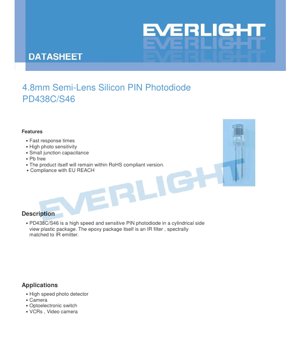
PD438C/S46 ni photodiode ya silikoni yenye utendaji wa hali ya juu, iliyoundwa kwa matumizi yanayohitaji majibu ya haraka na usikivu mkubwa kwa mwanga wa infrared. Inatumia ufungaji wa plastiki wa silinda mwembamba wenye kipenyo cha 4.8mm. Kipengele muhimu cha kifaa hiki ni kwamba ufungaji wake wa epoxy hutumika kama kichujio cha infrared kilichojumuishwa, ambacho kina sifa za wigo zinazolingana na vitoa mwanga vya infrared vilivyo kawaida, na kuimarisha utendaji wake katika mifumo ya kugundua infrared kwa kuchuja mwanga unaoonekana usiohitajika.
Photodiode hii ina sifa za wakati wa majibu mwepesi, usikivu mkubwa wa mwanga, na uwezo mdogo wa capacitor ya kiungo, inayofaa kwa kugundua kasi ya mwanga. Imetengenezwa kwa vifaa visivyo na risasi na inakidhi kanuni zinazohusiana na mazingira.
2. Detailed Technical Parameters
2.1 Absolute Maximum Ratings
Kifaa hiki kimeundwa kufanya kazi kwa uaminifu ndani ya mipaka iliyobainishwa. Kuzidi viwango hivi kunaweza kusababisha uharibifu wa kudumu.
- Reverse voltage (VR):32 V - The maximum reverse bias voltage that can be applied across the photodiode pins.
- Power dissipation (Pd):150 mW - The maximum power the device can dissipate under specified conditions, primarily in the form of heat.
- Operating Temperature (Topr):-40°C to +85°C - The ambient temperature range over which the device is guaranteed to meet its published specifications.
- Storage Temperature (Tstg):-40°C to +100°C - The safe temperature range for storage when the device is not powered.
- Soldering temperature (Tsol):260°C, muda wa kudumu kwa sekunde 5 tu, hii inalingana na mahitaji ya kawaida ya mchakato wa kuuzwa tena bila risasi.
2.2 Electro-Optical Characteristics
Vigezo hivi vinapimwa kwenye joto la mazingira (Ta) Measured at 25°C, defining the core performance of the photodiode.
- Spectral Bandwidth (λ0.5):840 nm to 1100 nm. This defines the wavelength range over which the photodiode's responsivity is at least half of its peak value. It is primarily sensitive to light in the near-infrared region.
- Peak Sensitivity Wavelength (λp):940 nm (typical). The wavelength of light to which the photodiode is most sensitive. This matches the common emission wavelength of many infrared LEDs.
- Open-Circuit Voltage (VOC):0.35 V (typical), measured under irradiation at a wavelength of 940 nm and an irradiance (Ee) of 5 mW/cm². This is the voltage generated by the photodiode when there is no external load.
- Short-circuit current (ISC):18 µA (typical), at Ee= 1 mW/cm², λp=940nm condition. This is the photocurrent when the output is short-circuited.
- Reverse photocurrent (IL):18 µA (typical, minimum 10.2 µA), at Ee= 1 mW/cm², λp=940nm, na voltage ya kinyume ya upendeleo (VR) ni 5V. Hii ndiyo kigezo kikuu cha kufanya kazi katika hali ya photoconductive.
- Mkondo wa giza (Id):5 nA (kiwango cha kawaida, kiwango cha juu 30 nA), kwa VR= 10V na katika hali ya giza kabisa. Hii ndiyo mkondo mdogo wa uvujaji unaotiririka hata wakati hakuna mwanga, na ndiyo kigezo muhimu cha uwiano wa ishara-kwa-kelele.
- Reverse breakdown voltage (BVR):Minimum 32V, typical 170V, measured at a reverse current of 100 µA. This indicates the voltage at which junction breakdown occurs.
- Total capacitance (Ct):18 pF (typical), at VR= 3V and a test frequency of 1 MHz. Lower capacitance enables faster response time.
- Rise/Fall time (tr/tf):50 ns / 50 ns (typical), under the conditions of VR= 10V and load resistance (RL) of 1 kΩ. This specifies the response speed of the photodiode to optical pulses.
Tolerances for key parameters are specified as: luminous intensity ±10%, dominant wavelength ±1nm, forward voltage ±0.1V.
3. Performance Curve Analysis
The datasheet provides several characteristic curves illustrating performance under various conditions. These are crucial for design engineers.
3.1 Spectral Sensitivity
A curve plotting relative sensitivity versus wavelength. It confirms the peak sensitivity at approximately 940nm and shows a gradual decline in spectral response at the boundaries of the 840-1100nm range. The integrated epoxy lens acts as a filter, attenuating the response outside the target infrared band.
3.2 Relationship Between Dark Current and Ambient Temperature
Mkunjo huu kwa kawaida unaonyesha mkondo wa giza (Id) unaokua kwa kasi kielelezo kadiri joto linavyoongezeka. Kuelewa uhusiano huu ni muhimu kwa matumizi yanayofanya kazi katika anuwai pana ya joto, kwani inafafanua kikomo cha chini cha mwanga unaoweza kugunduliwa (sakafu ya kelele).
3.3 Mkondo wa Mwanga wa Kinyume dhidi ya Mnururisho (Ee)
) RelationshipLThe graph shows the linear relationship between the generated photocurrent (I
) and the incident optical power density. Under specified conditions, the photodiode operates in a highly linear region, which is crucial for analog optical measurement applications.
3.4 Uhusiano wa Uwezo wa Mwisho na Voltage ya KinyumetJunction capacitance (C
) decreases as the reverse bias voltage increases. This is a fundamental characteristic of a PN junction. Designers can use a higher bias voltage to reduce capacitance, thereby improving bandwidth and response speed, at the cost of a slight increase in dark current.
3.5 Uhusiano wa Muda wa Kujibu na Upinzani wa MzigoLThis curve shows how the rise/fall time is affected by the external load resistance (RL) The effect of the value. A smaller R
typically leads to a faster response but results in a smaller output voltage swing. This graph helps optimize the trade-off between speed and amplitude in circuit design.
3.6 Relationship Between Power Consumption and Ambient Temperature
Inaelezea hali ya nguvu ya juu inayoruhusiwa kupungua kadri halijoto ya mazingira inavyoongezeka. Wakati halijoto iko juu ya 25°C, kifaa hakiwezi kutawanya 150mW yote, nguvu ya juu lazima ipungue kwa mstari hadi sifuri inapofikia halijoto ya juu ya kiungo.
4. Mechanical and Packaging Information
4.1 Package Dimensions
The PD438C/S46 employs a cylindrical side-view plastic package with a nominal diameter of 4.8mm. The dimension drawing specifies the body diameter, length, lead pitch, and lead diameter. An important note indicates that all dimensional tolerances are ±0.25mm unless otherwise specified on the drawing. The side-view configuration is well-suited for applications where the optical path is parallel to the PCB surface.
4.2 Polarity Identification
Polarity is typically indicated on the package or in the drawings. For photodiodes, when operating in reverse bias (photoconductive mode), the cathode is usually connected to the positive supply voltage, and the anode is connected to the circuit ground or the input of a transimpedance amplifier. Correct polarity is crucial for proper operation.
5. Welding and Assembly Guide
- This device is suitable for standard surface-mount assembly processes.Uchimbaji wa kulehemu:
- Joto la juu la kupendekezwa la kulehemu ni 260°C. Muda ambao pini za kifaa zinakabiliwa na joto hili la kilele au zaidi haupaswi kuzidi sekunde 5. Hii inalingana na mkunjo wa kawaida wa kulehemu bila risasi (mfano, IPC/JEDEC J-STD-020).Kulehemu kwa mkono:
- Ikiwa ni lazima kufanya uuzaji wa mikono, taa ya joto inayodhibitiwa inapaswa kutumika. Muda wa mguso wa kila pini unapaswa kupunguzwa kwa kiwango cha chini, ili kuzuia joto la ziada kusafirisha kwenye chipi nyeti ya semiconductor.Kusafisha:
- Mchakato wa kawaida wa kusafisha PCB unaweza kutumika, lakini unapaswa kuthibitisha utangamano wa kioevu cha kusafisha na nyenzo za ufungaji wa plastiki.Hifadhi Masharti:
Vifaa vinapaswa kuhifadhiwa kwenye mfuko wao asili wa kuzuia unyevu, kwa halijoto kati ya -40°C hadi +100°C, na kudumisha unyevu mdogo, ili kuzuia oksidi ya pini na kunyonya unyevu kwa kifurushi.
6. Packaging and Ordering Information
6.1 Packaging Specifications
The standard packaging process is as follows: 500 pieces are packed in one bag. Five bags are placed into an inner box. Finally, ten inner boxes are loaded into a master (outer) carton. This results in a total of 25,000 pieces per master carton.
6.2 Label Specifications
- Lebo lililoshinikizwa kwenye kifurushi lina maelezo muhimu yanayotumika kwa kufuatilia na kutambua:CPN:
- Nambari ya Bidhaa ya Mteja (ikiwa imetolewa).P/N:
- Nambari ya Bidhaa ya Mzalishaji (mfano, PD438C/S46).QTY:
- Idadi ya vipengee vilivyomo kwenye kifurushi.CAT, HUE, REF:
- Ni msimbo wa kiwango cha nguvu ya mwanga, kiwango cha urefu wa wimbi kuu, na kiwango cha voltage ya mbele, unaoonyesha uainishaji wa utendaji.LOT No:
- Nambari ya kundi la uzalishaji, inatumika kwa kufuatilia.REF:
Nambari ya kumbukumbu inayotumika kutambua lebo.
7. Application Recommendations
- 7.1 Mandhari ya Kawaida ya UtumiziKigunduzi cha Mwanga cha Kasi:
- Inafaa kwa miunganisho ya data ya mwanga, encoder na ugunduzi wa msukumo, wakati wake wa kukabiliana wa ns 50 ni faida muhimu.Matumizi ya kamera:
- Inaweza kutumiwa katika mifumo ya kufokusisha kiotomatiki, kupima mwanga au kama kigunduzi cha uwepo wa infrared.Swichi ya fotoelektriki:
- Kwa kugundua vitu, sensorer za groove, na swichi za kikomo. Kichujio cha infrared kilichojumuishwa husaidia kuzuia usumbufu wa mwanga wa mazingira.Virekodi video na kamera:
Kihistoria, zimetumika kwa sensorer za kukokotoa tepi, vipokeaji vya kudhibiti kwa mbali, au kazi nyingine za ndani za kuhisi kwa mwanga.
- 7.2 Design ConsiderationsBias Voltage:
- It is recommended to operate in photoconductive mode (with reverse bias applied) to achieve high-speed and linear operation. A typical bias voltage range is 5V to 10V to balance speed (lower capacitance) and noise (lower dark current).Circuit Topology:
- Ili kupata kasi bora na mstari wa moja kwa moja, tumia kivutio cha umeme cha upinzani wa kuvuka kubadilisha mkondo wa mwanga kuwa voltage. Upinzani wa maoni na uwezo katika TIA lazima uchaguliwe kulingana na upana wa ukubwa unaohitajika na uwezo wa diode ya mwanga.Usanidi wa mwanga:
- Ufungaji wa kuona kwa upande unahitaji muundo wa kikokotoo wa kikokotoo ili kuhakikisha usanidi sahihi na chanzo cha mwanga (kwa kawaida pia ni LED ya infrared inayoonekana kwa upande).Uzuia Mwangaza wa Mazingira:
Ingawa epoxy inatumika kama kichujio cha infrared, katika mazingira yenye vyanzo vikali vya mwanga wa infrared (kama vile jua), inaweza kuhitaji uchujaji wa ziada wa optiki au mbinu za usimbaji/ufumbuzi.
8. Technical Comparison and Differentiation
- PD438C/S46 inatoa faida kadhaa muhimu katika kategoria yake:Infrared filter iliyojumuishwa:
- Tofauti na photodiode nyingi za msingi zinazohitaji filter tofauti, epoxy ya ufungaji imeundwa kwa kusudi kuchuja mwanga, ikirahisisha usanikishaji na kupunguza idadi ya vipengele.Side-view package:
- The 4.8mm cylindrical side-view package is a specific form factor optimized for applications where the optical path is parallel to the PCB, providing a compact and directional field of view.Balanced performance:
- It offers a good balance between speed (50ns), sensitivity (18 µA at 1 mW/cm²), and dark current (5 nA), making it a versatile choice for general-purpose infrared detection.Ukadiriaji thabiti:
Ina ukadiriaji wa voltage ya nyuma ya 32V na anuwai pana ya joto la uendeshaji (-40°C hadi +85°C), inayofaa kwa mazingira ya viwanda na magari (kulingana na kanusho, kwa matumizi yasiyo ya msingi wa usalama).
9. Maswali Yanayoulizwa Mara kwa Mara (Kulingana na Vigezo vya Kiufundi)
Swali: Kuna tofauti gani kati ya kufanya kazi katika hali ya voltaiki ya jua (bila upendeleo) na hali ya upitishaji wa mwanga (kwa upendeleo wa kinyume)?RJibu: Katika hali ya voltaiki ya jua (VOC=0V), diodi ya mwanga hutoa voltage yake mwenyewe (angalia VR). Ina ina sifa ya mkondo wa giza mdogo sana, lakini uwezo wa umeme mkubwa na majibu yanayochukua muda mrefu. Hali ya upitishaji wa mwanga (kutumia Vr) inapanua eneo la kukauka, kupunguza uwezo wa umeme na kuongeza kasi ya majibu (angalia tf/td), kwa gharama ya kuwepo kwa mkondo mdogo wa giza unaoendelea (I
). Kwa ajili ya kugundua kwa kasi, hali ya upitishaji wa mwanga ndiyo inayopendekezwa.LSwali: Je, kwa namna gani kuelewa parameta ya "reverse photocurrent (I
)"?
Jibu: Hii ndio parameta muhimu zaidi katika usanidi wa saketi. Inakuambia kwamba, chini ya hali maalum za mwanga (1 mW/cm² kwenye urefu wa wimbi wa 940nm) na kwa kutumia bias ya nyuma ya 5V, kwa kawaida unaweza kutarajia kupata photocurrent ya 18 µA. Saketi yako ya kikuza lazima isanidiwe ili kuweza kushughulikia anuwai hii ya mkondo. Thamani ya chini ya 10.2 µA ni muhimu kwa usanidi wa hali mbaya zaidi.
Swali: Kwa nini mkondo wa giza (dark current) ni muhimu?
A: Dark current is the primary noise source in a photodiode when no light is present. It sets the lower limit for detectable light. A lower dark current (typically 5 nA for this device) means the sensor can detect fainter light signals. Note that dark current approximately doubles for every 10°C increase in temperature.
Q: Can I use it with light sources other than 940nm?
A: Yes, but sensitivity will be reduced. Please refer to the spectral sensitivity curve. The photodiode will respond to light from approximately 840nm to 1100nm, but the output current for the same optical power will be lower if the wavelength is not near the 940nm peak.
10. Mifano ya Uundaji na Matumizi Halisi
- Case: Designing an Infrared Proximity Sensor for an Automatic Faucet.Mchoro wa Mfumo:
- LED ya infrared (inayotoa mwanga wa 940nm) na diodi ya mwanga PD438C/S46 zimewekwa kando nyuma ya dirisha lenye uwazi. LED inaendeshwa kwa mipigo. Wakati hakuna kitu, mwanga mwingi wa infrared hutawanyika. Mkono unapokaribia bomba la maji, mwanga wa infrared ulioakisiwa huingia kwenye diodi ya mwanga.Sababu za Uchaguzi wa Vipengele:
- PD438C/S46 ilichaguliwa kwa sababu unyeti wake wa kilele cha 940nm unalingana na LED. Kichujio chake cha infrared kilichojumuishwa kwenye kifurushi husaidia kuzuia mwanga wa mazingira unaoonekana kutoka kwa taa ya juu, na hivyo kupunguza kusababishwa kwa makosa. Kifurushi cha kuangalia kwa upande huruhusu kitoa na kigundua vyote viwe vimewekwa kwa usawa kwenye PCB, vikielekezwa nje.Ubunifu wa saketi:
- Diodi ya mwanga imewekwa kinyume na 5V. Pato lake limeunganishwa na kikuza cha mpito-upinzani. Faida ya kikuza (upinzani wa maoni) imewekwa ili ishara inayotarajiwa ya mwanga ulioakisiwa (sehemu ya 18 µA/mW/cm²) itoe voltage inayoweza kutumika. Kilinganishi nyuma ya kikuza hugundua wakati voltage hiyo inapozidi kizingiti kilichowekwa.Uboreshaji:
Chagua mzunguko wa msisimko wa LED na muda wa msisimko, ili uepuke mzunguko wa mwanga wa mazingira (kwa mfano, 100Hz kutoka kwa taa za umeme kuu). Mfumo hutafuta ishara tu zinazolingana na msisimko wa LED, na hivyo kutoa uwezo bora wa kukabiliana na kelele.
11. Introduction to Working Principles
PIN photodiode ni kifaa cha semiconductor chenye eneo la asili (I) lenye upana na uchanganyiko mdogo wa doping, lililowekwa kati ya maeneo ya aina ya P na aina ya N. Wakati fotoni zenye nguvu zaidi ya pengo la bendi la semiconductor (kwa silicon, wavelength chini ya takriban 1100nm) zinapogonga kifaa, zinaweza kuzalisha jozi za elektroni-na-shimo katika eneo la asili. Chini ya ushawishi wa uga wa umeme uliojengwa ndani (hali ya photovoltaic) au uga wa upendeleo wa nyuma uliowekwa nje (hali ya photoconductive), mashtaka haya hutenganishwa, na kuzalisha mkondo wa mwanga unaolingana na ukubwa wa mwanga unaoingia. Ikilinganishwa na PN photodiode ya kawaida, eneo lenye upana la asili katika muundo wa PIN hupunguza uwezo wa kiunganishi (kufanikisha majibu ya haraka) na kuongeza kiasi cha kunyonya kwa fotoni (kuboresha usikivu).
12. Technology Trends and Background
- Silicon PIN photodiodes kama PD438C/S46 ni suluhisho zilizokomaa, zinazotegemeka, na zenye gharama nafuu za kugundua infrared ya karibu. Mienendo ya sasa katika uwanja huu ni pamoja na:Integration:
- Evolving towards integrated solutions that combine photodiodes, amplifiers, and sometimes even LED drivers and digital logic into a single package or chip (e.g., Opto-ASICs).Miniaturization:
- Developing photodiodes in smaller surface-mount packages (e.g., chip-scale packages) for space-constrained applications like mobile devices.Specialized Materials:
- For wavelengths beyond silicon's cutoff (approximately 1100nm), materials such as InGaAs are used. However, silicon remains dominant in the visible and near-infrared spectrum due to its low cost and mature manufacturing processes.Performance Enhancement:
Utafiti unaoendelea unalenga kupunguza zaidi capacitance na mkondo wa giza kupitia usambazaji wa doping wa hali ya juu na muundo wa kifaa, ili kuboresha kasi na usikivu. PD438C/S46 inawakilisha, katika muktadha huu mpana wa kiteknolojia, kijenzi kilichoboreshwa vyema, kilicholengwa kwa matumizi maalum, na kinachotoa usawa wa vitendo wa utendaji, ukubwa na gharama kwa kazi nyingi za kihisia za infrared za viwanda na matumizi ya kawaida.
Maelezo ya kina ya istilahi za maelezo ya LED.
Ufafanuzi kamili wa istilahi za kiteknolojia za LED.
I. Viashiria Muhimu vya Utendaji wa Kielektroniki na Mwanga
| Istilahi | Unit/Representation | Layman's Explanation | Why It Matters |
|---|---|---|---|
| Ufanisi wa Mwanga (Luminous Efficacy) | lm/W (lumeni kwa watt) | Kiasi cha mwanga kinachotolewa kwa kila wati wa umeme, ukubwa wake unalingana na ufanisi wa nishati. | Huamua moja kwa moja kiwango cha ufanisi wa nishati cha taa na gharama ya umeme. |
| Luminous Flux | lm (lumen) | Jumla ya kiasi cha mwanga kinachotolewa na chanzo cha mwanga, kinachojulikana kwa kawaida kama "mwangaza". | Kuamua kama taa inatoa mwanga wa kutosha. |
| Pembe ya kuangazia (Viewing Angle) | ° (digrii), kama 120° | Pembe wakati ukali wa mwanga unapungua kwa nusu, huamua upana wa boriti ya mwanga. | Huathiri eneo la mwangaza na usawa wake. |
| Joto la rangi (CCT) | K (Kelvin), k.m. 2700K/6500K | Joto la rangi la mwanga, thamani ya chini inaelekea manjano/joto, thamani ya juu inaelekea nyeupe/baridi. | Huamua mazingira ya taa na matumizi yanayofaa. |
| Kielelezo cha Uonyeshaji Rangi (CRI / Ra) | Hakuna kitengo, 0–100 | Uwezo wa chanzo cha mwanga kuleta rangi halisi ya kitu, Ra≥80 ni bora. | Inaathiri ukweli wa rangi, hutumika katika maeneo yenye mahitaji makubwa kama vile maduka makubwa, makumbusho ya sanaa. |
| Tofauti ya rangi (SDCM) | Hatua za duaradufu za MacAdam, k.m. "5-step" | Kipimo cha nambari cha usawa wa rangi, hatua ndogo zaidi, rangi sawa zaidi. | Hakikisha hakuna tofauti ya rangi kati ya taa za kundi moja. |
| Dominant Wavelength | nm (nanomita), k.m. 620nm (nyekundu) | Thamani ya wavelength inayolingana na rangi ya LED ya rangi. | Amua rangi ya LED za rangi moja kama nyekundu, manjano, kijani, n.k. |
| Spectral Distribution | Wavelength vs. Intensity Curve | Inaonyesha usambazaji wa nguvu ya mwanga unaotolewa na LED katika urefu wa mawimbi mbalimbali. | Inaathiri uhalisi wa rangi na ubora wa rangi. |
Electrical Parameters
| Istilahi | Symbols | Layman's Explanation | Design Considerations |
|---|---|---|---|
| Voltage ya Mbele (Forward Voltage) | Vf | Voltage ya chini inayohitajika kuwasha LED, kama "kizingiti cha kuanzisha". | Voltage ya chanzo cha usukumaji lazima iwe ≥ Vf, voltage inajumlishwa wakati LED nyingi zimeunganishwa mfululizo. |
| Forward Current | If | The current value that allows the LED to emit light normally. | Mara nyingi hutumia usukumaji wa mkondo wa mara kwa mara, mkondo huamua mwangaza na maisha ya taa. |
| Mkondo wa juu zaidi wa msukumo (Pulse Current) | Ifp | Peak current that can be withstood for a short period, used for dimming or flashing. | Pulse width and duty cycle must be strictly controlled, otherwise overheating damage will occur. |
| Reverse Voltage | Vr | The maximum reverse voltage that an LED can withstand; exceeding it may cause breakdown. | Mzunguko unahitaji kuzuia uunganishaji wa nyuma au mshtuko wa voltage. |
| Thermal Resistance | Rth (°C/W) | Upinzani wa joto kutoka kwenye chip hadi kwenye sehemu ya kuunganishia, thamani ya chini inaonyesha usambazaji bora wa joto. | Upinzani mkubwa wa joto unahitaji muundo wenye nguvu zaidi wa kupoza joto, vinginevyo joto la kiungo litaongezeka. |
| Uvumilivu wa kutokwa umeme tuli (ESD Immunity) | V (HBM), k.m. 1000V | Uwezo wa kupiga umeme wa tuli, thamani ya juu zaidi haifai kuharibiwa na umeme wa tuli. | Hatua za kinga za umeme wa tuli zinahitajika katika uzalishaji, hasa kwa LED zenye usikivu mkubwa. |
Tatu, Usimamizi wa Joto na Uaminifu
| Istilahi | Viashiria Muhimu | Layman's Explanation | Athari |
|---|---|---|---|
| Joto la Kiungo (Junction Temperature) | Tj (°C) | Joto halisi la kufanya kazi ndani ya Chip ya LED. | For every 10°C reduction, the lifespan may double; excessively high temperatures lead to lumen depreciation and color shift. |
| Lumen Depreciation | L70 / L80 (saa) | Muda unaohitajika ili mwangaza upunguke hadi 70% au 80% ya thamani ya awali. | Kufafanua moja kwa moja "maisha ya huduma" ya LED. |
| Udumishaji wa Lumen (Lumen Maintenance) | % (k.m. 70%) | Asilimia ya mwangaza uliobaki baada ya kutumia kwa muda fulani. | Inaonyesha uwezo wa kudumisha mwangaza baada ya matumizi ya muda mrefu. |
| Color Shift | Δu′v′ or MacAdam Ellipse | The degree of color change during usage. | Inaathiri usawa wa rangi katika mandhari ya taa. |
| Uzeefu wa joto (Thermal Aging) | Kupungua kwa utendaji wa nyenzo | Uharibifu wa nyenzo za ufungaji unaosababishwa na joto la muda mrefu. | Inaweza kusababisha kupungua kwa mwangaza, mabadiliko ya rangi, au kushindwa kwa mzunguko wazi. |
IV. Ufungaji na Nyenzo
| Istilahi | Aina za Kawaida | Layman's Explanation | Sifa na Matumizi |
|---|---|---|---|
| Aina ya Ufungashaji | EMC, PPA, Kauri | Nyenzo za kifuniko zinazolinda chip na kutoa mwingiliano wa mwanga na joto. | EMC ina msimamo mzuri wa joto na gharama nafuu; kauri ina usambazaji bora wa joto na maisha marefu. |
| Muundo wa chip | Front-side, Flip Chip | Chip Electrode Layout. | Flip-chip design offers better heat dissipation and higher luminous efficacy, suitable for high-power applications. |
| Phosphor coating | YAG, silicate, nitride | Coated on the blue LED chip, partially converted to yellow/red light, mixed to form white light. | Different phosphors affect luminous efficacy, color temperature, and color rendering. |
| Lens/Optical Design | Flat, Microlens, Total Internal Reflection | Optical structures on the encapsulation surface to control light distribution. | Determines the emission angle and light distribution curve. |
V. Quality Control and Binning
| Istilahi | Bin Content | Layman's Explanation | Purpose |
|---|---|---|---|
| Luminous Flux Binning | Codes such as 2G, 2H | Grouped by brightness level, each group has a minimum/maximum lumen value. | Hakikisha mwangaza wa bidhaa za kundi moja unaolingana. |
| Voltage binning | Codes such as 6W, 6X | Grouped by forward voltage range. | Facilitates driver power supply matching and improves system efficiency. |
| Color Grading | 5-step MacAdam ellipse | Group by color coordinates to ensure colors fall within an extremely small range. | Ensure color consistency to avoid uneven colors within the same luminaire. |
| Color temperature binning | 2700K, 3000K, n.k. | Pangawianishwa kulingana na joto la rangi, kila kikundi kina safu ya kuratibu husika. | Kukidhi mahitaji ya joto la rangi kwa matukio tofauti. |
Sita, Uchunguzi na Uthibitishaji
| Istilahi | Kigezo/Uchunguzi | Layman's Explanation | Maana |
|---|---|---|---|
| LM-80 | Upimaji wa Uendelevu wa Lumeni | Long-term illumination under constant temperature conditions, recording brightness attenuation data. | Used to estimate LED lifetime (combined with TM-21). |
| TM-21 | Life Projection Standard | Projecting the lifespan under actual use conditions based on LM-80 data. | Toa utabiri wa kisayansi wa maisha ya taa. |
| IESNA standard | Illuminating Engineering Society Standards | Covers optical, electrical, and thermal test methods. | Industry-recognized testing basis. |
| RoHS / REACH | Uthibitisho wa usafi wa mazingira | Hakikisha bidhaa haina vitu hatari (kama risasi, zebaki). | Masharti ya kuingia katika soko la kimataifa. |
| ENERGY STAR / DLC | Uthibitisho wa Ufanisi wa Nishati | Uthibitisho wa Ufanisi wa Nishati na Utendaji kwa Bidhaa za Taa. | Inatumika kwa shughuli za ununuzi wa serikali na miradi ya ruzuku, kuimarisha ushindani wa soko. |